
- Track every order
- Save books to your wishlist
- Earn rewards on every order
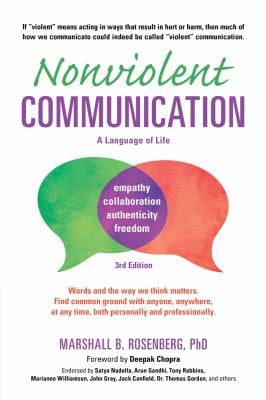
Nonviolent Communication: a Language of Life : Life-Changing Tools for Healthy Relationships
3.2 (4)
Paperback
Nonviolent Communication: a Language of Life : Life-Changing Tools for Healthy Relationships
3.2 (4)
Paperback
- All Available Copies
- Overview
- About the Author
- Awards
- Professional Reviews
- Reader Reviews
- Table Of Contents
- Borrow
Overview
2,000,000 COPIES SOLD WORLDWIDE - TRANSLATED IN MORE THAN 35 LANGUAGES What is Violent Communication? If
"violent" means acting in ways that result in hurt or harm, then much of how we communicate --judging others, bullying, having racial bias, blaming, finger pointing, discriminating, speaking without listening, criticizing others or ourselves, name-calling, reacting when angry, using political rhetoric, being defensive or judging who's
"good/bad" or what's
"right/wrong" with people-- could indeed be called
"violent communication." What is Nonviolent Communication? Nonviolent Communication is the integration of four things: - Consciousness: a set of principles that support living a life of compassion, collaboration, courage, and authenticity - Language: understanding how words contribute to connection or distance - Communication: knowing how to ask for what we want, how to hear others even in disagreement, and how to move toward solutions that work for all - Means of influence: sharing
"power with others" rather than using
"power over others" Nonviolent Communication serves our desire to do three things: - Increase our ability to live with choice, meaning, and connection - Connect empathically with self and others to have more satisfying relationships - Sharing of resources so everyone is able to benefit
Marshall B. Rosenberg
Marshall B. Rosenberg was renowned for his pioneering work in the field of nonviolent communication, a concept he developed and which has been applied worldwide in various forms of conflict resolution, including peacebuilding and personal growth. His most famous work, Nonviolent Communication: A Language of Life, has inspired a multitude of trainers and practitioners to adopt more empathetic and compassionate ways of interacting with others.
Rosenberg's work primarily focused on the transformative power of communication in fostering human connections and resolving conflicts. His principles have been incorporated into mediation and counseling practices globally, emphasizing honesty, empathy, and deep listening. Throughout his career, he received multiple accolades for his contributions to educational psychology and mediation.
Born on October 6, 1934, in Canton, Ohio, Rosenberg was deeply influenced by the humanistic psychology movements of the 20th century. His personal life, including his upbringing and family, was marked by a commitment to understanding and relieving human suffering, which shaped his professional journey. Marshall enjoyed a variety of hobbies that reflected his interests in human behavior and communication.
Born: October 06, 1934
Hometown: Canton, Ohio, USA
Categories
All Available Copies Find out more about shipping times from these sellers.
| Condition | Price | |||
|---|---|---|---|---|
New (172 available)

Ships Separately |
$17.73 USD | Add To Cart | Ships separately from Better World Books suppliers | |
|
eBook Obtain a digital book from our friends at eBooks.com.
|
{{ebooksDotComPrice}} {{ebooksDotComCurrency}} | eBooks.com | Digital edition from eBooks.com | |
|
Audio Book Obtain a digital book from our friends at AudiobooksNow.com.
|
{{audioBooksNowPrice}} {{audioBooksNowCurrency}} | AudiobooksNow.com | Digital edition from AudiobooksNow.com |
Professional Reviews
Reader Reviews for Nonviolent Communication: a Language of Life : Life-Changing Tools for Healthy Relationships
Table Of Contents
| Foreword | p. xiii |
| Acknowledgments | p. xvii |
| Giving From the Heart | p. 1 |
| Introduction | p. 1 |
| A Way to Focus Attention | p. 3 |
| The NVC Process | p. 6 |
| Applying NVC in Our Lives and the World | p. 8 |
| NVC in Action: "Murderer, Assassin, Child-Killer!" | p. 13 |
| Communication That Blocks Compassion | p. 15 |
| Moralistic Judgments | p. 15 |
| Making Comparisons | p. 18 |
| Denial of Responsibility | p. 19 |
| Other Forms of Life-Alienating Communication | p. 22 |
| Observing Without Evaluating | p. 25 |
| The Highest Form of Human Intelligence | p. 28 |
| Distinguishing Observations From Evaluations | p. 30 |
| NVC in Action: "The Most Arrogant Speaker We've Ever Had!" | p. 32 |
| Observation or Evaluation? | p. 34 |
| Identifying and Expressing Feelings | p. 37 |
| The Heavy Cost of Unexpressed Feelings | p. 37 |
| Feelings versus Non-Feelings | p. 41 |
| Building a Vocabulary for Feelings | p. 43 |
| Expressing Feelings | p. 47 |
| Taking Responsibility for Our Feelings | p. 49 |
| Hearing a Negative Message: Four Options | p. 49 |
| The Needs at the Roots of Feelings | p. 52 |
| The Pain of Expressing Our Needs versus the Pain of Not Expressing Our Needs | p. 55 |
| From Emotional Slavery to Emotional Liberation | p. 57 |
| NVC in Action: "Bring Back the Stigma of Illegitimacy!" | p. 61 |
| Acknowledging Needs | p. 65 |
| Requesting That Which Would Enrich Life | p. 67 |
| Using Positive Action Language | p. 67 |
| Making Requests Consciously | p. 72 |
| Asking for a Reflection | p. 74 |
| Requesting Honesty | p. 76 |
| Making Requests of a Group | p. 77 |
| Requests versus Demands | p. 79 |
| Denning Our Objective When Making Requests | p. 81 |
| NVC in Action: Sharing Fears About a Best Friend's Smoking | p. 85 |
| Expressing Requests | p. 88 |
| Receiving Empathically | p. 91 |
| Presence: Don't Just Do Something, Stand There | p. 91 |
| Listening for Feelings and Needs | p. 94 |
| Paraphrasing | p. 96 |
| Sustaining Empathy | p. 101 |
| When Pain Blocks Our Ability to Empathize | p. 103 |
| NVC in Action: A Wife Connects With Her Dying Husband | p. 105 |
| Receiving Empathically versus Non-Empathically | p. 109 |
| The Power of Empathy | p. 113 |
| Empathy That Heals | p. 113 |
| Empathy and the Ability to Be Vulnerable | p. 115 |
| Using Empathy to Defuse Danger | p. 117 |
| Empathy in Hearing Someone's "No!" | p. 120 |
| Empathy to Revive a Lifeless Conversation | p. 121 |
| Empathy for Silence | p. 123 |
| Connecting Compassionately With Ourselves | p. 129 |
| Remembering the Specialness of What We Are | p. 129 |
| Evaluating Ourselves When We've Been Less Than Perfect | p. 130 |
| Translating Self-Judgments and Inner Demands | p. 132 |
| NVC Mourning | p. 132 |
| Self-Forgiveness | p. 133 |
| The Lesson of the Polka-Dotted Suit | p. 134 |
| Don't Do Anything That Isn't Play! | p. 135 |
| Translating "Have to" to "Choose to" | p. 136 |
| Cultivating Awareness of the Energy Behind Our Actions | p. 138 |
| Expressing Anger Fully | p. 141 |
| Distinguishing Stimulus From Cause | p. 141 |
| All Anger Has a Life-Serving Core | p. 144 |
| Stimulus versus Cause: Practical Implications | p. 145 |
| Four Steps to Expressing Anger | p. 148 |
| Offering Empathy First | p. 149 |
| Taking Our Time | p. 152 |
| NVC in Action: Parent and Teen Dialogue A Life-Threatening Issue | p. 154 |
| Conflict Resolution and Mediation | p. 161 |
| Human Connection | p. 161 |
| NVC Conflict Resolution versus Traditional Mediation | p. 162 |
| NVC Conflict Resolution Steps-A Quick Overview | p. 164 |
| On Needs, Strategies, and Analysis | p. 165 |
| Empathy to Ease the Pain That Prevents Hearing | p. 170 |
| Using Present and Positive Action Language to Resolve Conflict | p. 172 |
| Using Action Verbs | p. 173 |
| Translating "No" | p. 174 |
| NVC and the Mediator Role | p. 175 |
| When People Say "No" to Meeting Face to Face | p. 181 |
| Informal Mediation: Sticking Our Nose in Other People's Business | p. 182 |
| The Protective Use of Force | p. 185 |
| When the Use of Force Is Unavoidable | p. 185 |
| The Thinking Behind the Use of Force | p. 185 |
| Types of Punitive Force | p. 186 |
| The Costs of Punishment | p. 188 |
| Two Questions That Reveal the Limitations of Punishment | p. 189 |
| The Protective Use of Force in Schools | p. 190 |
| Liberating Ourselves and Counseling Others | p. 195 |
| Freeing Ourselves From Old Programming | p. 195 |
| Resolving Internal Conflicts | p. 196 |
| Caring for Our Inner Environment | p. 197 |
| Replacing Diagnosis With NVC | p. 199 |
| NVC in Action: Dealing With Resentment and Self-Judgment | p. 204 |
| Expressing Appreciation in Nonviolent Communication | p. 209 |
| The Intention Behind the Appreciation | p. 209 |
| The Three Components of Appreciation | p. 210 |
| Receiving Appreciation | p. 212 |
| The Hunger for Appreciation | p. 214 |
| Overcoming the Reluctance to Express Appreciation | p. 215 |
| Epilogue | p. 217 |
| Bibliography | p. 220 |
| Index | p. 223 |
| The Four-Part Nonviolent Communication Process | p. 231 |
| Some Basic Feelings and Needs We All Have | p. 232 |
| About Nonviolent Communication | p. 233 |
| About PuddleDancer Press | p. 234 |
| About the Center for Nonviolent Communication | p. 235 |
| Trade Books From PuddleDancer Press | p. 236 |
| Trade Booklets From PuddleDancer Press | p. 242 |
| About the Author | p. 244 |
| Table of Contents provided by Ingram. All Rights Reserved. |
| Find at your local library from our friends at WorldCat | Find Libraries |
Overview
2,000,000 COPIES SOLD WORLDWIDE - TRANSLATED IN MORE THAN 35 LANGUAGES What is Violent Communication? If"violent" means acting in ways that result in hurt or harm, then much of how we communicate --judging others, bullying, having racial bias, blamin ...
Read full overview
Overview
2,000,000 COPIES SOLD WORLDWIDE - TRANSLATED IN MORE THAN 35 LANGUAGES What is Violent Communication? If
"violent" means acting in ways that result in hurt or harm, then much of how we communicate --judging others, bullying, having racial bias, blaming, finger pointing, discriminating, speaking without listening, criticizing others or ourselves, name-calling, reacting when angry, using political rhetoric, being defensive or judging who's
"good/bad" or what's
"right/wrong" with people-- could indeed be called
"violent communication." What is Nonviolent Communication? Nonviolent Communication is the integration of four things: - Consciousness: a set of principles that support living a life of compassion, collaboration, courage, and authenticity - Language: understanding how words contribute to connection or distance - Communication: knowing how to ask for what we want, how to hear others even in disagreement, and how to move toward solutions that work for all - Means of influence: sharing
"power with others" rather than using
"power over others" Nonviolent Communication serves our desire to do three things: - Increase our ability to live with choice, meaning, and connection - Connect empathically with self and others to have more satisfying relationships - Sharing of resources so everyone is able to benefit
Product Details
About the Author
Marshall B. Rosenberg
Marshall B. Rosenberg was renowned for his pioneering work in the field of nonviolent communication, a concept he developed and which has been applied worldwide in various forms of conflict resolution, including peacebuilding and personal growth. His most famous work, Nonviolent Communication: A Language of Life, has inspired a multitude of trainers and practitioners to adopt more empathetic and compassionate ways of interacting with others.
Rosenberg's work primarily focused on the transformative power of communication in fostering human connections and resolving conflicts. His principles have been incorporated into mediation and counseling practices globally, emphasizing honesty, empathy, and deep listening. Throughout his career, he received multiple accolades for his contributions to educational psychology and mediation.
Born on October 6, 1934, in Canton, Ohio, Rosenberg was deeply influenced by the humanistic psychology movements of the 20th century. His personal life, including his upbringing and family, was marked by a commitment to understanding and relieving human suffering, which shaped his professional journey. Marshall enjoyed a variety of hobbies that reflected his interests in human behavior and communication.
Born: October 06, 1934
Hometown: Canton, Ohio, USA
Reviews
Professional Reviews
Table Of Contents
| Foreword | p. xiii |
| Acknowledgments | p. xvii |
| Giving From the Heart | p. 1 |
| Introduction | p. 1 |
| A Way to Focus Attention | p. 3 |
| The NVC Process | p. 6 |
| Applying NVC in Our Lives and the World | p. 8 |
| NVC in Action: "Murderer, Assassin, Child-Killer!" | p. 13 |
| Communication That Blocks Compassion | p. 15 |
| Moralistic Judgments | p. 15 |
| Making Comparisons | p. 18 |
| Denial of Responsibility | p. 19 |
| Other Forms of Life-Alienating Communication | p. 22 |
| Observing Without Evaluating | p. 25 |
| The Highest Form of Human Intelligence | p. 28 |
| Distinguishing Observations From Evaluations | p. 30 |
| NVC in Action: "The Most Arrogant Speaker We've Ever Had!" | p. 32 |
| Observation or Evaluation? | p. 34 |
| Identifying and Expressing Feelings | p. 37 |
| The Heavy Cost of Unexpressed Feelings | p. 37 |
| Feelings versus Non-Feelings | p. 41 |
| Building a Vocabulary for Feelings | p. 43 |
| Expressing Feelings | p. 47 |
| Taking Responsibility for Our Feelings | p. 49 |
| Hearing a Negative Message: Four Options | p. 49 |
| The Needs at the Roots of Feelings | p. 52 |
| The Pain of Expressing Our Needs versus the Pain of Not Expressing Our Needs | p. 55 |
| From Emotional Slavery to Emotional Liberation | p. 57 |
| NVC in Action: "Bring Back the Stigma of Illegitimacy!" | p. 61 |
| Acknowledging Needs | p. 65 |
| Requesting That Which Would Enrich Life | p. 67 |
| Using Positive Action Language | p. 67 |
| Making Requests Consciously | p. 72 |
| Asking for a Reflection | p. 74 |
| Requesting Honesty | p. 76 |
| Making Requests of a Group | p. 77 |
| Requests versus Demands | p. 79 |
| Denning Our Objective When Making Requests | p. 81 |
| NVC in Action: Sharing Fears About a Best Friend's Smoking | p. 85 |
| Expressing Requests | p. 88 |
| Receiving Empathically | p. 91 |
| Presence: Don't Just Do Something, Stand There | p. 91 |
| Listening for Feelings and Needs | p. 94 |
| Paraphrasing | p. 96 |
| Sustaining Empathy | p. 101 |
| When Pain Blocks Our Ability to Empathize | p. 103 |
| NVC in Action: A Wife Connects With Her Dying Husband | p. 105 |
| Receiving Empathically versus Non-Empathically | p. 109 |
| The Power of Empathy | p. 113 |
| Empathy That Heals | p. 113 |
| Empathy and the Ability to Be Vulnerable | p. 115 |
| Using Empathy to Defuse Danger | p. 117 |
| Empathy in Hearing Someone's "No!" | p. 120 |
| Empathy to Revive a Lifeless Conversation | p. 121 |
| Empathy for Silence | p. 123 |
| Connecting Compassionately With Ourselves | p. 129 |
| Remembering the Specialness of What We Are | p. 129 |
| Evaluating Ourselves When We've Been Less Than Perfect | p. 130 |
| Translating Self-Judgments and Inner Demands | p. 132 |
| NVC Mourning | p. 132 |
| Self-Forgiveness | p. 133 |
| The Lesson of the Polka-Dotted Suit | p. 134 |
| Don't Do Anything That Isn't Play! | p. 135 |
| Translating "Have to" to "Choose to" | p. 136 |
| Cultivating Awareness of the Energy Behind Our Actions | p. 138 |
| Expressing Anger Fully | p. 141 |
| Distinguishing Stimulus From Cause | p. 141 |
| All Anger Has a Life-Serving Core | p. 144 |
| Stimulus versus Cause: Practical Implications | p. 145 |
| Four Steps to Expressing Anger | p. 148 |
| Offering Empathy First | p. 149 |
| Taking Our Time | p. 152 |
| NVC in Action: Parent and Teen Dialogue A Life-Threatening Issue | p. 154 |
| Conflict Resolution and Mediation | p. 161 |
| Human Connection | p. 161 |
| NVC Conflict Resolution versus Traditional Mediation | p. 162 |
| NVC Conflict Resolution Steps-A Quick Overview | p. 164 |
| On Needs, Strategies, and Analysis | p. 165 |
| Empathy to Ease the Pain That Prevents Hearing | p. 170 |
| Using Present and Positive Action Language to Resolve Conflict | p. 172 |
| Using Action Verbs | p. 173 |
| Translating "No" | p. 174 |
| NVC and the Mediator Role | p. 175 |
| When People Say "No" to Meeting Face to Face | p. 181 |
| Informal Mediation: Sticking Our Nose in Other People's Business | p. 182 |
| The Protective Use of Force | p. 185 |
| When the Use of Force Is Unavoidable | p. 185 |
| The Thinking Behind the Use of Force | p. 185 |
| Types of Punitive Force | p. 186 |
| The Costs of Punishment | p. 188 |
| Two Questions That Reveal the Limitations of Punishment | p. 189 |
| The Protective Use of Force in Schools | p. 190 |
| Liberating Ourselves and Counseling Others | p. 195 |
| Freeing Ourselves From Old Programming | p. 195 |
| Resolving Internal Conflicts | p. 196 |
| Caring for Our Inner Environment | p. 197 |
| Replacing Diagnosis With NVC | p. 199 |
| NVC in Action: Dealing With Resentment and Self-Judgment | p. 204 |
| Expressing Appreciation in Nonviolent Communication | p. 209 |
| The Intention Behind the Appreciation | p. 209 |
| The Three Components of Appreciation | p. 210 |
| Receiving Appreciation | p. 212 |
| The Hunger for Appreciation | p. 214 |
| Overcoming the Reluctance to Express Appreciation | p. 215 |
| Epilogue | p. 217 |
| Bibliography | p. 220 |
| Index | p. 223 |
| The Four-Part Nonviolent Communication Process | p. 231 |
| Some Basic Feelings and Needs We All Have | p. 232 |
| About Nonviolent Communication | p. 233 |
| About PuddleDancer Press | p. 234 |
| About the Center for Nonviolent Communication | p. 235 |
| Trade Books From PuddleDancer Press | p. 236 |
| Trade Booklets From PuddleDancer Press | p. 242 |
| About the Author | p. 244 |
| Table of Contents provided by Ingram. All Rights Reserved. |
Borrow
All Available Copies
| Condition | Source | Price | |
|---|---|---|---|
|
New (172 available)
Ships Separately |
Ships separately from Better World Books suppliers | $17.73 USD | Add To Cart |
|
eBook Obtain a digital book from our friends at eBooks.com.
|
Digital edition from eBooks.com | {{ebooksDotComPrice}} {{ebooksDotComCurrency}} | eBooks.com |
|
Audio Book Obtain a digital book from our friends at AudiobooksNow.com.
|
|
{{audioBooksNowPrice}} {{audioBooksNowCurrency}} | Audiobook |
From Our Blog
Going along with my previous Book Bench stolen post, an my love [...]
B Corporations have been making news lately. The New York Times recently [...]
When your for-profit company has a social and environmental mission built into [...]
Limited Preview for 'Nonviolent Communication: a Language of Life : Life-Changing Tools for Healthy Relationships' provided by Archive.org
*This is a limited preview of the contents of this book and does not directly represent the item available for sale.*
A preview for 'Nonviolent Communication: a Language of Life : Life-Changing Tools for Healthy Relationships' is unavailable.
You are now leaving the Better World Books website to complete your transaction. Your eBook download will be facilitated by our friends at eBooks.com. Thank you for your support and for shopping with Better World Books!
You are now leaving the Better World Books website to complete your transaction. Your audio book download will be facilitated by our friends at AudiobooksNow.com. Thank you for your support and for shopping with Better World Books!
You are now leaving the Better World Books website. Thank you for your support and for shopping with Better World Books!