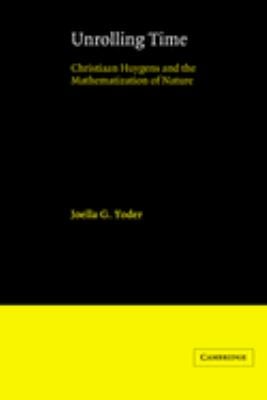
This case study examines the interrelationship between mathematics and physics in the work of one of the major figures of the Scientific Revolution, the Dutch mathematician, physicist, and astronomer, Christiaan Huygens (1629-1695). Professor Yoder offers a detailed account of the discoveries that Huygens made at the end of 1659, including the invention of a pendulum clock that theoretically kept absolutely uniform time, and the creation of a mathematical theory of evolutes. She also describes the way that each of these important discoveries arose from the interaction of Huygens' mathematics and physics. A discussion of Huygens' relationship with other scientists and the priority disputes that sometimes motivated his research help place his work in the context of the period. The reception of Huygens' masterpiece, the Horologium Oscillatorium of 1673 and the place of evolutes in the history of mathematics are also analyzed. Finally, the role of Huygens in the rise of applied mathematics is addressed.
| Condition | Price | |||
|---|---|---|---|---|
|
New (301 available)
Ships Separately |
$78.21 USD | Add To Cart | Ships separately from Better World Books suppliers | |
|
eBook Obtain a digital book from our friends at eBooks.com.
|
{{ebooksDotComPrice}} {{ebooksDotComCurrency}} | eBooks.com | Digital edition from eBooks.com | |
|
Audio Book Obtain a digital book from our friends at AudiobooksNow.com.
|
{{audioBooksNowPrice}} {{audioBooksNowCurrency}} | AudiobooksNow.com | Digital edition from AudiobooksNow.com |
| Find at your local library from our friends at WorldCat | Find Libraries |
This case study examines the interrelationship between mathematics and physics in the work of one of the major figures of the Scientific Revolution, the Dutch mathematician, physicist, and astronomer, Christiaan Huygens (1629-1695). Professor Yoder o ...
Read full overview
This case study examines the interrelationship between mathematics and physics in the work of one of the major figures of the Scientific Revolution, the Dutch mathematician, physicist, and astronomer, Christiaan Huygens (1629-1695). Professor Yoder offers a detailed account of the discoveries that Huygens made at the end of 1659, including the invention of a pendulum clock that theoretically kept absolutely uniform time, and the creation of a mathematical theory of evolutes. She also describes the way that each of these important discoveries arose from the interaction of Huygens' mathematics and physics. A discussion of Huygens' relationship with other scientists and the priority disputes that sometimes motivated his research help place his work in the context of the period. The reception of Huygens' masterpiece, the Horologium Oscillatorium of 1673 and the place of evolutes in the history of mathematics are also analyzed. Finally, the role of Huygens in the rise of applied mathematics is addressed.
| Condition | Source | Price | |
|---|---|---|---|
|
New (301 available)
Ships Separately |
Ships separately from Better World Books suppliers | $78.21 USD | Add To Cart |
|
eBook Obtain a digital book from our friends at eBooks.com.
|
Digital edition from eBooks.com | {{ebooksDotComPrice}} {{ebooksDotComCurrency}} | eBooks.com |
|
Audio Book Obtain a digital book from our friends at AudiobooksNow.com.
|
|
{{audioBooksNowPrice}} {{audioBooksNowCurrency}} | Audiobook |
*This is a limited preview of the contents of this book and does not directly represent the item available for sale.*
You are now leaving the Better World Books website to complete your transaction. Your eBook download will be facilitated by our friends at eBooks.com. Thank you for your support and for shopping with Better World Books!
You are now leaving the Better World Books website to complete your transaction. Your audio book download will be facilitated by our friends at AudiobooksNow.com. Thank you for your support and for shopping with Better World Books!
You are now leaving the Better World Books website. Thank you for your support and for shopping with Better World Books!