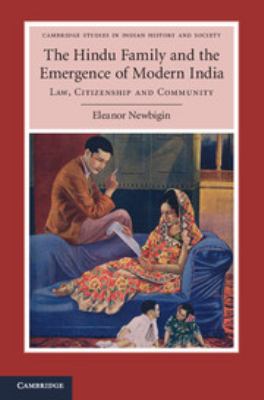
Between 1955 and 1956 the Government of India passed four Hindu Law Acts to reform and codify Hindu family law. Scholars have understood these acts as a response to growing concern about women's rights but, in a powerful re-reading of their history, this book traces the origins of the Hindu law reform project to changes in the political-economy of late colonial rule. The Hindu Family and the Emergence of Modern India considers how questions regarding family structure, property rights and gender relations contributed to the development of representative politics, and how, in solving these questions, India's secular and state power structures were consequently drawn into a complex and unique relationship with Hindu law. In this comprehensive and illuminating resource for scholars and students, Newbigin demonstrates the significance of gender and economy to the history of twentieth-century democratic government, as it emerged in India and beyond.
| Condition | Price | |||
|---|---|---|---|---|
|
New (297 available)
Ships Separately |
$130.39 USD | Add To Cart | Ships separately from Better World Books suppliers | |
|
eBook Obtain a digital book from our friends at eBooks.com.
|
{{ebooksDotComPrice}} {{ebooksDotComCurrency}} | eBooks.com | Digital edition from eBooks.com | |
|
Audio Book Obtain a digital book from our friends at AudiobooksNow.com.
|
{{audioBooksNowPrice}} {{audioBooksNowCurrency}} | AudiobooksNow.com | Digital edition from AudiobooksNow.com |
| Find at your local library from our friends at WorldCat | Find Libraries |
Between 1955 and 1956 the Government of India passed four Hindu Law Acts to reform and codify Hindu family law. Scholars have understood these acts as a response to growing concern about women's rights but, in a powerful re-reading of their history, ...
Read full overview
Between 1955 and 1956 the Government of India passed four Hindu Law Acts to reform and codify Hindu family law. Scholars have understood these acts as a response to growing concern about women's rights but, in a powerful re-reading of their history, this book traces the origins of the Hindu law reform project to changes in the political-economy of late colonial rule. The Hindu Family and the Emergence of Modern India considers how questions regarding family structure, property rights and gender relations contributed to the development of representative politics, and how, in solving these questions, India's secular and state power structures were consequently drawn into a complex and unique relationship with Hindu law. In this comprehensive and illuminating resource for scholars and students, Newbigin demonstrates the significance of gender and economy to the history of twentieth-century democratic government, as it emerged in India and beyond.
| Condition | Source | Price | |
|---|---|---|---|
|
New (297 available)
Ships Separately |
Ships separately from Better World Books suppliers | $130.39 USD | Add To Cart |
|
eBook Obtain a digital book from our friends at eBooks.com.
|
Digital edition from eBooks.com | {{ebooksDotComPrice}} {{ebooksDotComCurrency}} | eBooks.com |
|
Audio Book Obtain a digital book from our friends at AudiobooksNow.com.
|
|
{{audioBooksNowPrice}} {{audioBooksNowCurrency}} | Audiobook |
*This is a limited preview of the contents of this book and does not directly represent the item available for sale.*
You are now leaving the Better World Books website to complete your transaction. Your eBook download will be facilitated by our friends at eBooks.com. Thank you for your support and for shopping with Better World Books!
You are now leaving the Better World Books website to complete your transaction. Your audio book download will be facilitated by our friends at AudiobooksNow.com. Thank you for your support and for shopping with Better World Books!
You are now leaving the Better World Books website. Thank you for your support and for shopping with Better World Books!