
- Track every order
- Save books to your wishlist
- Earn rewards on every order
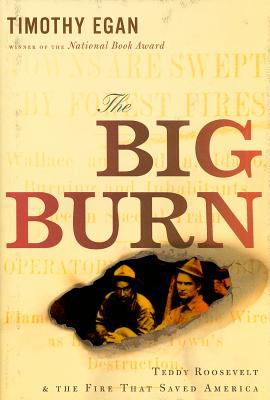
The Big Burn : Teddy Roosevelt and the Fire That Saved America
3.4 (39)
Hardcover
- Other Available Editions
The Big Burn : Teddy Roosevelt and the Fire That Saved America
3.4 (39)
Hardcover
- Other Available Editions
- All Available Copies
- Overview
- About the Author
- Awards
- Professional Reviews
- Reader Reviews
- Table Of Contents
- Borrow
Overview
In THE WORST HARD TIME, Timothy Egan put the environmental disaster of the Dust Bowl at the center of a rich history, told through characters he brought to indelible life. Now he performs the same alchemy with the Big Burn, the largest-ever forest fire in America and the tragedy that cemented Teddy Roosevelt's legacy in the land.On the afternoon of August 20, 1910, a battering ram of wind moved through the drought-stricken national forests of Washington, Idaho, Montana, whipping the hundreds of small blazes burning across the forest floor into a roaring inferno that jumped from treetop to ridge as it raged, destroying towns and timber in an eyeblink. Forest rangers had assembled nearly ten thousand men -- college boys, day-workers, immigrants from mining camps -- to fight the fires. But no living person had seen anything like those flames, and neither the rangers nor anyone else knew how to subdue them.Egan narrates the struggles of the overmatched rangers against the implacable fire with unstoppable dramatic force, through the eyes of the people who lived it. Equally dramatic, though, is the larger story he tells of outsized president Teddy Roosevelt and his chief forester Gifford Pinchot. Pioneering the notion of conservation, Roosevelt and Pinchot did nothing less than create the idea of public land as our national treasure, owned by every citizen. The robber barons fought him and the rangers charged with protecting the reserves, but even as TR's national forests were smoldering they were saved: The heroism shown by those same rangers turned public opinion permanently in favor of the forests, though it changed the mission of the forest service with consequences felt in the fires of today.THE BIG BURN tells an epic story, paints a moving portrait of the people who lived it, and offers a critical cautionary tale for our time.
Timothy Egan
Timothy Egan is a prominent American author and journalist, known for his in-depth and compelling historical narratives. His works often explore significant historical events and figures in American history, with a focus on the Pacific Northwest. Notable titles by Egan include The Worst Hard Time, which won the National Book Award for Nonfiction, and The Big Burn, detailing the largest forest fire in American history and its impact on the nation's conservation policies.
Egan has also received praise for his contributions to journalism, having worked as a writer for The New York Times, where he was part of the team that won a Pulitzer Prize for National Reporting. His writing is characterized by a mix of thorough research and engaging storytelling, appealing to both critics and general readers.
Timothy Egan was born in Seattle, Washington, and his writing is often informed by his deep roots in the Pacific Northwest. He continues to live and write in Seattle, drawing from the rich history and diverse culture of the region. Aside from writing, Egan enjoys exploring the great outdoors, a hobby that influences much of his work.
Categories
All Available Copies Find out more about shipping times from these sellers.
| Condition | Price | |||
|---|---|---|---|---|
Used Good (10 available)

|
$5.93 USD | Shelf Steals® | Add To Cart |
Ships directly from Better World Books
|
|
Used Good (6 available)
Former Library Book
|
$5.93 USD | Shelf Steals® | Add To Cart |
Ships directly from Better World Books
|
|
eBook Obtain a digital book from our friends at eBooks.com.
|
{{ebooksDotComPrice}} {{ebooksDotComCurrency}} | eBooks.com | Digital edition from eBooks.com | |
|
Audio Book Obtain a digital book from our friends at AudiobooksNow.com.
|
{{audioBooksNowPrice}} {{audioBooksNowCurrency}} | AudiobooksNow.com | Digital edition from AudiobooksNow.com |
Awards
Professional Reviews
"Ingold captures the momentum of a wildfire."-- Publishers Weekly
Reader Reviews for The Big Burn : Teddy Roosevelt and the Fire That Saved America
| Find at your local library from our friends at WorldCat | Find Libraries |
Overview
In THE WORST HARD TIME, Timothy Egan put the environmental disaster of the Dust Bowl at the center of a rich history, told through characters he brought to indelible life. Now he performs the same alchemy with the Big Burn, the largest-ever forest fi ...
Read full overview
Overview
In THE WORST HARD TIME, Timothy Egan put the environmental disaster of the Dust Bowl at the center of a rich history, told through characters he brought to indelible life. Now he performs the same alchemy with the Big Burn, the largest-ever forest fire in America and the tragedy that cemented Teddy Roosevelt's legacy in the land.On the afternoon of August 20, 1910, a battering ram of wind moved through the drought-stricken national forests of Washington, Idaho, Montana, whipping the hundreds of small blazes burning across the forest floor into a roaring inferno that jumped from treetop to ridge as it raged, destroying towns and timber in an eyeblink. Forest rangers had assembled nearly ten thousand men -- college boys, day-workers, immigrants from mining camps -- to fight the fires. But no living person had seen anything like those flames, and neither the rangers nor anyone else knew how to subdue them.Egan narrates the struggles of the overmatched rangers against the implacable fire with unstoppable dramatic force, through the eyes of the people who lived it. Equally dramatic, though, is the larger story he tells of outsized president Teddy Roosevelt and his chief forester Gifford Pinchot. Pioneering the notion of conservation, Roosevelt and Pinchot did nothing less than create the idea of public land as our national treasure, owned by every citizen. The robber barons fought him and the rangers charged with protecting the reserves, but even as TR's national forests were smoldering they were saved: The heroism shown by those same rangers turned public opinion permanently in favor of the forests, though it changed the mission of the forest service with consequences felt in the fires of today.THE BIG BURN tells an epic story, paints a moving portrait of the people who lived it, and offers a critical cautionary tale for our time.
Product Details
About the Author
Timothy Egan
Timothy Egan is a prominent American author and journalist, known for his in-depth and compelling historical narratives. His works often explore significant historical events and figures in American history, with a focus on the Pacific Northwest. Notable titles by Egan include The Worst Hard Time, which won the National Book Award for Nonfiction, and The Big Burn, detailing the largest forest fire in American history and its impact on the nation's conservation policies.
Egan has also received praise for his contributions to journalism, having worked as a writer for The New York Times, where he was part of the team that won a Pulitzer Prize for National Reporting. His writing is characterized by a mix of thorough research and engaging storytelling, appealing to both critics and general readers.
Timothy Egan was born in Seattle, Washington, and his writing is often informed by his deep roots in the Pacific Northwest. He continues to live and write in Seattle, drawing from the rich history and diverse culture of the region. Aside from writing, Egan enjoys exploring the great outdoors, a hobby that influences much of his work.
Awards
Reviews
Professional Reviews
"Ingold captures the momentum of a wildfire."-- Publishers Weekly
Borrow
All Available Copies
| Condition | Source | Price | |
|---|---|---|---|
|
Used Good (10 available)
Ships from |
Ships directly from Better World Books
|
$5.93 USD
Shelf Steals® |
Add To Cart |
|
Used Good (6 available)
Former Library Book
Former Library Book Ships from |
Ships directly from Better World Books
|
$5.93 USD
Shelf Steals® |
Add To Cart |
|
eBook Obtain a digital book from our friends at eBooks.com.
|
Digital edition from eBooks.com | {{ebooksDotComPrice}} {{ebooksDotComCurrency}} | eBooks.com |
|
Audio Book Obtain a digital book from our friends at AudiobooksNow.com.
|
|
{{audioBooksNowPrice}} {{audioBooksNowCurrency}} | Audiobook |
Limited Preview for 'The Big Burn : Teddy Roosevelt and the Fire That Saved America' provided by Archive.org
*This is a limited preview of the contents of this book and does not directly represent the item available for sale.*
A preview for 'The Big Burn : Teddy Roosevelt and the Fire That Saved America' is unavailable.
You are now leaving the Better World Books website to complete your transaction. Your eBook download will be facilitated by our friends at eBooks.com. Thank you for your support and for shopping with Better World Books!
You are now leaving the Better World Books website to complete your transaction. Your audio book download will be facilitated by our friends at AudiobooksNow.com. Thank you for your support and for shopping with Better World Books!
You are now leaving the Better World Books website. Thank you for your support and for shopping with Better World Books!