
- Track every order
- Save books to your wishlist
- Earn rewards on every order
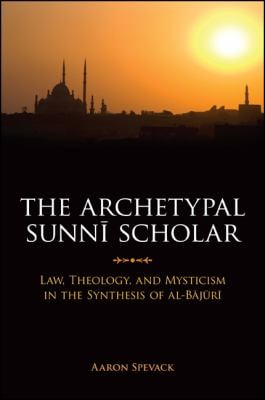
The Archetypal Sunni Scholar : Law, Theology, and Mysticism in the Synthesis of Al-Bajuri
Hardcover
The Archetypal Sunni Scholar : Law, Theology, and Mysticism in the Synthesis of Al-Bajuri
Hardcover
- All Available Copies
- Overview
- About the Author
- Awards
- Professional Reviews
- Reader Reviews
- Table Of Contents
- Borrow
Overview
Considers the work of nineteenth-century theologian Ibrahim al-Bajuri and contests the notion of intellectual decline in Islamic thought from the thirteenth through nineteenth centuries. This is a rare study of a late premodern Islamic thinker, Ibrahim al- B?j?r?, a nineteenth-century scholar and rector of Cairo's al-Azhar University. Aaron Spevack explores al- B?j?r?'s legal, theological, and mystical thought, highlighting its originality and vibrancy in relation to the millennium of scholarship that preceded and informed it, and also detailing its continuing legacy. The book makes a case for the normativity of the Gabrielian Paradigm, the study of law, rational theology, and Sufism, in the person of al- B?j?r?. Soon after his death in 1860, this typical pattern of scholarship would face significant challenges from modernists, reformers, and fundamentalists. Spevack challenges beliefs that rational theology, syllogistic logic, and Sufism were not part of the predominant conception of orthodox scholarship and shows this scholarly archetype has not disappeared as an ideal. In addition, the book contests prevailing beliefs in academic and Muslim circles about intellectual decline from the thirteenth through nineteenth centuries.
Categories
All Available Copies Find out more about shipping times from these sellers.
| Condition | Price | |||
|---|---|---|---|---|
|
eBook Obtain a digital book from our friends at eBooks.com.
|
{{ebooksDotComPrice}} {{ebooksDotComCurrency}} | eBooks.com | Digital edition from eBooks.com | |
|
Audio Book Obtain a digital book from our friends at AudiobooksNow.com.
|
{{audioBooksNowPrice}} {{audioBooksNowCurrency}} | AudiobooksNow.com | Digital edition from AudiobooksNow.com |
Professional Reviews
"Spevack's trailblazing book is a lucid survey and deep analysis of the works and ideas of al-Bajuri. Spevack shows precisely how al-Bajuri served as an 'archetypal' Sunni scholar. In the process, he succeeds in evoking the subtlety, sophistication, and dynamism of the postclassical Islamic traditions of theology, mysticism, and jurisprudence." -- Robert Wisnovsky, McGill University
"Here is a readable and comprehensive introduction to the intellectual production of one of the last giants of the Sunni legal tradition in the nineteenth century. Sensitive to the scholar's strong affiliation with a millennium-long tradition, this introduction will be appreciated by seasoned scholars and newcomers alike." -- Ahmad Atif Ahmad, University of California, Santa Barbara
"Spevack's book is an important corrective to Eurocentric narratives of the nineteenth century that focus solely on Islamic thinkers whose main concern is with European 'modernity' and its challenges while breezily ignoring the continuing tradition of madrasah scholarship in the modern period." -- Khaled El-Rouayheb, Harvard University
| Find at your local library from our friends at WorldCat | Find Libraries |
Overview
Considers the work of nineteenth-century theologian Ibrahim al-Bajuri and contests the notion of intellectual decline in Islamic thought from the thirteenth through nineteenth centuries. This is a rare study of a late premodern Islamic thinker, Ibrah ...
Read full overview
Overview
Considers the work of nineteenth-century theologian Ibrahim al-Bajuri and contests the notion of intellectual decline in Islamic thought from the thirteenth through nineteenth centuries. This is a rare study of a late premodern Islamic thinker, Ibrahim al- B?j?r?, a nineteenth-century scholar and rector of Cairo's al-Azhar University. Aaron Spevack explores al- B?j?r?'s legal, theological, and mystical thought, highlighting its originality and vibrancy in relation to the millennium of scholarship that preceded and informed it, and also detailing its continuing legacy. The book makes a case for the normativity of the Gabrielian Paradigm, the study of law, rational theology, and Sufism, in the person of al- B?j?r?. Soon after his death in 1860, this typical pattern of scholarship would face significant challenges from modernists, reformers, and fundamentalists. Spevack challenges beliefs that rational theology, syllogistic logic, and Sufism were not part of the predominant conception of orthodox scholarship and shows this scholarly archetype has not disappeared as an ideal. In addition, the book contests prevailing beliefs in academic and Muslim circles about intellectual decline from the thirteenth through nineteenth centuries.
Product Details
Professional Reviews
"Spevack's trailblazing book is a lucid survey and deep analysis of the works and ideas of al-Bajuri. Spevack shows precisely how al-Bajuri served as an 'archetypal' Sunni scholar. In the process, he succeeds in evoking the subtlety, sophistication, and dynamism of the postclassical Islamic traditions of theology, mysticism, and jurisprudence." -- Robert Wisnovsky, McGill University
"Here is a readable and comprehensive introduction to the intellectual production of one of the last giants of the Sunni legal tradition in the nineteenth century. Sensitive to the scholar's strong affiliation with a millennium-long tradition, this introduction will be appreciated by seasoned scholars and newcomers alike." -- Ahmad Atif Ahmad, University of California, Santa Barbara
"Spevack's book is an important corrective to Eurocentric narratives of the nineteenth century that focus solely on Islamic thinkers whose main concern is with European 'modernity' and its challenges while breezily ignoring the continuing tradition of madrasah scholarship in the modern period." -- Khaled El-Rouayheb, Harvard University
All Available Copies
| Condition | Source | Price | |
|---|---|---|---|
|
eBook Obtain a digital book from our friends at eBooks.com.
|
Digital edition from eBooks.com | {{ebooksDotComPrice}} {{ebooksDotComCurrency}} | eBooks.com |
|
Audio Book Obtain a digital book from our friends at AudiobooksNow.com.
|
|
{{audioBooksNowPrice}} {{audioBooksNowCurrency}} | Audiobook |
Limited Preview for 'The Archetypal Sunni Scholar : Law, Theology, and Mysticism in the Synthesis of Al-Bajuri' provided by Archive.org
*This is a limited preview of the contents of this book and does not directly represent the item available for sale.*
A preview for 'The Archetypal Sunni Scholar : Law, Theology, and Mysticism in the Synthesis of Al-Bajuri' is unavailable.
You are now leaving the Better World Books website to complete your transaction. Your eBook download will be facilitated by our friends at eBooks.com. Thank you for your support and for shopping with Better World Books!
You are now leaving the Better World Books website to complete your transaction. Your audio book download will be facilitated by our friends at AudiobooksNow.com. Thank you for your support and for shopping with Better World Books!
You are now leaving the Better World Books website. Thank you for your support and for shopping with Better World Books!