
- All Available Copies
- Overview
- About the Author
- Awards
- Professional Reviews
- Reader Reviews
- Table Of Contents
- Borrow
Overview
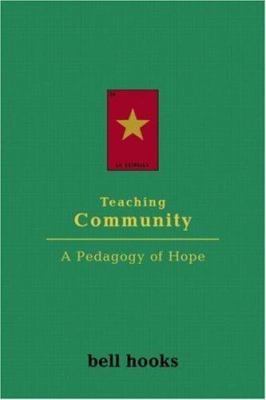
Ten years ago, bell hooks astonished readers with Teaching to Transgress: Education as the Practice of Freedom . Now comes Teaching Community: A Pedagogy of Hope - a powerful, visionary work that will enrich our teaching and our lives. Combining critical thinking about education with autobiographical narratives, hooks invites readers to extend the discourse of race, gender, class and nationality beyond the classroom into everyday situations of learning. bell hooks writes candidly about her own experiences. Teaching, she explains, can happen anywhere, any time - not just in college classrooms but in churches, in bookstores, in homes where people get together to share ideas that affect their daily lives. In Teaching Community bell hooks seeks to theorize from the place of the positive, looking at what works. Writing about struggles to end racism and white supremacy, she makes the useful point that
"No one is born a racist. Everyone makes a choice." Teaching Community tells us how we can choose to end racism and create a beloved community. hooks looks at many issues-among them, spirituality in the classroom, white people looking to end racism, and erotic relationships between professors and students. Spirit, struggle, service, love, the ideals of shared knowledge and shared learning - these values motivate progressive social change. Teachers of vision know that democratic education can never be confined to a classroom. Teaching - so often undervalued in our society -- can be a joyous and inclusive activity. bell hooks shows the way.
"When teachers teach with love, combining care, commitment, knowledge, responsibility, respect, and trust, we are often able to enter the classroom and go straight to the heart of the matter, which is knowing what to do on any given day to create the best climate for learning."
Bell Hooks
Bell Hooks was born Gloria Watkins on September 25, 1952. She grew up in a small Southern community that gave her a sense of belonging as well as a sense of racial separation. She has degrees from Stanford University, the University of Wisconsin, and the University of California at Santa Cruz. She has served as a noted activist and social critic and has taught at numerous colleges. Hooks uses her great-grandmother's name to write under as a tribute to her ancestors. Hooks writes daring and controversial works that explore African-American female identities. In works such as Ain't I a Woman: Black Women and Feminism and Talking Back: Thinking Feminist, Thinking Black, she points out how feminism works for and against black women. Oppressed since slavery, black women must overcome the dual odds of race and gender discrimination to come to terms with equality and self-worth.
Categories
All Available Copies Find out more about shipping times from these sellers.
| Condition | Price | |||
|---|---|---|---|---|
New (674 available)

Ships Separately |
$37.81 USD | Add To Cart | Ships separately from Better World Books suppliers | |
|
eBook Obtain a digital book from our friends at eBooks.com.
|
{{ebooksDotComPrice}} {{ebooksDotComCurrency}} | eBooks.com | Digital edition from eBooks.com | |
|
Audio Book Obtain a digital book from our friends at AudiobooksNow.com.
|
{{audioBooksNowPrice}} {{audioBooksNowCurrency}} | AudiobooksNow.com | Digital edition from AudiobooksNow.com |
Professional Reviews
"Refreshingly original thinking about spirituality, family values, and even erotic relationships between professors and students...The author's clear and consistent voice for progressive, democratic education adds an important dimension to society's thinking about shared values and the creation of a loving and fair community." -- Publishers Weekly
"Teaching Community is magnificent. Educators, learners, and intellectuals will find the book to be an eye opening piece of work. [hook's] mastery of language, as it always does, creates a highly stimulating space from which readers can learn and actively participate in the analytical process. Black, white, male, female, teacher, and student should read the book for themselves and for the beloved community." -- Rolling Out
"hooks addresses many other topics of keen interest to all educators at various stages of their careers." -- Rosemary P. Carbine, College of the Holy Cross, Teaching Theology and Religion
Reader Reviews for Teaching Community : A Pedagogy of Hope
| Find at your local library from our friends at WorldCat | Find Libraries |
Overview
Ten years ago, bell hooks astonished readers with Teaching to Transgress: Education as the Practice of Freedom . Now comes Teaching Community: A Pedagogy of Hope - a powerful, visionary work that will enrich our teaching and our lives. Combining crit ...
Read full overview
Overview
Ten years ago, bell hooks astonished readers with Teaching to Transgress: Education as the Practice of Freedom . Now comes Teaching Community: A Pedagogy of Hope - a powerful, visionary work that will enrich our teaching and our lives. Combining critical thinking about education with autobiographical narratives, hooks invites readers to extend the discourse of race, gender, class and nationality beyond the classroom into everyday situations of learning. bell hooks writes candidly about her own experiences. Teaching, she explains, can happen anywhere, any time - not just in college classrooms but in churches, in bookstores, in homes where people get together to share ideas that affect their daily lives. In Teaching Community bell hooks seeks to theorize from the place of the positive, looking at what works. Writing about struggles to end racism and white supremacy, she makes the useful point that
"No one is born a racist. Everyone makes a choice." Teaching Community tells us how we can choose to end racism and create a beloved community. hooks looks at many issues-among them, spirituality in the classroom, white people looking to end racism, and erotic relationships between professors and students. Spirit, struggle, service, love, the ideals of shared knowledge and shared learning - these values motivate progressive social change. Teachers of vision know that democratic education can never be confined to a classroom. Teaching - so often undervalued in our society -- can be a joyous and inclusive activity. bell hooks shows the way.
"When teachers teach with love, combining care, commitment, knowledge, responsibility, respect, and trust, we are often able to enter the classroom and go straight to the heart of the matter, which is knowing what to do on any given day to create the best climate for learning."
Product Details
About the Author
Bell Hooks
Bell Hooks was born Gloria Watkins on September 25, 1952. She grew up in a small Southern community that gave her a sense of belonging as well as a sense of racial separation. She has degrees from Stanford University, the University of Wisconsin, and the University of California at Santa Cruz. She has served as a noted activist and social critic and has taught at numerous colleges. Hooks uses her great-grandmother's name to write under as a tribute to her ancestors. Hooks writes daring and controversial works that explore African-American female identities. In works such as Ain't I a Woman: Black Women and Feminism and Talking Back: Thinking Feminist, Thinking Black, she points out how feminism works for and against black women. Oppressed since slavery, black women must overcome the dual odds of race and gender discrimination to come to terms with equality and self-worth.
Reviews
Professional Reviews
"Refreshingly original thinking about spirituality, family values, and even erotic relationships between professors and students...The author's clear and consistent voice for progressive, democratic education adds an important dimension to society's thinking about shared values and the creation of a loving and fair community." -- Publishers Weekly
"Teaching Community is magnificent. Educators, learners, and intellectuals will find the book to be an eye opening piece of work. [hook's] mastery of language, as it always does, creates a highly stimulating space from which readers can learn and actively participate in the analytical process. Black, white, male, female, teacher, and student should read the book for themselves and for the beloved community." -- Rolling Out
"hooks addresses many other topics of keen interest to all educators at various stages of their careers." -- Rosemary P. Carbine, College of the Holy Cross, Teaching Theology and Religion
Borrow
All Available Copies
| Condition | Source | Price | |
|---|---|---|---|
|
New (674 available)
Ships Separately |
Ships separately from Better World Books suppliers | $37.81 USD | Add To Cart |
|
eBook Obtain a digital book from our friends at eBooks.com.
|
Digital edition from eBooks.com | {{ebooksDotComPrice}} {{ebooksDotComCurrency}} | eBooks.com |
|
Audio Book Obtain a digital book from our friends at AudiobooksNow.com.
|
|
{{audioBooksNowPrice}} {{audioBooksNowCurrency}} | Audiobook |
Limited Preview for 'Teaching Community : A Pedagogy of Hope' provided by Archive.org
*This is a limited preview of the contents of this book and does not directly represent the item available for sale.*
A preview for 'Teaching Community : A Pedagogy of Hope' is unavailable.
You are now leaving the Better World Books website to complete your transaction. Your eBook download will be facilitated by our friends at eBooks.com. Thank you for your support and for shopping with Better World Books!
You are now leaving the Better World Books website to complete your transaction. Your audio book download will be facilitated by our friends at AudiobooksNow.com. Thank you for your support and for shopping with Better World Books!
You are now leaving the Better World Books website. Thank you for your support and for shopping with Better World Books!