
- Track every order
- Save books to your wishlist
- Earn rewards on every order
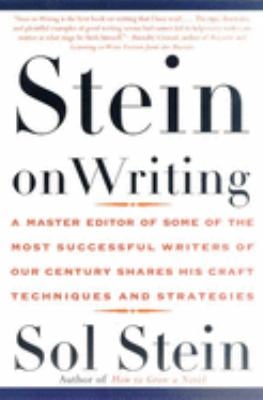
Stein on Writing : A Master Editor of Some of the Most Successful Writers of Our Century Shares His Craft Techniques and Strategies
3.9 (18)
Paperback
Stein on Writing : A Master Editor of Some of the Most Successful Writers of Our Century Shares His Craft Techniques and Strategies
3.9 (18)
Paperback
- All Available Copies
- Overview
- About the Author
- Awards
- Professional Reviews
- Reader Reviews
- Table Of Contents
- Borrow
Overview
Stein on Writing provides immediately useful advice for all writers of fiction and nonfiction, whether they are newcomers or old hands, students or instructors, amateurs or professionals. As the always clear and direct Stein explains here,
"This is not a book of theory. It is a book of usable solutions--how to fix writing that is flawed, how to improve writing that is good, how to create interesting writing in the first place." With examples from bestsellers as well as from students' drafts, Stein offers detailed sections on characterization, dialogue, pacing, flashbacks, trimming away flabby wording, the so-called
"triage" method of revision, using the techniques of fiction to enliven nonfiction, and more.
Sol Stein
Sol Stein is a Chicago-born transplant to the Bronx. In the 1950's he was an anti-Communist scriptwriter for the Voice of America, Washington¿s Cold War propaganda radio network, and a leading defender of civil liberties. But he made his lasting mark in publishing. In 1962 he and his wife at the time, Patricia Day, founded the publishing house Stein and Day, which had immediate success that year with the director Elia Kazan¿s debut book, America, America. The story of a Greek youth who comes to the United States, the book sold three million copies, and Mr. Kazan turned it into a movie, released the next year. Mr. Stein was Stein and Day¿s editor in chief. In one of the many books Mr. Stein himself wrote, Bankruptcy: A Feast for Lawyers (1989), he exposed the bureaucratic nightmare that had accompanied the financial implosion of Stein and Day after 27 years in business. Solomon Stein was born in Chicago on Oct. 13, 1926, to Louis and Zelda (Zam) Stein, Jewish immigrants who fled Russia. His mother became a translator for the United Nations. His father was a jewelry designer. The family moved to the North Bronx in 1930. Mr. Stein went on to enroll at City College, but his studies there were interrupted when he enlisted in the Army Air Forces in 1944. He voluntarily transferred to the infantry and served in Germany during the post-World War II occupation. After returning from military service, he completed his bachelor of social science degree and earned a master¿s in English and comparative literature at Columbia. Besides working as an anti-Communist scriptwriter for the Voice of America, Mr. Stein was a member of its ideological advisory staff starting in the early 1950s. The journalist Robert Scheer, who was editor of the left-leaning Ramparts magazine in the late 1960s, branded him The Archdeacon of the Cold War. Sol Sttein passed away on September 26, 2019 at the age of 92.
Categories
All Available Copies Find out more about shipping times from these sellers.
| Condition | Price | |||
|---|---|---|---|---|
Used Good (11 available)

|
$5.78 USD | Add To Cart |
Ships directly from Better World Books
|
|
|
Used Good (1 available)
Former Library Book
|
$5.78 USD | Add To Cart |
Ships directly from Better World Books
|
|
|
New (127 available)
Ships Separately |
$19.21 USD | Add To Cart | Ships separately from Better World Books suppliers | |
|
eBook Obtain a digital book from our friends at eBooks.com.
|
{{ebooksDotComPrice}} {{ebooksDotComCurrency}} | eBooks.com | Digital edition from eBooks.com | |
|
Audio Book Obtain a digital book from our friends at AudiobooksNow.com.
|
{{audioBooksNowPrice}} {{audioBooksNowCurrency}} | AudiobooksNow.com | Digital edition from AudiobooksNow.com |
Professional Reviews
"Stimulating . . . Offers a banquet of savvy advice. Unlike Anne Lamott, et al., Stein aims not to help his readers wrestle with writerly anguish; rather, he gets on the page, citing examples from writers famous and fledgling, closely analyzing first sentences, creation of character, plotting, and dialogue . . . Stein concentrates more on fiction--point of view and the creation of love scenes--but his advice on such issues as self-editing and choosing a title applies also to nonfiction. A section on nonfiction contains worthy remarks about adapting fictional techniques (suspense, visual particularity, etc.)." -- Publishers Weekly
"This book can jump-start anyone's creativity. Highly recommended for all writing collections." -- Library Journal
"My publisher Sol Stein was my producer, and editor Sol Stein was my director. Stein saw what I didn't think possible." -- Elia Kazan
"[Stein] went over my manuscript with an ifallible eye for the soft spots in my prose, giving me one of the best editorial readinds I've ever had." -- Lionel Trilling
Reader Reviews for Stein on Writing : A Master Editor of Some of the Most Successful Writers of Our Century Shares His Craft Techniques and Strategies
Table Of Contents
| Preface | p. xi |
| The Essentials | |
| The Writer's Job May Be Different Than You Think | p. 3 |
| Come Right In: First Sentences, First Paragraphs | p. 15 |
| Welcome to the Twentieth Century | p. 42 |
| Fiction | |
| Competing with God: Making Fascinating People | p. 49 |
| Markers: The Key to Swift Characterization | p. 74 |
| Thwarting Desire: The Basics of Plotting | p. 82 |
| The Actors Studio Method for Developing Drama in Plots | p. 90 |
| The Crucible: A Key to Successful Plotting | p. 94 |
| Suspense: Keeping the Reader Reading | p. 97 |
| The Adrenaline Pump: Creating Tension | p. 105 |
| The Secrets of Good Dialogue | p. 110 |
| How to Show Instead of Tell | p. 122 |
| Choosing a Point of View | p. 129 |
| Flashbacks: How to Bring Background into the Foreground | p. 143 |
| The Keys to Credibility | p. 152 |
| The Secret Snapshot Technique: Reaching For Hidden Treasure | p. 156 |
| How to Use All Six of Your Senses | p. 160 |
| Love Scenes | p. 167 |
| Creating the Envelope | p. 186 |
| Fiction and Nonfiction | |
| Amphetamines for Speeding Up Pace | p. 193 |
| Liposuctioning Flab | p. 197 |
| Tapping Your Originality | p. 209 |
| The Door to Your Book: Titles That Attract | p. 212 |
| Nonfiction | |
| Using the Techniques of Fiction to Enhance Nonfiction | p. 223 |
| Conflict, Suspense, and Tension in Nonfiction | p. 232 |
| Quoting What They Say | p. 240 |
| Guts: The Decisive Ingredient | p. 242 |
| Literary Values in Fiction and Nonfiction | |
| Commercial? Popular? Literary? | p. 249 |
| Particularity | p. 254 |
| Similes and Metaphors | p. 264 |
| Increasing the Effect on the Reader through Resonance | p. 268 |
| Revision | |
| Triage: A Better Way of Revising Fiction | p. 277 |
| Reprieve: Revising Nonfiction | p. 290 |
| Where to Get Help | |
| Where to Get Help | p. 297 |
| A Final Word | p. 302 |
| A Glossary of Terms Used by Writers and Editors | p. 305 |
| Table of Contents provided by Syndetics. All Rights Reserved. |
| Find at your local library from our friends at WorldCat | Find Libraries |
Overview
Stein on Writing provides immediately useful advice for all writers of fiction and nonfiction, whether they are newcomers or old hands, students or instructors, amateurs or professionals. As the always clear and direct Stein explains here,"This is no ...
Read full overview
Overview
Stein on Writing provides immediately useful advice for all writers of fiction and nonfiction, whether they are newcomers or old hands, students or instructors, amateurs or professionals. As the always clear and direct Stein explains here,
"This is not a book of theory. It is a book of usable solutions--how to fix writing that is flawed, how to improve writing that is good, how to create interesting writing in the first place." With examples from bestsellers as well as from students' drafts, Stein offers detailed sections on characterization, dialogue, pacing, flashbacks, trimming away flabby wording, the so-called
"triage" method of revision, using the techniques of fiction to enliven nonfiction, and more.
Product Details
About the Author
Sol Stein
Sol Stein is a Chicago-born transplant to the Bronx. In the 1950's he was an anti-Communist scriptwriter for the Voice of America, Washington¿s Cold War propaganda radio network, and a leading defender of civil liberties. But he made his lasting mark in publishing. In 1962 he and his wife at the time, Patricia Day, founded the publishing house Stein and Day, which had immediate success that year with the director Elia Kazan¿s debut book, America, America. The story of a Greek youth who comes to the United States, the book sold three million copies, and Mr. Kazan turned it into a movie, released the next year. Mr. Stein was Stein and Day¿s editor in chief. In one of the many books Mr. Stein himself wrote, Bankruptcy: A Feast for Lawyers (1989), he exposed the bureaucratic nightmare that had accompanied the financial implosion of Stein and Day after 27 years in business. Solomon Stein was born in Chicago on Oct. 13, 1926, to Louis and Zelda (Zam) Stein, Jewish immigrants who fled Russia. His mother became a translator for the United Nations. His father was a jewelry designer. The family moved to the North Bronx in 1930. Mr. Stein went on to enroll at City College, but his studies there were interrupted when he enlisted in the Army Air Forces in 1944. He voluntarily transferred to the infantry and served in Germany during the post-World War II occupation. After returning from military service, he completed his bachelor of social science degree and earned a master¿s in English and comparative literature at Columbia. Besides working as an anti-Communist scriptwriter for the Voice of America, Mr. Stein was a member of its ideological advisory staff starting in the early 1950s. The journalist Robert Scheer, who was editor of the left-leaning Ramparts magazine in the late 1960s, branded him The Archdeacon of the Cold War. Sol Sttein passed away on September 26, 2019 at the age of 92.
Reviews
Professional Reviews
"Stimulating . . . Offers a banquet of savvy advice. Unlike Anne Lamott, et al., Stein aims not to help his readers wrestle with writerly anguish; rather, he gets on the page, citing examples from writers famous and fledgling, closely analyzing first sentences, creation of character, plotting, and dialogue . . . Stein concentrates more on fiction--point of view and the creation of love scenes--but his advice on such issues as self-editing and choosing a title applies also to nonfiction. A section on nonfiction contains worthy remarks about adapting fictional techniques (suspense, visual particularity, etc.)." -- Publishers Weekly
"This book can jump-start anyone's creativity. Highly recommended for all writing collections." -- Library Journal
"My publisher Sol Stein was my producer, and editor Sol Stein was my director. Stein saw what I didn't think possible." -- Elia Kazan
"[Stein] went over my manuscript with an ifallible eye for the soft spots in my prose, giving me one of the best editorial readinds I've ever had." -- Lionel Trilling
Table Of Contents
| Preface | p. xi |
| The Essentials | |
| The Writer's Job May Be Different Than You Think | p. 3 |
| Come Right In: First Sentences, First Paragraphs | p. 15 |
| Welcome to the Twentieth Century | p. 42 |
| Fiction | |
| Competing with God: Making Fascinating People | p. 49 |
| Markers: The Key to Swift Characterization | p. 74 |
| Thwarting Desire: The Basics of Plotting | p. 82 |
| The Actors Studio Method for Developing Drama in Plots | p. 90 |
| The Crucible: A Key to Successful Plotting | p. 94 |
| Suspense: Keeping the Reader Reading | p. 97 |
| The Adrenaline Pump: Creating Tension | p. 105 |
| The Secrets of Good Dialogue | p. 110 |
| How to Show Instead of Tell | p. 122 |
| Choosing a Point of View | p. 129 |
| Flashbacks: How to Bring Background into the Foreground | p. 143 |
| The Keys to Credibility | p. 152 |
| The Secret Snapshot Technique: Reaching For Hidden Treasure | p. 156 |
| How to Use All Six of Your Senses | p. 160 |
| Love Scenes | p. 167 |
| Creating the Envelope | p. 186 |
| Fiction and Nonfiction | |
| Amphetamines for Speeding Up Pace | p. 193 |
| Liposuctioning Flab | p. 197 |
| Tapping Your Originality | p. 209 |
| The Door to Your Book: Titles That Attract | p. 212 |
| Nonfiction | |
| Using the Techniques of Fiction to Enhance Nonfiction | p. 223 |
| Conflict, Suspense, and Tension in Nonfiction | p. 232 |
| Quoting What They Say | p. 240 |
| Guts: The Decisive Ingredient | p. 242 |
| Literary Values in Fiction and Nonfiction | |
| Commercial? Popular? Literary? | p. 249 |
| Particularity | p. 254 |
| Similes and Metaphors | p. 264 |
| Increasing the Effect on the Reader through Resonance | p. 268 |
| Revision | |
| Triage: A Better Way of Revising Fiction | p. 277 |
| Reprieve: Revising Nonfiction | p. 290 |
| Where to Get Help | |
| Where to Get Help | p. 297 |
| A Final Word | p. 302 |
| A Glossary of Terms Used by Writers and Editors | p. 305 |
| Table of Contents provided by Syndetics. All Rights Reserved. |
Borrow
All Available Copies
| Condition | Source | Price | |
|---|---|---|---|
|
Used Good (11 available)
Ships from |
Ships directly from Better World Books
|
$5.78 USD | Add To Cart |
|
Used Good (1 available)
Former Library Book
Former Library Book Ships from |
Ships directly from Better World Books
|
$5.78 USD | Add To Cart |
|
New (127 available)
Ships Separately |
Ships separately from Better World Books suppliers | $19.21 USD | Add To Cart |
|
eBook Obtain a digital book from our friends at eBooks.com.
|
Digital edition from eBooks.com | {{ebooksDotComPrice}} {{ebooksDotComCurrency}} | eBooks.com |
|
Audio Book Obtain a digital book from our friends at AudiobooksNow.com.
|
|
{{audioBooksNowPrice}} {{audioBooksNowCurrency}} | Audiobook |
Limited Preview for 'Stein on Writing : A Master Editor of Some of the Most Successful Writers of Our Century Shares His Craft Techniques and Strategies' provided by Archive.org
*This is a limited preview of the contents of this book and does not directly represent the item available for sale.*
A preview for 'Stein on Writing : A Master Editor of Some of the Most Successful Writers of Our Century Shares His Craft Techniques and Strategies' is unavailable.
You are now leaving the Better World Books website to complete your transaction. Your eBook download will be facilitated by our friends at eBooks.com. Thank you for your support and for shopping with Better World Books!
You are now leaving the Better World Books website to complete your transaction. Your audio book download will be facilitated by our friends at AudiobooksNow.com. Thank you for your support and for shopping with Better World Books!
You are now leaving the Better World Books website. Thank you for your support and for shopping with Better World Books!