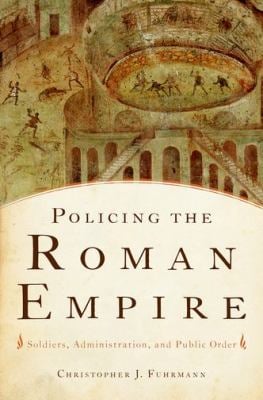
Historians often regard the police as a modern development, and indeed, many pre-modern societies had no such institution. Most recent scholarship has claimed that Roman society relied on kinship networks or community self-regulation as a means of conflict resolution and social control. This model, according to Christopher Fuhrmann, fails to properly account for the imperial-era evidence, which argues in fact for an expansion of state-sponsored policing activities in the first three centuries of the Common Era. Drawing on a wide variety of source material--from art, archaeology, administrative documents, Egyptian papyri, laws, Jewish and Christian religious texts, and ancient narratives-- Policing the Roman Empire provides a comprehensive overview of Roman imperial policing practices with chapters devoted to fugitive slave hunting, the pivotal role of Augustus, the expansion of policing under his successors, and communities lacking soldier-police that were forced to rely on self-help or civilian police. Rather than merely cataloguing references to police, this study sets policing in the broader context of Roman attitudes towards power, public order, and administration. Fuhrmann argues that a broad range of groups understood the potential value of police, from the emperors to the peasantry. Years of different police initiatives coalesced into an uneven patchwork of police institutions that were not always coordinated, effective, or upright. But the end result was a new means by which the Roman state--more ambitious than often supposed--could seek to control the lives of its subjects, as in the imperial persecutions of Christians. The first synoptic analysis of Roman policing in over a hundred years, and the first ever in English, Policing the Roman Empire will be of great interest to scholars and students of classics, history, law, and religion.
| Condition | Price | |||
|---|---|---|---|---|
|
New (289 available)
Ships Separately |
$194.78 USD | Add To Cart | Ships separately from Better World Books suppliers | |
|
eBook Obtain a digital book from our friends at eBooks.com.
|
{{ebooksDotComPrice}} {{ebooksDotComCurrency}} | eBooks.com | Digital edition from eBooks.com | |
|
Audio Book Obtain a digital book from our friends at AudiobooksNow.com.
|
{{audioBooksNowPrice}} {{audioBooksNowCurrency}} | AudiobooksNow.com | Digital edition from AudiobooksNow.com |
| Find at your local library from our friends at WorldCat | Find Libraries |
Historians often regard the police as a modern development, and indeed, many pre-modern societies had no such institution. Most recent scholarship has claimed that Roman society relied on kinship networks or community self-regulation as a means of co ...
Read full overview
Historians often regard the police as a modern development, and indeed, many pre-modern societies had no such institution. Most recent scholarship has claimed that Roman society relied on kinship networks or community self-regulation as a means of conflict resolution and social control. This model, according to Christopher Fuhrmann, fails to properly account for the imperial-era evidence, which argues in fact for an expansion of state-sponsored policing activities in the first three centuries of the Common Era. Drawing on a wide variety of source material--from art, archaeology, administrative documents, Egyptian papyri, laws, Jewish and Christian religious texts, and ancient narratives-- Policing the Roman Empire provides a comprehensive overview of Roman imperial policing practices with chapters devoted to fugitive slave hunting, the pivotal role of Augustus, the expansion of policing under his successors, and communities lacking soldier-police that were forced to rely on self-help or civilian police. Rather than merely cataloguing references to police, this study sets policing in the broader context of Roman attitudes towards power, public order, and administration. Fuhrmann argues that a broad range of groups understood the potential value of police, from the emperors to the peasantry. Years of different police initiatives coalesced into an uneven patchwork of police institutions that were not always coordinated, effective, or upright. But the end result was a new means by which the Roman state--more ambitious than often supposed--could seek to control the lives of its subjects, as in the imperial persecutions of Christians. The first synoptic analysis of Roman policing in over a hundred years, and the first ever in English, Policing the Roman Empire will be of great interest to scholars and students of classics, history, law, and religion.
| Condition | Source | Price | |
|---|---|---|---|
|
New (289 available)
Ships Separately |
Ships separately from Better World Books suppliers | $194.78 USD | Add To Cart |
|
eBook Obtain a digital book from our friends at eBooks.com.
|
Digital edition from eBooks.com | {{ebooksDotComPrice}} {{ebooksDotComCurrency}} | eBooks.com |
|
Audio Book Obtain a digital book from our friends at AudiobooksNow.com.
|
|
{{audioBooksNowPrice}} {{audioBooksNowCurrency}} | Audiobook |
*This is a limited preview of the contents of this book and does not directly represent the item available for sale.*
You are now leaving the Better World Books website to complete your transaction. Your eBook download will be facilitated by our friends at eBooks.com. Thank you for your support and for shopping with Better World Books!
You are now leaving the Better World Books website to complete your transaction. Your audio book download will be facilitated by our friends at AudiobooksNow.com. Thank you for your support and for shopping with Better World Books!
You are now leaving the Better World Books website. Thank you for your support and for shopping with Better World Books!