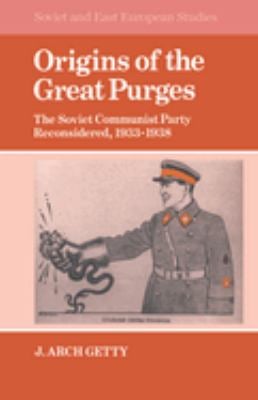
This is a study of the structure of the Soviet Communist Party in the 1930s. Based upon archival and published sources, the work describes the events in the Bolshevik Party leading up to the Great Purges of 1937-1938. Professor Getty concludes that the party bureaucracy was chaotic rather than totalitarian, and that local officials had relative autonomy within a considerably fragmented political system. The Moscow leadership, of which Stalin was the most authoritarian actor, reacted to social and political processes as much as instigating them. Because of disputes, confusion, and inefficiency, they often promoted contradictory policies. Avoiding the usual concentration on Stalin's personality, the author puts forward the controversial hypothesis that the Great Purges occurred not as the end product of a careful Stalin plan, but rather as the bloody but ad hoc result of Moscow's incremental attempts to centralise political power.
| Condition | Price | |||
|---|---|---|---|---|
|
New (280 available)
Ships Separately |
$39.49 USD | Add To Cart | Ships separately from Better World Books suppliers | |
|
eBook Obtain a digital book from our friends at eBooks.com.
|
{{ebooksDotComPrice}} {{ebooksDotComCurrency}} | eBooks.com | Digital edition from eBooks.com | |
|
Audio Book Obtain a digital book from our friends at AudiobooksNow.com.
|
{{audioBooksNowPrice}} {{audioBooksNowCurrency}} | AudiobooksNow.com | Digital edition from AudiobooksNow.com |
| Find at your local library from our friends at WorldCat | Find Libraries |
This is a study of the structure of the Soviet Communist Party in the 1930s. Based upon archival and published sources, the work describes the events in the Bolshevik Party leading up to the Great Purges of 1937-1938. Professor Getty concludes that t ...
Read full overview
This is a study of the structure of the Soviet Communist Party in the 1930s. Based upon archival and published sources, the work describes the events in the Bolshevik Party leading up to the Great Purges of 1937-1938. Professor Getty concludes that the party bureaucracy was chaotic rather than totalitarian, and that local officials had relative autonomy within a considerably fragmented political system. The Moscow leadership, of which Stalin was the most authoritarian actor, reacted to social and political processes as much as instigating them. Because of disputes, confusion, and inefficiency, they often promoted contradictory policies. Avoiding the usual concentration on Stalin's personality, the author puts forward the controversial hypothesis that the Great Purges occurred not as the end product of a careful Stalin plan, but rather as the bloody but ad hoc result of Moscow's incremental attempts to centralise political power.
| Condition | Source | Price | |
|---|---|---|---|
|
New (280 available)
Ships Separately |
Ships separately from Better World Books suppliers | $39.49 USD | Add To Cart |
|
eBook Obtain a digital book from our friends at eBooks.com.
|
Digital edition from eBooks.com | {{ebooksDotComPrice}} {{ebooksDotComCurrency}} | eBooks.com |
|
Audio Book Obtain a digital book from our friends at AudiobooksNow.com.
|
|
{{audioBooksNowPrice}} {{audioBooksNowCurrency}} | Audiobook |
*This is a limited preview of the contents of this book and does not directly represent the item available for sale.*
You are now leaving the Better World Books website to complete your transaction. Your eBook download will be facilitated by our friends at eBooks.com. Thank you for your support and for shopping with Better World Books!
You are now leaving the Better World Books website to complete your transaction. Your audio book download will be facilitated by our friends at AudiobooksNow.com. Thank you for your support and for shopping with Better World Books!
You are now leaving the Better World Books website. Thank you for your support and for shopping with Better World Books!