
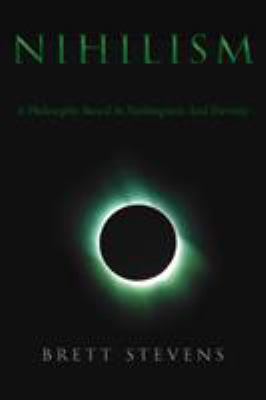
Nihilism : A Philosophy Based in Nothingness and Eternity
Paperback
- All Available Copies
- Overview
- About the Author
- Awards
- Professional Reviews
- Reader Reviews
- Table Of Contents
- Borrow
Overview
Most people see the world in binary categories. They believe that there is either an inherent moral good that we must all obey, or there are no rules and life is pointless anarchy. Nihilism argues for a middle path: we lack inherent order, but are defined by our choices, which means that we must start making smarter choices by understanding the reality in which we live more than the human social reality which we have used to replace it in our minds. A work of philosophy in the continental tradition, Nihilism examines the human relationship with philosophical doubt through a series of essays designed to stimulate the ancient knowledge within us of what is right and what is real. Searching for a level of thought underneath the brain-destroying methods of politics and economics, the philosophy of nihilism approaches thought at its most basic level and highest degree of abstraction. It escapes the bias of human perspective and instructs our ability to perceive itself, unleashing a new level of critical thinking that side-steps the mental ghetto of modernity and the attendant problems of civilization decline and personal lassitude. While many rail against nihilism as the death of culture and religion, the philosophy itself encourages a consequentialist, reality-based outlook that forms the basis for moral choice. Unlike the control-oriented systems of thought that form the basis of contemporary society, nihilism reverts the crux of moral thinking to the relationship between the individual and the effects of that individual's actions in reality. From this, a new range of choice expands, including the decision to affirm religious and moral truth as superior methods of Darwinistic adaptation to the question of human survival, which necessarily includes civilization. Inspired by transcendentalist thinkers and the ancient traditions of both the West and the Far East, the philosophy of nihilism negates the false intermediate steps imposed on us by degenerated values systems. In the footsteps of philosopher Friedrich W. Nietzsche, who called for a
"re-evaluation of all values," nihilism subverts linguistic and social categorical thinking in order to achieve self-discipline of the mind. As part of this pursuit, Nihilism investigates thought from writers as diverse as William S. Burroughs, Aldous Huxley, Arthur Schopenhauer and Immanuel Kant. For those who seek the truth beyond the socially-convenient explanations that humans tell one another, nihilism is a philosophy both for a new age and for all time.
Categories
All Available Copies Find out more about shipping times from these sellers.
| Condition | Price | |||
|---|---|---|---|---|
New (138 available)

Ships Separately |
$26.72 USD | Add To Cart | Ships separately from Better World Books suppliers | |
|
eBook Obtain a digital book from our friends at eBooks.com.
|
{{ebooksDotComPrice}} {{ebooksDotComCurrency}} | eBooks.com | Digital edition from eBooks.com | |
|
Audio Book Obtain a digital book from our friends at AudiobooksNow.com.
|
{{audioBooksNowPrice}} {{audioBooksNowCurrency}} | AudiobooksNow.com | Digital edition from AudiobooksNow.com |
| Find at your local library from our friends at WorldCat | Find Libraries |
Overview
Most people see the world in binary categories. They believe that there is either an inherent moral good that we must all obey, or there are no rules and life is pointless anarchy. Nihilism argues for a middle path: we lack inherent order, but are de ...
Read full overview
Overview
Most people see the world in binary categories. They believe that there is either an inherent moral good that we must all obey, or there are no rules and life is pointless anarchy. Nihilism argues for a middle path: we lack inherent order, but are defined by our choices, which means that we must start making smarter choices by understanding the reality in which we live more than the human social reality which we have used to replace it in our minds. A work of philosophy in the continental tradition, Nihilism examines the human relationship with philosophical doubt through a series of essays designed to stimulate the ancient knowledge within us of what is right and what is real. Searching for a level of thought underneath the brain-destroying methods of politics and economics, the philosophy of nihilism approaches thought at its most basic level and highest degree of abstraction. It escapes the bias of human perspective and instructs our ability to perceive itself, unleashing a new level of critical thinking that side-steps the mental ghetto of modernity and the attendant problems of civilization decline and personal lassitude. While many rail against nihilism as the death of culture and religion, the philosophy itself encourages a consequentialist, reality-based outlook that forms the basis for moral choice. Unlike the control-oriented systems of thought that form the basis of contemporary society, nihilism reverts the crux of moral thinking to the relationship between the individual and the effects of that individual's actions in reality. From this, a new range of choice expands, including the decision to affirm religious and moral truth as superior methods of Darwinistic adaptation to the question of human survival, which necessarily includes civilization. Inspired by transcendentalist thinkers and the ancient traditions of both the West and the Far East, the philosophy of nihilism negates the false intermediate steps imposed on us by degenerated values systems. In the footsteps of philosopher Friedrich W. Nietzsche, who called for a
"re-evaluation of all values," nihilism subverts linguistic and social categorical thinking in order to achieve self-discipline of the mind. As part of this pursuit, Nihilism investigates thought from writers as diverse as William S. Burroughs, Aldous Huxley, Arthur Schopenhauer and Immanuel Kant. For those who seek the truth beyond the socially-convenient explanations that humans tell one another, nihilism is a philosophy both for a new age and for all time.
Product Details
Borrow
All Available Copies
| Condition | Source | Price | |
|---|---|---|---|
|
New (138 available)
Ships Separately |
Ships separately from Better World Books suppliers | $26.72 USD | Add To Cart |
|
eBook Obtain a digital book from our friends at eBooks.com.
|
Digital edition from eBooks.com | {{ebooksDotComPrice}} {{ebooksDotComCurrency}} | eBooks.com |
|
Audio Book Obtain a digital book from our friends at AudiobooksNow.com.
|
|
{{audioBooksNowPrice}} {{audioBooksNowCurrency}} | Audiobook |
Limited Preview for 'Nihilism : A Philosophy Based in Nothingness and Eternity' provided by Archive.org
*This is a limited preview of the contents of this book and does not directly represent the item available for sale.*
A preview for 'Nihilism : A Philosophy Based in Nothingness and Eternity' is unavailable.
You are now leaving the Better World Books website to complete your transaction. Your eBook download will be facilitated by our friends at eBooks.com. Thank you for your support and for shopping with Better World Books!
You are now leaving the Better World Books website to complete your transaction. Your audio book download will be facilitated by our friends at AudiobooksNow.com. Thank you for your support and for shopping with Better World Books!
You are now leaving the Better World Books website. Thank you for your support and for shopping with Better World Books!