"A classic."
-- New York Times
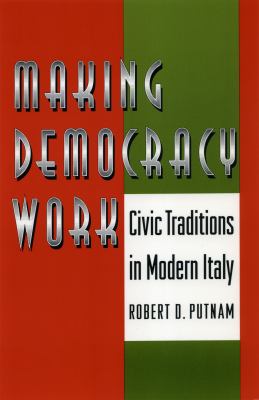
"Seminal, epochal, path-breaking . . . a Democracy in America for our times."-- The Nation From the bestselling author of Bowling Alone , a landmark account of the secret of successful democracies Why do some democratic governments succeed and others fail? In a book that has received attention from policymakers and civic activists in America and around the world, acclaimed political scientist and bestselling author Robert Putnam and his collaborators offer empirical evidence for the importance of
"civic community" in developing successful institutions. Their focus is on a unique experiment begun in 1970, when Italy created new governments for each of its regions. After spending two decades analyzing the efficacy of these governments in such fields as agriculture, housing, and healthcare, they reveal patterns of associationism, trust, and cooperation that facilitate good governance and economic prosperity. The result is a landmark book filled with crucial insights about how to make democracy work.
Robert D. Putnam is the Peter and Isabel Malkin Professor of Public Policy at Harvard University. A leading humanist and a renowned scientist, he has consulted for the last four U.S. Presidents. He has written fourteen books including Better Together: Restoring the American Community, Democracies in Flux: The Evolution of Social Capital in Contemporary Society, and Our Kids: The American Dream in Crisis.
| Condition | Price | |||
|---|---|---|---|---|
|
Used Good (2 available)
Former Library Book |
$5.78 USD | Add To Cart |
Ships directly from Better World Books |
|
|
Used Very Good (1 available)
Former Library Book |
$5.78 USD | Add To Cart |
Ships directly from Better World Books |
|
|
Used Very Good (1 available)
|
$5.78 USD | Add To Cart |
Ships directly from Better World Books |
|
|
New (314 available)
Ships Separately |
$52.33 USD | Add To Cart | Ships separately from Better World Books suppliers | |
|
eBook Obtain a digital book from our friends at eBooks.com.
|
{{ebooksDotComPrice}} {{ebooksDotComCurrency}} | eBooks.com | Digital edition from eBooks.com | |
|
Audio Book Obtain a digital book from our friends at AudiobooksNow.com.
|
{{audioBooksNowPrice}} {{audioBooksNowCurrency}} | AudiobooksNow.com | Digital edition from AudiobooksNow.com |
| List of Figures | |
| List of Tables | |
| Preface | |
| Introduction: Studying Institutional Performance | p. 3 |
| A Voyage of Inquiry | p. 3 |
| Charting the Voyage | p. 7 |
| Methods of Inquiry | p. 12 |
| Changing the Rules: Two Decades of Institutional Development | p. 17 |
| Creating Regional Government | p. 18 |
| The Regional Political Elite: "A New Way of Doing Politics" | p. 26 |
| The Deepening of Regional Autonomy | p. 38 |
| Putting Down Roots: The Region and its Constituents | p. 47 |
| Measuring Institutional Performance | p. 63 |
| Twelve Indicators of Institutional Performance | p. 65 |
| Coherence and Reliability of the Index of Institutional Performance | p. 73 |
| Institutional Performance and Constituency Evaluations | p. 76 |
| Explaining Institutional Performance | p. 83 |
| Socioeconomic Modernity | p. 83 |
| The Civic Community: Some Theoretical Speculations | p. 86 |
| The Civic Community: Testing the Theory | p. 91 |
| Social and Political Life in the Civic Community | p. 99 |
| Other Explanations for Institutional Success? | p. 116 |
| Tracing the Roots of the Civic Community | p. 121 |
| The Civic Legacies of Medieval Italy | p. 121 |
| Civic Traditions After Unification | p. 137 |
| Measuring the Durability of Civic Traditions | p. 148 |
| Economic Development and Civic Traditions | p. 152 |
| Social Capital and Institutional Success | p. 163 |
| Dilemmas of Collective Action | p. 163 |
| Social Capital, Trust, and Rotating Credit Associations | p. 167 |
| Norms of Reciprocity and Networks of Civic Engagement | p. 171 |
| History and Institutional Performance: Two Social Equilibria | p. 177 |
| Lessons from the Italian Regional Experiment | p. 181 |
| Appendix A: Research Methods | p. 187 |
| Appendix B: Statistical Evidence on Attitude Change among Regional Councilors | p. 193 |
| Appendix C: Institutional Performance (1978-1985) | p. 198 |
| Appendix D: Regional Abbreviations Used in Scattergrams | p. 200 |
| Appendix E: Local Government Performance (1982-1986) and Regional Government Performance (1978-1985) | p. 201 |
| Appendix F: Traditions of Civic Involvement (1860-1920) | p. 205 |
| Notes | p. 207 |
| Index | p. 249 |
| Table of Contents provided by Blackwell. All Rights Reserved. |
| Find at your local library from our friends at WorldCat | Find Libraries |
"A classic." -- New York Times"Seminal, epochal, path-breaking . . . a Democracy in America for our times."-- The Nation From the bestselling author of Bowling Alone , a landmark account of the secret of successful democracies Why do some de ...
Read full overview
"A classic."
-- New York Times
"Seminal, epochal, path-breaking . . . a Democracy in America for our times."-- The Nation From the bestselling author of Bowling Alone , a landmark account of the secret of successful democracies Why do some democratic governments succeed and others fail? In a book that has received attention from policymakers and civic activists in America and around the world, acclaimed political scientist and bestselling author Robert Putnam and his collaborators offer empirical evidence for the importance of
"civic community" in developing successful institutions. Their focus is on a unique experiment begun in 1970, when Italy created new governments for each of its regions. After spending two decades analyzing the efficacy of these governments in such fields as agriculture, housing, and healthcare, they reveal patterns of associationism, trust, and cooperation that facilitate good governance and economic prosperity. The result is a landmark book filled with crucial insights about how to make democracy work.
Robert D. Putnam is the Peter and Isabel Malkin Professor of Public Policy at Harvard University. A leading humanist and a renowned scientist, he has consulted for the last four U.S. Presidents. He has written fourteen books including Better Together: Restoring the American Community, Democracies in Flux: The Evolution of Social Capital in Contemporary Society, and Our Kids: The American Dream in Crisis.
| List of Figures | |
| List of Tables | |
| Preface | |
| Introduction: Studying Institutional Performance | p. 3 |
| A Voyage of Inquiry | p. 3 |
| Charting the Voyage | p. 7 |
| Methods of Inquiry | p. 12 |
| Changing the Rules: Two Decades of Institutional Development | p. 17 |
| Creating Regional Government | p. 18 |
| The Regional Political Elite: "A New Way of Doing Politics" | p. 26 |
| The Deepening of Regional Autonomy | p. 38 |
| Putting Down Roots: The Region and its Constituents | p. 47 |
| Measuring Institutional Performance | p. 63 |
| Twelve Indicators of Institutional Performance | p. 65 |
| Coherence and Reliability of the Index of Institutional Performance | p. 73 |
| Institutional Performance and Constituency Evaluations | p. 76 |
| Explaining Institutional Performance | p. 83 |
| Socioeconomic Modernity | p. 83 |
| The Civic Community: Some Theoretical Speculations | p. 86 |
| The Civic Community: Testing the Theory | p. 91 |
| Social and Political Life in the Civic Community | p. 99 |
| Other Explanations for Institutional Success? | p. 116 |
| Tracing the Roots of the Civic Community | p. 121 |
| The Civic Legacies of Medieval Italy | p. 121 |
| Civic Traditions After Unification | p. 137 |
| Measuring the Durability of Civic Traditions | p. 148 |
| Economic Development and Civic Traditions | p. 152 |
| Social Capital and Institutional Success | p. 163 |
| Dilemmas of Collective Action | p. 163 |
| Social Capital, Trust, and Rotating Credit Associations | p. 167 |
| Norms of Reciprocity and Networks of Civic Engagement | p. 171 |
| History and Institutional Performance: Two Social Equilibria | p. 177 |
| Lessons from the Italian Regional Experiment | p. 181 |
| Appendix A: Research Methods | p. 187 |
| Appendix B: Statistical Evidence on Attitude Change among Regional Councilors | p. 193 |
| Appendix C: Institutional Performance (1978-1985) | p. 198 |
| Appendix D: Regional Abbreviations Used in Scattergrams | p. 200 |
| Appendix E: Local Government Performance (1982-1986) and Regional Government Performance (1978-1985) | p. 201 |
| Appendix F: Traditions of Civic Involvement (1860-1920) | p. 205 |
| Notes | p. 207 |
| Index | p. 249 |
| Table of Contents provided by Blackwell. All Rights Reserved. |
| Condition | Source | Price | |
|---|---|---|---|
|
Used Good (2 available)
Former Library Book Former Library Book Ships from |
Ships directly from Better World Books |
$5.78 USD | Add To Cart |
|
Used Very Good (1 available)
Former Library Book Former Library Book Ships from |
Ships directly from Better World Books |
$5.78 USD | Add To Cart |
|
Used Very Good (1 available)
Ships from |
Ships directly from Better World Books |
$5.78 USD | Add To Cart |
|
New (314 available)
Ships Separately |
Ships separately from Better World Books suppliers | $52.33 USD | Add To Cart |
|
eBook Obtain a digital book from our friends at eBooks.com.
|
Digital edition from eBooks.com | {{ebooksDotComPrice}} {{ebooksDotComCurrency}} | eBooks.com |
|
Audio Book Obtain a digital book from our friends at AudiobooksNow.com.
|
|
{{audioBooksNowPrice}} {{audioBooksNowCurrency}} | Audiobook |
What do the following names have in common, besides their obvious amazing [...]
Everyone has a favorite cult book. Maybe it’s Fight Club, maybe it’s [...]
Nora Roberts Born: October, 1950Hometown: Silver Spring, MDThe Book That “Made” Nora [...]
*This is a limited preview of the contents of this book and does not directly represent the item available for sale.*
You are now leaving the Better World Books website to complete your transaction. Your eBook download will be facilitated by our friends at eBooks.com. Thank you for your support and for shopping with Better World Books!
You are now leaving the Better World Books website to complete your transaction. Your audio book download will be facilitated by our friends at AudiobooksNow.com. Thank you for your support and for shopping with Better World Books!
You are now leaving the Better World Books website. Thank you for your support and for shopping with Better World Books!