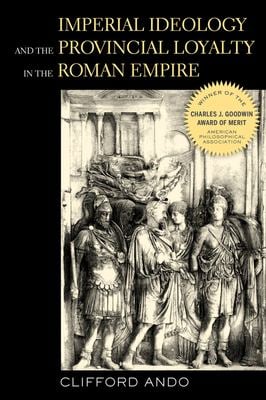
The Roman empire remains unique. Although Rome claimed to rule the world, it did not. Rather, its uniqueness stems from the culture it created and the loyalty it inspired across an area that stretched from the Tyne to the Euphrates. Moreover, the empire created this culture with a bureaucracy smaller than that of a typical late-twentieth-century research university. In approaching this problem, Clifford Ando does not ask the ever-fashionable question, Why did the Roman empire fall? Rather, he asks, Why did the empire last so long? Imperial Ideology and Provincial Loyalty in the Roman Empire argues that the longevity of the empire rested not on Roman military power but on a gradually realized consensus that Roman rule was justified. This consensus was itself the product of a complex conversation between the central government and its far-flung peripheries. Ando investigates the mechanisms that sustained this conversation, explores its contribution to the legitimation of Roman power, and reveals as its product the provincial absorption of the forms and content of Roman political and legal discourse. Throughout, his sophisticated and subtle reading is informed by current thinking on social formation by theorists such as Max Weber, J rgen Habermas, and Pierre Bourdieu.
| Condition | Price | |||
|---|---|---|---|---|
|
New (356 available)
Ships Separately |
$87.70 USD | Add To Cart | Ships separately from Better World Books suppliers | |
|
eBook Obtain a digital book from our friends at eBooks.com.
|
{{ebooksDotComPrice}} {{ebooksDotComCurrency}} | eBooks.com | Digital edition from eBooks.com | |
|
Audio Book Obtain a digital book from our friends at AudiobooksNow.com.
|
{{audioBooksNowPrice}} {{audioBooksNowCurrency}} | AudiobooksNow.com | Digital edition from AudiobooksNow.com |
| Illustrations | p. ix |
| Preface and Acknowledgments | p. xi |
| Abbreviations | p. xv |
| Communis Patria | p. 1 |
| Ancient and Modern Contexts | p. 17 |
| Ideology in the Roman Empire | p. 19 |
| The Roman Achievement in Ancient Thought | p. 49 |
| Consensus and Communication | p. 71 |
| The Communicative Actions of the Roman Government | p. 73 |
| Consensus in Theory and Practice | p. 131 |
| The Creation of Consensus | p. 175 |
| Images of Emperor and Empire | p. 206 |
| From Imperium to Patria | p. 275 |
| Orbis Terrarum and Orbis Romanus | p. 277 |
| The King is a Body Politick ... for That a Body Politique Never Dieth | p. 336 |
| Singulare Et Unicum Imperium | p. 406 |
| Works Cited | p. 413 |
| General Index | p. 451 |
| Index Locorum | p. 459 |
| Table of Contents provided by Publisher. All Rights Reserved. |
| Find at your local library from our friends at WorldCat | Find Libraries |
The Roman empire remains unique. Although Rome claimed to rule the world, it did not. Rather, its uniqueness stems from the culture it created and the loyalty it inspired across an area that stretched from the Tyne to the Euphrates. Moreover, the emp ...
Read full overview
The Roman empire remains unique. Although Rome claimed to rule the world, it did not. Rather, its uniqueness stems from the culture it created and the loyalty it inspired across an area that stretched from the Tyne to the Euphrates. Moreover, the empire created this culture with a bureaucracy smaller than that of a typical late-twentieth-century research university. In approaching this problem, Clifford Ando does not ask the ever-fashionable question, Why did the Roman empire fall? Rather, he asks, Why did the empire last so long? Imperial Ideology and Provincial Loyalty in the Roman Empire argues that the longevity of the empire rested not on Roman military power but on a gradually realized consensus that Roman rule was justified. This consensus was itself the product of a complex conversation between the central government and its far-flung peripheries. Ando investigates the mechanisms that sustained this conversation, explores its contribution to the legitimation of Roman power, and reveals as its product the provincial absorption of the forms and content of Roman political and legal discourse. Throughout, his sophisticated and subtle reading is informed by current thinking on social formation by theorists such as Max Weber, J rgen Habermas, and Pierre Bourdieu.
| Illustrations | p. ix |
| Preface and Acknowledgments | p. xi |
| Abbreviations | p. xv |
| Communis Patria | p. 1 |
| Ancient and Modern Contexts | p. 17 |
| Ideology in the Roman Empire | p. 19 |
| The Roman Achievement in Ancient Thought | p. 49 |
| Consensus and Communication | p. 71 |
| The Communicative Actions of the Roman Government | p. 73 |
| Consensus in Theory and Practice | p. 131 |
| The Creation of Consensus | p. 175 |
| Images of Emperor and Empire | p. 206 |
| From Imperium to Patria | p. 275 |
| Orbis Terrarum and Orbis Romanus | p. 277 |
| The King is a Body Politick ... for That a Body Politique Never Dieth | p. 336 |
| Singulare Et Unicum Imperium | p. 406 |
| Works Cited | p. 413 |
| General Index | p. 451 |
| Index Locorum | p. 459 |
| Table of Contents provided by Publisher. All Rights Reserved. |
| Condition | Source | Price | |
|---|---|---|---|
|
New (356 available)
Ships Separately |
Ships separately from Better World Books suppliers | $87.70 USD | Add To Cart |
|
eBook Obtain a digital book from our friends at eBooks.com.
|
Digital edition from eBooks.com | {{ebooksDotComPrice}} {{ebooksDotComCurrency}} | eBooks.com |
|
Audio Book Obtain a digital book from our friends at AudiobooksNow.com.
|
|
{{audioBooksNowPrice}} {{audioBooksNowCurrency}} | Audiobook |
*This is a limited preview of the contents of this book and does not directly represent the item available for sale.*
You are now leaving the Better World Books website to complete your transaction. Your eBook download will be facilitated by our friends at eBooks.com. Thank you for your support and for shopping with Better World Books!
You are now leaving the Better World Books website to complete your transaction. Your audio book download will be facilitated by our friends at AudiobooksNow.com. Thank you for your support and for shopping with Better World Books!
You are now leaving the Better World Books website. Thank you for your support and for shopping with Better World Books!