
- All Available Copies
- Overview
- About the Author
- Awards
- Professional Reviews
- Reader Reviews
- Table Of Contents
- Borrow
Overview
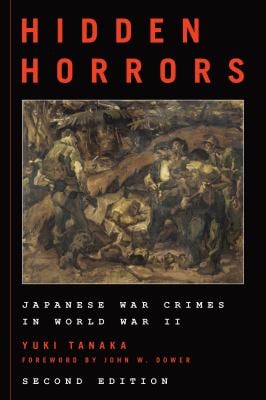
This landmark book documents little-known wartime Japanese atrocities during World War II. Yuki Tanaka's case studies, still remarkably original and significant, include cannibalism; the slaughter and starvation of prisoners of war; the rape, enforced prostitution, and murder of noncombatants; and biological warfare experiments. The author describes how desperate Japanese soldiers consumed the flesh of their own comrades killed in fighting as well as that of Australians, Pakistanis, and Indians. He traces the fate of sixty-five shipwrecked Australian nurses and British soldiers who were shot or stabbed to death by their captors. Another thirty-two nurses were captured and sent to Sumatra to become
"comfort women"--sex slaves for Japanese soldiers. Tanaka recounts how thousands of Australian and British POWs were massacred in the infamous Sandakan camp in the Borneo jungle in 1945, while those who survived were forced to endure a tortuous 160-mile march on which anyone who dropped out of line was immediately shot. This new edition also includes a powerful chapter on the island of Nauru, where thirty-nine leprosy patients were killed and thousands of Naurans were ill-treated and forced to leave their homes. Without denying individual and national responsibility, the author explores individual atrocities in their broader social, psychological, and institutional milieu and places Japanese behavior during the war in the broader context of the dehumanization of men at war. In his substantially revised conclusion, Tanaka brings in significant new interpretations to explain why Japanese imperial forces were so brutal, tracing the historical processes that created such a unique military structure and ideology. Finally, he investigates why a strong awareness of their collective responsibility for wartime atrocities has been and still is lacking among the Japanese.
Categories
All Available Copies Find out more about shipping times from these sellers.
| Condition | Price | |||
|---|---|---|---|---|
|
eBook Obtain a digital book from our friends at eBooks.com.
|
{{ebooksDotComPrice}} {{ebooksDotComCurrency}} | eBooks.com | Digital edition from eBooks.com | |
|
Audio Book Obtain a digital book from our friends at AudiobooksNow.com.
|
{{audioBooksNowPrice}} {{audioBooksNowCurrency}} | AudiobooksNow.com | Digital edition from AudiobooksNow.com |
Professional Reviews
| Find at your local library from our friends at WorldCat | Find Libraries |
Overview
This landmark book documents little-known wartime Japanese atrocities during World War II. Yuki Tanaka's case studies, still remarkably original and significant, include cannibalism; the slaughter and starvation of prisoners of war; the rape, enforce ...
Read full overview
Overview
This landmark book documents little-known wartime Japanese atrocities during World War II. Yuki Tanaka's case studies, still remarkably original and significant, include cannibalism; the slaughter and starvation of prisoners of war; the rape, enforced prostitution, and murder of noncombatants; and biological warfare experiments. The author describes how desperate Japanese soldiers consumed the flesh of their own comrades killed in fighting as well as that of Australians, Pakistanis, and Indians. He traces the fate of sixty-five shipwrecked Australian nurses and British soldiers who were shot or stabbed to death by their captors. Another thirty-two nurses were captured and sent to Sumatra to become
"comfort women"--sex slaves for Japanese soldiers. Tanaka recounts how thousands of Australian and British POWs were massacred in the infamous Sandakan camp in the Borneo jungle in 1945, while those who survived were forced to endure a tortuous 160-mile march on which anyone who dropped out of line was immediately shot. This new edition also includes a powerful chapter on the island of Nauru, where thirty-nine leprosy patients were killed and thousands of Naurans were ill-treated and forced to leave their homes. Without denying individual and national responsibility, the author explores individual atrocities in their broader social, psychological, and institutional milieu and places Japanese behavior during the war in the broader context of the dehumanization of men at war. In his substantially revised conclusion, Tanaka brings in significant new interpretations to explain why Japanese imperial forces were so brutal, tracing the historical processes that created such a unique military structure and ideology. Finally, he investigates why a strong awareness of their collective responsibility for wartime atrocities has been and still is lacking among the Japanese.
Product Details
Professional Reviews
All Available Copies
| Condition | Source | Price | |
|---|---|---|---|
|
eBook Obtain a digital book from our friends at eBooks.com.
|
Digital edition from eBooks.com | {{ebooksDotComPrice}} {{ebooksDotComCurrency}} | eBooks.com |
|
Audio Book Obtain a digital book from our friends at AudiobooksNow.com.
|
|
{{audioBooksNowPrice}} {{audioBooksNowCurrency}} | Audiobook |
Limited Preview for 'Hidden Horrors : Japanese War Crimes in World War II' provided by Archive.org
*This is a limited preview of the contents of this book and does not directly represent the item available for sale.*
A preview for 'Hidden Horrors : Japanese War Crimes in World War II' is unavailable.
You are now leaving the Better World Books website to complete your transaction. Your eBook download will be facilitated by our friends at eBooks.com. Thank you for your support and for shopping with Better World Books!
You are now leaving the Better World Books website to complete your transaction. Your audio book download will be facilitated by our friends at AudiobooksNow.com. Thank you for your support and for shopping with Better World Books!
You are now leaving the Better World Books website. Thank you for your support and for shopping with Better World Books!