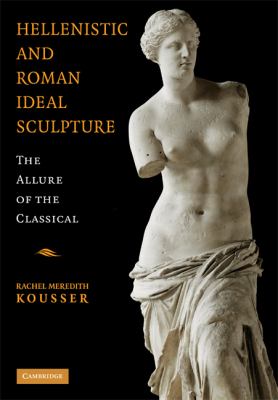
In this book, Rachel Kousser draws on contemporary reception theory to present a new approach to Hellenistic and Roman ideal sculpture. She analyzes the Romans' preference for retrospective, classicizing statuary based on Greek models as opposed to the innovative creations prized by modern scholars. Using a case study of a particular sculptural type, a forceful yet erotic image of Venus, Kousser argues that the Romans self-consciously employed such sculptures to represent their ties to the past in a rapidly evolving world. Kousser presents Hellenistic and Roman ideal sculpture as an example of a highly effective artistic tradition that was, by modern standards, extraordinarily conservative. At the same time, the Romans' flexible and opportunistic use of past forms also had important implications for the future: it constituted the origins of classicism in Western art.
| Condition | Price | |||
|---|---|---|---|---|
|
New (308 available)
Ships Separately |
$130.82 USD | Add To Cart | Ships separately from Better World Books suppliers | |
|
eBook Obtain a digital book from our friends at eBooks.com.
|
{{ebooksDotComPrice}} {{ebooksDotComCurrency}} | eBooks.com | Digital edition from eBooks.com | |
|
Audio Book Obtain a digital book from our friends at AudiobooksNow.com.
|
{{audioBooksNowPrice}} {{audioBooksNowCurrency}} | AudiobooksNow.com | Digital edition from AudiobooksNow.com |
| Find at your local library from our friends at WorldCat | Find Libraries |
In this book, Rachel Kousser draws on contemporary reception theory to present a new approach to Hellenistic and Roman ideal sculpture. She analyzes the Romans' preference for retrospective, classicizing statuary based on Greek models as opposed to t ...
Read full overview
In this book, Rachel Kousser draws on contemporary reception theory to present a new approach to Hellenistic and Roman ideal sculpture. She analyzes the Romans' preference for retrospective, classicizing statuary based on Greek models as opposed to the innovative creations prized by modern scholars. Using a case study of a particular sculptural type, a forceful yet erotic image of Venus, Kousser argues that the Romans self-consciously employed such sculptures to represent their ties to the past in a rapidly evolving world. Kousser presents Hellenistic and Roman ideal sculpture as an example of a highly effective artistic tradition that was, by modern standards, extraordinarily conservative. At the same time, the Romans' flexible and opportunistic use of past forms also had important implications for the future: it constituted the origins of classicism in Western art.
| Condition | Source | Price | |
|---|---|---|---|
|
New (308 available)
Ships Separately |
Ships separately from Better World Books suppliers | $130.82 USD | Add To Cart |
|
eBook Obtain a digital book from our friends at eBooks.com.
|
Digital edition from eBooks.com | {{ebooksDotComPrice}} {{ebooksDotComCurrency}} | eBooks.com |
|
Audio Book Obtain a digital book from our friends at AudiobooksNow.com.
|
|
{{audioBooksNowPrice}} {{audioBooksNowCurrency}} | Audiobook |
*This is a limited preview of the contents of this book and does not directly represent the item available for sale.*
You are now leaving the Better World Books website to complete your transaction. Your eBook download will be facilitated by our friends at eBooks.com. Thank you for your support and for shopping with Better World Books!
You are now leaving the Better World Books website to complete your transaction. Your audio book download will be facilitated by our friends at AudiobooksNow.com. Thank you for your support and for shopping with Better World Books!
You are now leaving the Better World Books website. Thank you for your support and for shopping with Better World Books!