
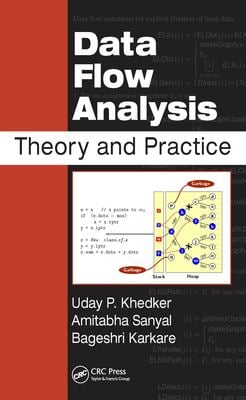
Data Flow Analysis : Theory and Practice
Not Applicable
Data Flow Analysis : Theory and Practice
Not Applicable
- All Available Copies
- Overview
- About the Author
- Awards
- Professional Reviews
- Reader Reviews
- Table Of Contents
- Borrow
Overview
Data flow analysis is used to discover information for a wide variety of useful applications, ranging from compiler optimizations to software engineering and verification. Modern compilers apply it to produce performance-maximizing code, and software engineers use it to re-engineer or reverse engineer programs and verify the integrity of their programs. Supplementary Online Materials to Strengthen Understanding Unlike most comparable books, many of which are limited to bit vector frameworks and classical constant propagation, Data Flow Analysis: Theory and Practice offers comprehensive coverage of both classical and contemporary data flow analysis. It prepares foundations useful for both researchers and students in the field by standardizing and unifying various existing research, concepts, and notations. It also presents mathematical foundations of data flow analysis and includes study of data flow analysis implantation through use of the GNU Compiler Collection (GCC). Divided into three parts, this unique text combines discussions of inter- and intraprocedural analysis and then describes implementation of a generic data flow analyzer (gdfa) for bit vector frameworks in GCC. Through the inclusion of case studies and examples to reinforce material, this text equips readers with a combination of mutually supportive theory and practice, and they will be able to access the author's accompanying Web page. Here they can experiment with the analyses described in the book, and can make use of updated features, including: Slides used in the authors' courses The source of the generic data flow analyzer (gdfa) An errata that features errors as they are discovered Additional updated relevant material discovered in the course of research
Categories
All Available Copies Find out more about shipping times from these sellers.
| Condition | Price | |||
|---|---|---|---|---|
|
eBook Obtain a digital book from our friends at eBooks.com.
|
{{ebooksDotComPrice}} {{ebooksDotComCurrency}} | eBooks.com | Digital edition from eBooks.com | |
|
Audio Book Obtain a digital book from our friends at AudiobooksNow.com.
|
{{audioBooksNowPrice}} {{audioBooksNowCurrency}} | AudiobooksNow.com | Digital edition from AudiobooksNow.com |
Professional Reviews
Table Of Contents
| Preface: An Introduction to Data Flow Analysis | |
| A Motivating Example | |
| Program Analysis: The Larger Perspective | |
| Characteristics of Data Flow Analysis | |
| Summary and Concluding Remarks | |
| Intraprocedural Data Flow Analysis | |
| Classical Bit Vector Data Flow Analysis | |
| Basic Concepts and Notations | |
| Discovering Local Data Flow Information | |
| Discovering Global Properties of Variables | |
| Discovering Global Properties of Expressions | |
| Combined May-Must Analyses | |
| Summary and Concluding Remarks | |
| Theoretical Abstractions in Data Flow Analysis | |
| Graph Properties Relevant to Data Flow Analysis | |
| Data Flow Framework | |
| Data Flow Assignments | |
| Computing Data Flow Assignments | |
| Complexity of Data Flow Analysis for Rapid Frameworks | |
| Summary and Concluding Remarks | |
| General Data Flow Frameworks | |
| Non-Separable Flow Functions | |
| Discovering Properties of Variables | |
| Discovering Properties of Pointers | |
| Liveness Analysis of Heap Data | |
| Modeling Entity Dependence | |
| Summary and Concluding Remarks | |
| Complexity of Iterative Data Flow Analysis | |
| Generic Flow Functions and Data Flow Equations | |
| Generic Round Robin Iterative Algorithm | |
| Complexity of Round Robin Iterative Algorithm | |
| Summary and Concluding Remarks | |
| Single Static Assignment Form as Intermediate Representation | |
| Introduction | |
| Construction of SSA Form Programs | |
| Destruction of SSA | |
| Summary and Concluding Remarks | |
| Interprocedural Data Flow Analysis | |
| Introduction to Interprocedural Data Flow Analysis | |
| A Motivating Example | |
| Program Representations for Interprocedural Analysis | |
| Modeling Interprocedural Data Flow Analysis | |
| Compromising Precision for Scalability | |
| Language Features Influencing Interprocedural Analysis | |
| Common Variants of Interprocedural Data Flow Analysis | |
| An Aside on Interprocedural Optimizations | |
| Summary and Concluding Remarks | |
| Functional Approach to Interprocedural Data Flow Analysis | |
| Side Effects Analysis of Procedure Calls | |
| Handling the Effects of Parameters | |
| Whole Program Analysis | |
| Summary and Concluding Remarks | |
| Value Based Approach to Interprocedural Data Flow Analysis | |
| Program Model for Value Based Approaches to Interprocedural Data Flow Analysis | |
| Interprocedural Analysis Using Restricted Contexts | |
| Interprocedural Analysis Using Unrestricted Contexts | |
| Bounding Unrestricted Contexts Using Data Flow Values | |
| The Motivating Example Revisited | |
| Summary and Concluding Remarks | |
| Implementing Data Flow Analysis | |
| Implementing Data Flow Analysis in GCC | |
| Specifying a Data Flow Analysis | |
| An Example of Data Flow Analysis | |
| Implementing the Generic Data Flow Analyzer gdfa | |
| Extending the Generic Data Flow Analyzer gdfa | |
| Appendices: | |
| An Introduction to GCC | |
| About GCC | |
| Building GCC | |
| Further Readings in GCC | |
| Table of Contents provided by Publisher. All Rights Reserved. |
| Find at your local library from our friends at WorldCat | Find Libraries |
Overview
Data flow analysis is used to discover information for a wide variety of useful applications, ranging from compiler optimizations to software engineering and verification. Modern compilers apply it to produce performance-maximizing code, and software ...
Read full overview
Overview
Data flow analysis is used to discover information for a wide variety of useful applications, ranging from compiler optimizations to software engineering and verification. Modern compilers apply it to produce performance-maximizing code, and software engineers use it to re-engineer or reverse engineer programs and verify the integrity of their programs. Supplementary Online Materials to Strengthen Understanding Unlike most comparable books, many of which are limited to bit vector frameworks and classical constant propagation, Data Flow Analysis: Theory and Practice offers comprehensive coverage of both classical and contemporary data flow analysis. It prepares foundations useful for both researchers and students in the field by standardizing and unifying various existing research, concepts, and notations. It also presents mathematical foundations of data flow analysis and includes study of data flow analysis implantation through use of the GNU Compiler Collection (GCC). Divided into three parts, this unique text combines discussions of inter- and intraprocedural analysis and then describes implementation of a generic data flow analyzer (gdfa) for bit vector frameworks in GCC. Through the inclusion of case studies and examples to reinforce material, this text equips readers with a combination of mutually supportive theory and practice, and they will be able to access the author's accompanying Web page. Here they can experiment with the analyses described in the book, and can make use of updated features, including: Slides used in the authors' courses The source of the generic data flow analyzer (gdfa) An errata that features errors as they are discovered Additional updated relevant material discovered in the course of research
Product Details
Professional Reviews
Table Of Contents
| Preface: An Introduction to Data Flow Analysis | |
| A Motivating Example | |
| Program Analysis: The Larger Perspective | |
| Characteristics of Data Flow Analysis | |
| Summary and Concluding Remarks | |
| Intraprocedural Data Flow Analysis | |
| Classical Bit Vector Data Flow Analysis | |
| Basic Concepts and Notations | |
| Discovering Local Data Flow Information | |
| Discovering Global Properties of Variables | |
| Discovering Global Properties of Expressions | |
| Combined May-Must Analyses | |
| Summary and Concluding Remarks | |
| Theoretical Abstractions in Data Flow Analysis | |
| Graph Properties Relevant to Data Flow Analysis | |
| Data Flow Framework | |
| Data Flow Assignments | |
| Computing Data Flow Assignments | |
| Complexity of Data Flow Analysis for Rapid Frameworks | |
| Summary and Concluding Remarks | |
| General Data Flow Frameworks | |
| Non-Separable Flow Functions | |
| Discovering Properties of Variables | |
| Discovering Properties of Pointers | |
| Liveness Analysis of Heap Data | |
| Modeling Entity Dependence | |
| Summary and Concluding Remarks | |
| Complexity of Iterative Data Flow Analysis | |
| Generic Flow Functions and Data Flow Equations | |
| Generic Round Robin Iterative Algorithm | |
| Complexity of Round Robin Iterative Algorithm | |
| Summary and Concluding Remarks | |
| Single Static Assignment Form as Intermediate Representation | |
| Introduction | |
| Construction of SSA Form Programs | |
| Destruction of SSA | |
| Summary and Concluding Remarks | |
| Interprocedural Data Flow Analysis | |
| Introduction to Interprocedural Data Flow Analysis | |
| A Motivating Example | |
| Program Representations for Interprocedural Analysis | |
| Modeling Interprocedural Data Flow Analysis | |
| Compromising Precision for Scalability | |
| Language Features Influencing Interprocedural Analysis | |
| Common Variants of Interprocedural Data Flow Analysis | |
| An Aside on Interprocedural Optimizations | |
| Summary and Concluding Remarks | |
| Functional Approach to Interprocedural Data Flow Analysis | |
| Side Effects Analysis of Procedure Calls | |
| Handling the Effects of Parameters | |
| Whole Program Analysis | |
| Summary and Concluding Remarks | |
| Value Based Approach to Interprocedural Data Flow Analysis | |
| Program Model for Value Based Approaches to Interprocedural Data Flow Analysis | |
| Interprocedural Analysis Using Restricted Contexts | |
| Interprocedural Analysis Using Unrestricted Contexts | |
| Bounding Unrestricted Contexts Using Data Flow Values | |
| The Motivating Example Revisited | |
| Summary and Concluding Remarks | |
| Implementing Data Flow Analysis | |
| Implementing Data Flow Analysis in GCC | |
| Specifying a Data Flow Analysis | |
| An Example of Data Flow Analysis | |
| Implementing the Generic Data Flow Analyzer gdfa | |
| Extending the Generic Data Flow Analyzer gdfa | |
| Appendices: | |
| An Introduction to GCC | |
| About GCC | |
| Building GCC | |
| Further Readings in GCC | |
| Table of Contents provided by Publisher. All Rights Reserved. |
All Available Copies
| Condition | Source | Price | |
|---|---|---|---|
|
eBook Obtain a digital book from our friends at eBooks.com.
|
Digital edition from eBooks.com | {{ebooksDotComPrice}} {{ebooksDotComCurrency}} | eBooks.com |
|
Audio Book Obtain a digital book from our friends at AudiobooksNow.com.
|
|
{{audioBooksNowPrice}} {{audioBooksNowCurrency}} | Audiobook |
Limited Preview for 'Data Flow Analysis : Theory and Practice' provided by Archive.org
*This is a limited preview of the contents of this book and does not directly represent the item available for sale.*
A preview for 'Data Flow Analysis : Theory and Practice' is unavailable.
You are now leaving the Better World Books website to complete your transaction. Your eBook download will be facilitated by our friends at eBooks.com. Thank you for your support and for shopping with Better World Books!
You are now leaving the Better World Books website to complete your transaction. Your audio book download will be facilitated by our friends at AudiobooksNow.com. Thank you for your support and for shopping with Better World Books!
You are now leaving the Better World Books website. Thank you for your support and for shopping with Better World Books!