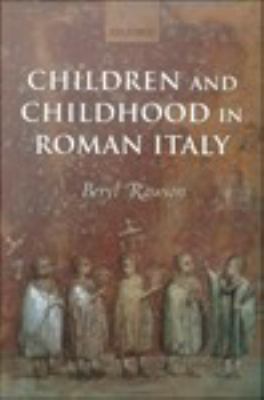
Concepts of childhood and the treatment of children are often used as a barometer of society's humanity, values, and priorities. Children and Childhood in Roman Italy argues that in Roman society children were, in principle and often in practice, welcome, valued and visible. There is no evidence directly from children themselves, but we can reconstruct attitudes to them, and their own experiences, from a wide variety of material - art and architecture, artefacts, funerary dedications, Roman law, literature, and public and private ritual. There are distinctively Roman aspects to the treatment of children and to children's experiences. Education at many levels was important. The commemoration of children who died young has no parallel, in earlier or later societies, before the twentieth century.This study builds on the dynamic work on the Roman family that has been developing in recent decades. Its focus on the period between the first century BCE and the early third century CE provides a context for new work being done on early Christian societies, especially in Rome.
| Condition | Price | |||
|---|---|---|---|---|
|
eBook Obtain a digital book from our friends at eBooks.com.
|
{{ebooksDotComPrice}} {{ebooksDotComCurrency}} | eBooks.com | Digital edition from eBooks.com | |
|
Audio Book Obtain a digital book from our friends at AudiobooksNow.com.
|
{{audioBooksNowPrice}} {{audioBooksNowCurrency}} | AudiobooksNow.com | Digital edition from AudiobooksNow.com |
| Find at your local library from our friends at WorldCat | Find Libraries |
Concepts of childhood and the treatment of children are often used as a barometer of society's humanity, values, and priorities. Children and Childhood in Roman Italy argues that in Roman society children were, in principle and often in practice, wel ...
Read full overview
Concepts of childhood and the treatment of children are often used as a barometer of society's humanity, values, and priorities. Children and Childhood in Roman Italy argues that in Roman society children were, in principle and often in practice, welcome, valued and visible. There is no evidence directly from children themselves, but we can reconstruct attitudes to them, and their own experiences, from a wide variety of material - art and architecture, artefacts, funerary dedications, Roman law, literature, and public and private ritual. There are distinctively Roman aspects to the treatment of children and to children's experiences. Education at many levels was important. The commemoration of children who died young has no parallel, in earlier or later societies, before the twentieth century.This study builds on the dynamic work on the Roman family that has been developing in recent decades. Its focus on the period between the first century BCE and the early third century CE provides a context for new work being done on early Christian societies, especially in Rome.
| Condition | Source | Price | |
|---|---|---|---|
|
eBook Obtain a digital book from our friends at eBooks.com.
|
Digital edition from eBooks.com | {{ebooksDotComPrice}} {{ebooksDotComCurrency}} | eBooks.com |
|
Audio Book Obtain a digital book from our friends at AudiobooksNow.com.
|
|
{{audioBooksNowPrice}} {{audioBooksNowCurrency}} | Audiobook |
*This is a limited preview of the contents of this book and does not directly represent the item available for sale.*
You are now leaving the Better World Books website to complete your transaction. Your eBook download will be facilitated by our friends at eBooks.com. Thank you for your support and for shopping with Better World Books!
You are now leaving the Better World Books website to complete your transaction. Your audio book download will be facilitated by our friends at AudiobooksNow.com. Thank you for your support and for shopping with Better World Books!
You are now leaving the Better World Books website. Thank you for your support and for shopping with Better World Books!