
- Track every order
- Save books to your wishlist
- Earn rewards on every order
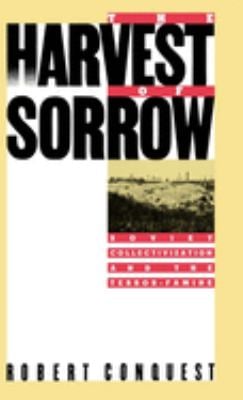
The Harvest of Sorrow : Soviet Collectivization and the Terror-Famine
Hardcover
- Other Available Editions
- Other Available Editions
- All Available Copies
- Overview
- About the Author
- Awards
- Professional Reviews
- Reader Reviews
- Table Of Contents
- Borrow
Overview
The Harvest of Sorrow is the first full history of one of the most horrendous human tragedies of the 20th century. Between 1929 and 1932 the Soviet Communist Party struck a double blow at the Russian peasantry: dekulakization, the dispossession and deportation of millions of peasant families, and collectivization, the abolition of private ownership of land and the concentration of the remaining peasants in party-controlled
"collective" farms. This was followed in 1932-33 by a
"terror-famine," inflicted by the State on the collectivized peasants of the Ukraine and certain other areas by setting impossibly high grain quotas, removing every other source of food, and preventing help from outside--even from other areas of the Soviet Union--from reaching the starving populace. The death toll resulting from the actions described in this book was an estimated 14.5 million--more than the total number of deaths for all countries in World War I. Ambitious, meticulously researched, and lucidly written, The Harvest of Sorrow is a deeply moving testament to those who died, and will register in the Western consciousness a sense of the dark side of this century's history.
Robert Conquest
George Robert Acworth Conquest was born in Great Malvern, Worcestershire, England on July 15, 1917. He was educated at Winchester College in England, the University of Grenoble in France, and Magdalen College, Oxford University. During World War II, he joined the Oxford and Buckinghamshire Light Infantry. After studying Bulgarian, he served as an intelligence officer in Bulgaria, where he remained after the war as the press officer at the British Embassy in Sofia. He started out as a poet. He edited volumes of the poetry anthology New Lines, which showcased work by Movement poets. His poetry collections included Between Mars and Venus and Arias from a Love Opera. He also edited Spectrum, a series of five anthologies that presented quality science-fiction stories from the 1940s and 1950s. His science-fiction works included A World of Difference and The Egyptologists written with Kingsley Amis. He is best known as a historian who documented the horrors perpetrated by the Soviet regime against its own citizens. He wrote numerous books on the Soviet system and politics including Power and Politics in the USSR, The Great Terror: Stalin's Purge of the Thirties, The Harvest of Sorrow: Soviet Collectivization and the Terror-Famine, Russia After Khrushchev, Industrial Workers in the USSR, The Nation Killers: The Soviet Deportation of Nationalities, and Kolyma: The Arctic Death Camps. He died from pneumonia on August 3, 2015 at the age of 98.
Categories
All Available Copies Find out more about shipping times from these sellers.
| Condition | Price | |||
|---|---|---|---|---|
|
Used Good (4 available)
Former Library Book 
|
$5.93 USD | Add To Cart |
Ships directly from Better World Books
|
|
|
Used Good (1 available)
|
$5.93 USD | Add To Cart |
Ships directly from Better World Books
|
|
|
New (304 available)
Ships Separately |
$115.61 USD | Add To Cart | Ships separately from Better World Books suppliers | |
|
eBook Obtain a digital book from our friends at eBooks.com.
|
{{ebooksDotComPrice}} {{ebooksDotComCurrency}} | eBooks.com | Digital edition from eBooks.com | |
|
Audio Book Obtain a digital book from our friends at AudiobooksNow.com.
|
{{audioBooksNowPrice}} {{audioBooksNowCurrency}} | AudiobooksNow.com | Digital edition from AudiobooksNow.com |
Professional Reviews
"Vital to understanding 'Stalin's revolution.'"--Patrick J. Rollins, Old Dominion University
"The Harvest of Sorrow is not just a heroic work of scholarship, but an embarrassment to Mikhail Gorbachev and an antidote to wishful thinking about the Soviet Union."*
"Essential reading for those who wish to understand the nature of the Soviet system...likely to become a classic."--The Wall Street Journal
"The Harvest of Sorrow is essential reading for those who wish to understand the nature of the Soviet system, and like Mr. Conquest's earlier account of Stalin's purges of the 1930s, The Great Terror, it is likely to become a classic."--The Wall Street Journal
"The most comprehensive history of the Soviet agricultural crisis....Also the most vivid portrayal of one of the great crimes against humanity of the twentieth century."--American Historical Review
"The first major scholarly book on the horrors [of Soviet collectivization]....Conquest has succeeded in restoring [the peasants'] human faces."--Time
"A very good book of its kind."--T.E. Smuck, University of Hawaii
"A superb book on a fascinating topic."--Bruce F. Adams, University of Louisville
"A superb book on one of the most important questions in Soviet history."--Herbert Ellison, University of Washington
"Excellent....It contains information on the Stalinist era, especially the consequences of collectivization, unavailable in any other book on Soviet society."--L.M. Kowal, University of Michigan
"[A] superb work of history."--Newsweek
"Meticulously researched...Robert Conquest presents a chilling account of Stalin's regime cold bloodedly killing twenty million of its own subjects."--The Washington Post Book World
"Powerful and well-documented."--The New Republic
"An excellent book....It is an eye-opener about a period of Soviet history that has been systematically falsified and ignored too often."--Steven M. Miner, Ohio University
"A carefully researched and superbly written study. It deals with a period, and a set of problems, that rank among the most important (and most neglected) of Soviet historical studies."--Los Angeles Times Book Review
"A comprehensive record of what may stand as the crime of the century."--The Chicago Tribune
"Brilliant and brutal. Should be required reading for all of Gorbachev's apologists."--John C.K. Daly, Kansas State University
"Absolutely essential to an understanding of the Soviet Union....Meticulously researched and well-written and the only comprehensive study of the appalling tragedy which befell in the Ukraine during collectivization."--Charles W. Chappius, Chicago State University
| Find at your local library from our friends at WorldCat | Find Libraries |
Overview
The Harvest of Sorrow is the first full history of one of the most horrendous human tragedies of the 20th century. Between 1929 and 1932 the Soviet Communist Party struck a double blow at the Russian peasantry: dekulakization, the dispossession and d ...
Read full overview
Overview
The Harvest of Sorrow is the first full history of one of the most horrendous human tragedies of the 20th century. Between 1929 and 1932 the Soviet Communist Party struck a double blow at the Russian peasantry: dekulakization, the dispossession and deportation of millions of peasant families, and collectivization, the abolition of private ownership of land and the concentration of the remaining peasants in party-controlled
"collective" farms. This was followed in 1932-33 by a
"terror-famine," inflicted by the State on the collectivized peasants of the Ukraine and certain other areas by setting impossibly high grain quotas, removing every other source of food, and preventing help from outside--even from other areas of the Soviet Union--from reaching the starving populace. The death toll resulting from the actions described in this book was an estimated 14.5 million--more than the total number of deaths for all countries in World War I. Ambitious, meticulously researched, and lucidly written, The Harvest of Sorrow is a deeply moving testament to those who died, and will register in the Western consciousness a sense of the dark side of this century's history.
Product Details
About the Author
Robert Conquest
George Robert Acworth Conquest was born in Great Malvern, Worcestershire, England on July 15, 1917. He was educated at Winchester College in England, the University of Grenoble in France, and Magdalen College, Oxford University. During World War II, he joined the Oxford and Buckinghamshire Light Infantry. After studying Bulgarian, he served as an intelligence officer in Bulgaria, where he remained after the war as the press officer at the British Embassy in Sofia. He started out as a poet. He edited volumes of the poetry anthology New Lines, which showcased work by Movement poets. His poetry collections included Between Mars and Venus and Arias from a Love Opera. He also edited Spectrum, a series of five anthologies that presented quality science-fiction stories from the 1940s and 1950s. His science-fiction works included A World of Difference and The Egyptologists written with Kingsley Amis. He is best known as a historian who documented the horrors perpetrated by the Soviet regime against its own citizens. He wrote numerous books on the Soviet system and politics including Power and Politics in the USSR, The Great Terror: Stalin's Purge of the Thirties, The Harvest of Sorrow: Soviet Collectivization and the Terror-Famine, Russia After Khrushchev, Industrial Workers in the USSR, The Nation Killers: The Soviet Deportation of Nationalities, and Kolyma: The Arctic Death Camps. He died from pneumonia on August 3, 2015 at the age of 98.
Professional Reviews
"Vital to understanding 'Stalin's revolution.'"--Patrick J. Rollins, Old Dominion University
"The Harvest of Sorrow is not just a heroic work of scholarship, but an embarrassment to Mikhail Gorbachev and an antidote to wishful thinking about the Soviet Union."*
"Essential reading for those who wish to understand the nature of the Soviet system...likely to become a classic."--The Wall Street Journal
"The Harvest of Sorrow is essential reading for those who wish to understand the nature of the Soviet system, and like Mr. Conquest's earlier account of Stalin's purges of the 1930s, The Great Terror, it is likely to become a classic."--The Wall Street Journal
"The most comprehensive history of the Soviet agricultural crisis....Also the most vivid portrayal of one of the great crimes against humanity of the twentieth century."--American Historical Review
"The first major scholarly book on the horrors [of Soviet collectivization]....Conquest has succeeded in restoring [the peasants'] human faces."--Time
"A very good book of its kind."--T.E. Smuck, University of Hawaii
"A superb book on a fascinating topic."--Bruce F. Adams, University of Louisville
"A superb book on one of the most important questions in Soviet history."--Herbert Ellison, University of Washington
"Excellent....It contains information on the Stalinist era, especially the consequences of collectivization, unavailable in any other book on Soviet society."--L.M. Kowal, University of Michigan
"[A] superb work of history."--Newsweek
"Meticulously researched...Robert Conquest presents a chilling account of Stalin's regime cold bloodedly killing twenty million of its own subjects."--The Washington Post Book World
"Powerful and well-documented."--The New Republic
"An excellent book....It is an eye-opener about a period of Soviet history that has been systematically falsified and ignored too often."--Steven M. Miner, Ohio University
"A carefully researched and superbly written study. It deals with a period, and a set of problems, that rank among the most important (and most neglected) of Soviet historical studies."--Los Angeles Times Book Review
"A comprehensive record of what may stand as the crime of the century."--The Chicago Tribune
"Brilliant and brutal. Should be required reading for all of Gorbachev's apologists."--John C.K. Daly, Kansas State University
"Absolutely essential to an understanding of the Soviet Union....Meticulously researched and well-written and the only comprehensive study of the appalling tragedy which befell in the Ukraine during collectivization."--Charles W. Chappius, Chicago State University
Borrow
All Available Copies
| Condition | Source | Price | |
|---|---|---|---|
|
Used Good (4 available)
Former Library Book
Former Library Book Ships from |
Ships directly from Better World Books
|
$5.93 USD | Add To Cart |
|
Used Good (1 available)
Ships from |
Ships directly from Better World Books
|
$5.93 USD | Add To Cart |
|
New (304 available)
Ships Separately |
Ships separately from Better World Books suppliers | $115.61 USD | Add To Cart |
|
eBook Obtain a digital book from our friends at eBooks.com.
|
Digital edition from eBooks.com | {{ebooksDotComPrice}} {{ebooksDotComCurrency}} | eBooks.com |
|
Audio Book Obtain a digital book from our friends at AudiobooksNow.com.
|
|
{{audioBooksNowPrice}} {{audioBooksNowCurrency}} | Audiobook |
Limited Preview for 'The Harvest of Sorrow : Soviet Collectivization and the Terror-Famine' provided by Archive.org
*This is a limited preview of the contents of this book and does not directly represent the item available for sale.*
A preview for 'The Harvest of Sorrow : Soviet Collectivization and the Terror-Famine' is unavailable.
You are now leaving the Better World Books website to complete your transaction. Your eBook download will be facilitated by our friends at eBooks.com. Thank you for your support and for shopping with Better World Books!
You are now leaving the Better World Books website to complete your transaction. Your audio book download will be facilitated by our friends at AudiobooksNow.com. Thank you for your support and for shopping with Better World Books!
You are now leaving the Better World Books website. Thank you for your support and for shopping with Better World Books!