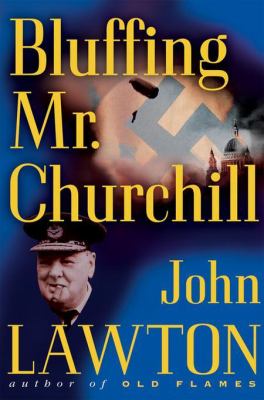
"With his Inspector Troy series, John Lawton has been compared to top historical espionage writers such as John le Carre and Len Deighton. Now Lawton offers us
""one of the most entertaining thrillers... in years"" (Sunday Telegraph). It is 1941. Wolfgang Stahl, an American spy operating undercover as an SS officer, has just fled Germany with Hitler's henchmen on his trail. He is carrying valuable cargo-the blueprint of the Fuhrer's secret plan to invade Russia. Stahl's man in the American embassy, the shy and sheltered Calvin M. Cormack, is teamed with a boisterous MI5 officer, Walter Stilton, to find the spy and bring him to safety. Their investigation takes them across war-torn London, from the shelled-out blocks to the ubiquitous pubs to the underground counterfeiting shops; and in Cormack's case, into the arms of Kitty, his partner's rambunctious daughter. As Cormack and Stilton close in on Stahl, bodies begin turning up-and the duo realize they may not be the only ones in pursuit of the spy. Someone, it seems, wants the German dead. When his partner is suddenly murdered in the line of duty, Cormack must turn to the ingenious devices of his lover Kitty's old flame-Sergeant Troy of Scotland Yard. Together, they investigate the trail of murders and come to a horrifying realization-are Cormack and his spy being played by one of their own in the American embassy? Brilliantly re-creating London in the time of ration tickets and bread lines, Bluffing Mr. Churchill is a blistering page-turner peopled by characters to which we find ourselves magnetically drawn. Says the London Observer,
""The sense of London during the Blitz is strong and the story, with its mix of real history and believable invention, is fast-paced, twisting and tense."" Cal stayed. The bombers came in waves. He sat in Gel-broaster's chair and watched the Blut und Eisen version of July 4th light up the sky and shake the earth around him. Away in the south, London burnt fiercely. Closer to home he could see incendiaries bursting in buildings in the little streets of Mayfair, feel the weight of the near misses as high explosives crashed around him. He felt oddly free from fear. The rational part of his mind told him that the next bomb after a near miss could well be a direct hit, and while the hotel was a relatively sound structure,
""steel ribs an' all,"" he was in a most exposed position-and the rest of his mind overruled, in thrall to nothing more cerebral, nothing less visceral, than the thrill of it all. Each part of the spectacle had its own color. Ack-ack shells burst white in the night, little puffs of man-made cloud in an otherwise cloudless sky-and if they were close enough they showered shards of metal rain on to the streets below, adding atonal, clattering, tinkling music to the show. Tracer bullets fired by night-fighters shot across the sky, a dozen differing shades, like a pool rack dispersed by a cue ball, shooting red, shooting white, shooting green. Incendiaries burst blue and orange and then took on their hue from whatever they consumed. Oil and rubber burnt black. Wood burnt red and orange. And the searchlights roved like giant's fingers."