
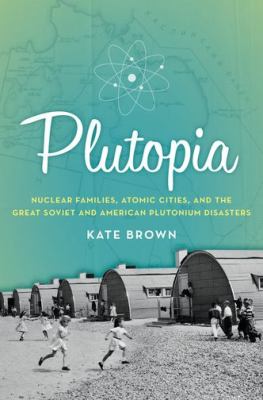
Plutopia : Nuclear Families, Atomic Cities, and the Great Soviet and American Plutonium Disasters
4.0 (9)
Hardcover
Plutopia : Nuclear Families, Atomic Cities, and the Great Soviet and American Plutonium Disasters
4.0 (9)
Hardcover
- All Available Copies
- Overview
- About the Author
- Awards
- Professional Reviews
- Reader Reviews
- Table Of Contents
- Borrow
Overview
While many transnational histories of the nuclear arms race have been written, Kate Brown provides the first definitive account of the great plutonium disasters of the United States and the Soviet Union. In Plutopia, Brown draws on official records and dozens of interviews to tell the extraordinary stories of Richland, Washington and Ozersk, Russia - the first two cities in the world to produce plutonium. To contain secrets, American and Soviet leaders created plutopias - communities of nuclear families living in highly-subsidized, limited-access atomic cities. Fully employed and medically monitored, the residents of Richland and Ozersk enjoyed all the pleasures of consumer society, while nearby, migrants, prisoners, and soldiers were banned from plutopia - they lived in temporary
"staging grounds" and often performed the most dangerous work at the plant. Brown shows that the plants' segregation of permanent and temporary workers and of nuclear and non-nuclear zones created a bubble of immunity, where dumps and accidents were glossed over and plant managers freely embezzled and polluted. In four decades, the Hanford plant near Richland and the Maiak plant near Ozersk each issued at least 200 million curies of radioactive isotopes into the surrounding environment - equaling four Chernobyls - laying waste to hundreds of square miles and contaminating rivers, fields, forests, and food supplies. Because of the decades of secrecy, downwind and downriver neighbors of the plutonium plants had difficulty proving what they suspected, that the rash of illnesses, cancers, and birth defects in their communities were caused by the plants' radioactive emissions. Plutopia was successful because in its zoned-off isolation it appeared to deliver the promises of the American dream and Soviet communism; in reality, it concealed disasters that remain highly unstable and threatening today. An untold and profoundly important piece of Cold War history, Plutopia invites readers to consider the nuclear footprint left by the arms race and the enormous price of paying for it.
Categories
All Available Copies Find out more about shipping times from these sellers.
| Condition | Price | |||
|---|---|---|---|---|
|
Used Good (1 available)
Former Library Book 
|
$14.85 USD | Add To Cart |
Ships directly from Better World Books
|
|
|
New (368 available)
Ships Separately |
$26.10 USD | Add To Cart | Ships separately from Better World Books suppliers | |
|
eBook Obtain a digital book from our friends at eBooks.com.
|
{{ebooksDotComPrice}} {{ebooksDotComCurrency}} | eBooks.com | Digital edition from eBooks.com | |
|
Audio Book Obtain a digital book from our friends at AudiobooksNow.com.
|
{{audioBooksNowPrice}} {{audioBooksNowCurrency}} | AudiobooksNow.com | Digital edition from AudiobooksNow.com |
Professional Reviews
"An unflinching and chilling account." --Seattle Times
"Harrowing... Meticulously researched... Plutopia has important messages for those managing today''s nuclear facilities, arguing for caution and transparency." --Nature
"The book tells two intertwined stories. One is an appalling narrative of environmental disasters... The second narrative is about the towns, the townspeople, and the creation of a spatially segmented landscape that enabled those disasters... This is admirable comparative history." --Carl Abbott, Environmental History
"Fascinating." -- Dissent
"One of the Cold War''s more striking perversities never made it to public view. ... Brown is a good writer, and she describes with precision the construction of the two sites (a difficult process in the U.S. case, an unbelievably horrid one in the Russian case), the hazardous occupations undertaken by their inhabitants, and the consciously contrived bubbles of socioeconomic inequality both places became." --Foreign Affairs
"Brown''s account is unique, partisan and occasionally personal in that she includes some of her thoughts about interviews she conducted... But because she is open and thorough about her sources, those are strengths to be celebrated, not weaknesses to be deplored. It also means her book is engaging, honest and, in the end, entirely credible." --New Scientist
"An amazing book... Brown found many parallels between Richland and Ozersk that disrupt the conservative Cold War dichotomy between the ''free world'' and the totalitarian one. Her research included not only uncovering previously secret documents in both countries but also tracking down and interviewing old-time residents of Ozersk and Richland. Her picture of the treatment of plutonium workers on both sides of the Iron Curtain is enough to make you gnash your teeth or cry." --Jon Wiener, American Historical Review
"Arresting, engagingly narrated... Kate Brown skillfully mixes Cold War policy assessment and associated political intrigue with sociological study of the lives of those who lived and worked in those places... Plutopia is history told through the voice of drama and investigative reporting." --Stephen E. Roulac, New York Journal of Books
"Plutopia is reporting and research at its best, both revealing a hidden history and impacting the important discussions about nuclear power that should be happening today." --Glenn Dallas, San Francisco Book Review
"An untold and profoundly important piece of Cold War history, Plutopia invites readers to consider the nuclear footprint left by the arms race and the enormous price of paying for it." --H-Soyuz
"Kate Brown has written a provocative and original study of two cities -- one American, one Soviet -- at the center of their countries'' nuclear weapons complexes. The striking parallels she finds between them help us -- impel us -- to see the Cold War in a new light. Plutopia will be much discussed. It is a fascinating and important book." --David Holloway, author of Stalin and the Bomb
"Kate Brown has produced a novel and arresting account of the consequences of Cold War Nuclear policies on both sides of the Iron Curtain. Interweaving documentary research in government archives, reviews and revisions of the public record, and a host of personal interviews with the citizens -- perpetrators, victims, and witnesses -- Brown''s Plutopia makes a lasting contribution to the continuing chronicle of the human and environmental disasters of the atomic age." --Peter Bacon Hales, author of Atomic Spaces: Living on the Manhattan Project
"It may be the best piece of research and writing in the nuclear history field in the last 25 years - perhaps the best ever... Extremely impressive." -- Rodney Carlisle, Prof. Emeritus, Rutgers University, author of Encyclopedia of the Atomic Age
Reader Reviews for Plutopia : Nuclear Families, Atomic Cities, and the Great Soviet and American Plutonium Disasters
Table Of Contents
| Acknowledgments | p. ix |
| Introduction | p. 3 |
| Incarcerated Space on the Western Nuclear Frontier | |
| Mr. Matthias Goes to Washington | p. 15 |
| Labor on the Lam | p. 19 |
| "Labor Shortage" | p. 26 |
| Defending the Nation | p. 32 |
| The City Plutonium Built | p. 37 |
| Work and the Women Left Holding Plutonium | p. 44 |
| Hazards | p. 50 |
| The Food Chain | p. 57 |
| Of Flies, Mice, and Men | p. 65 |
| The Soviet Working-Class Atom and the American Response | |
| The Arrest of a Journal | p. 75 |
| The Gulag and the Bomb | p. 83 |
| The Bronze Age Atom | p. 87 |
| Keeping Secrets | p. 92 |
| Beria's Visit | p. 97 |
| Reporting for Duty | p. 105 |
| Empire of Calamity | p. 115 |
| "A Few Good Men" in Pursuit of America's Permanent War Economy | p. 124 |
| Stalin's Rocket Engine: Rewarding the Plutonium People | p. 133 |
| Big Brother in the American Heartland | p. 141 |
| Neighbors | p. 150 |
| The Vodka Society | p. 156 |
| The Plutonium Disasters | |
| Managing a Risk Society | p. 165 |
| The Walking Wounded | p. 172 |
| Two Autopsies | p. 178 |
| Wahluke Slope: Into Harm's Way | p. 185 |
| Quiet Flows the Techa | p. 189 |
| Resettlement | p. 197 |
| The Zone of Immunity | p. 204 |
| The Socialist Consumers' Republic | p. 213 |
| The Uses of an Open Society | p. 221 |
| The Kyshtym Belch, 1957 | p. 231 |
| Karabolka, Beyond the Zone | p. 239 |
| Private Parts | p. 247 |
| "From Crabs to Caviar, We Had Everything" | p. 255 |
| Dismantling the Plutonium Curtain | |
| Plutonium into Portfolio Shares | p. 271 |
| Chernobyl Redux | p. 282 |
| 1984 | p. 287 |
| The Forsaken | p. 297 |
| Sick People | p. 306 |
| Cassandra in Coveralls | p. 313 |
| Nuclear Glasnost | p. 319 |
| All the King's Men | p. 324 |
| Futures | p. 331 |
| Archives and Abbreviations | p. 339 |
| Notes | p. 341 |
| Index | p. 399 |
| Table of Contents provided by Ingram. All Rights Reserved. |
| Find at your local library from our friends at WorldCat | Find Libraries |
Overview
While many transnational histories of the nuclear arms race have been written, Kate Brown provides the first definitive account of the great plutonium disasters of the United States and the Soviet Union. In Plutopia, Brown draws on official records a ...
Read full overview
Overview
While many transnational histories of the nuclear arms race have been written, Kate Brown provides the first definitive account of the great plutonium disasters of the United States and the Soviet Union. In Plutopia, Brown draws on official records and dozens of interviews to tell the extraordinary stories of Richland, Washington and Ozersk, Russia - the first two cities in the world to produce plutonium. To contain secrets, American and Soviet leaders created plutopias - communities of nuclear families living in highly-subsidized, limited-access atomic cities. Fully employed and medically monitored, the residents of Richland and Ozersk enjoyed all the pleasures of consumer society, while nearby, migrants, prisoners, and soldiers were banned from plutopia - they lived in temporary
"staging grounds" and often performed the most dangerous work at the plant. Brown shows that the plants' segregation of permanent and temporary workers and of nuclear and non-nuclear zones created a bubble of immunity, where dumps and accidents were glossed over and plant managers freely embezzled and polluted. In four decades, the Hanford plant near Richland and the Maiak plant near Ozersk each issued at least 200 million curies of radioactive isotopes into the surrounding environment - equaling four Chernobyls - laying waste to hundreds of square miles and contaminating rivers, fields, forests, and food supplies. Because of the decades of secrecy, downwind and downriver neighbors of the plutonium plants had difficulty proving what they suspected, that the rash of illnesses, cancers, and birth defects in their communities were caused by the plants' radioactive emissions. Plutopia was successful because in its zoned-off isolation it appeared to deliver the promises of the American dream and Soviet communism; in reality, it concealed disasters that remain highly unstable and threatening today. An untold and profoundly important piece of Cold War history, Plutopia invites readers to consider the nuclear footprint left by the arms race and the enormous price of paying for it.
Product Details
Reviews
Professional Reviews
"An unflinching and chilling account." --Seattle Times
"Harrowing... Meticulously researched... Plutopia has important messages for those managing today''s nuclear facilities, arguing for caution and transparency." --Nature
"The book tells two intertwined stories. One is an appalling narrative of environmental disasters... The second narrative is about the towns, the townspeople, and the creation of a spatially segmented landscape that enabled those disasters... This is admirable comparative history." --Carl Abbott, Environmental History
"Fascinating." -- Dissent
"One of the Cold War''s more striking perversities never made it to public view. ... Brown is a good writer, and she describes with precision the construction of the two sites (a difficult process in the U.S. case, an unbelievably horrid one in the Russian case), the hazardous occupations undertaken by their inhabitants, and the consciously contrived bubbles of socioeconomic inequality both places became." --Foreign Affairs
"Brown''s account is unique, partisan and occasionally personal in that she includes some of her thoughts about interviews she conducted... But because she is open and thorough about her sources, those are strengths to be celebrated, not weaknesses to be deplored. It also means her book is engaging, honest and, in the end, entirely credible." --New Scientist
"An amazing book... Brown found many parallels between Richland and Ozersk that disrupt the conservative Cold War dichotomy between the ''free world'' and the totalitarian one. Her research included not only uncovering previously secret documents in both countries but also tracking down and interviewing old-time residents of Ozersk and Richland. Her picture of the treatment of plutonium workers on both sides of the Iron Curtain is enough to make you gnash your teeth or cry." --Jon Wiener, American Historical Review
"Arresting, engagingly narrated... Kate Brown skillfully mixes Cold War policy assessment and associated political intrigue with sociological study of the lives of those who lived and worked in those places... Plutopia is history told through the voice of drama and investigative reporting." --Stephen E. Roulac, New York Journal of Books
"Plutopia is reporting and research at its best, both revealing a hidden history and impacting the important discussions about nuclear power that should be happening today." --Glenn Dallas, San Francisco Book Review
"An untold and profoundly important piece of Cold War history, Plutopia invites readers to consider the nuclear footprint left by the arms race and the enormous price of paying for it." --H-Soyuz
"Kate Brown has written a provocative and original study of two cities -- one American, one Soviet -- at the center of their countries'' nuclear weapons complexes. The striking parallels she finds between them help us -- impel us -- to see the Cold War in a new light. Plutopia will be much discussed. It is a fascinating and important book." --David Holloway, author of Stalin and the Bomb
"Kate Brown has produced a novel and arresting account of the consequences of Cold War Nuclear policies on both sides of the Iron Curtain. Interweaving documentary research in government archives, reviews and revisions of the public record, and a host of personal interviews with the citizens -- perpetrators, victims, and witnesses -- Brown''s Plutopia makes a lasting contribution to the continuing chronicle of the human and environmental disasters of the atomic age." --Peter Bacon Hales, author of Atomic Spaces: Living on the Manhattan Project
"It may be the best piece of research and writing in the nuclear history field in the last 25 years - perhaps the best ever... Extremely impressive." -- Rodney Carlisle, Prof. Emeritus, Rutgers University, author of Encyclopedia of the Atomic Age
Table Of Contents
| Acknowledgments | p. ix |
| Introduction | p. 3 |
| Incarcerated Space on the Western Nuclear Frontier | |
| Mr. Matthias Goes to Washington | p. 15 |
| Labor on the Lam | p. 19 |
| "Labor Shortage" | p. 26 |
| Defending the Nation | p. 32 |
| The City Plutonium Built | p. 37 |
| Work and the Women Left Holding Plutonium | p. 44 |
| Hazards | p. 50 |
| The Food Chain | p. 57 |
| Of Flies, Mice, and Men | p. 65 |
| The Soviet Working-Class Atom and the American Response | |
| The Arrest of a Journal | p. 75 |
| The Gulag and the Bomb | p. 83 |
| The Bronze Age Atom | p. 87 |
| Keeping Secrets | p. 92 |
| Beria's Visit | p. 97 |
| Reporting for Duty | p. 105 |
| Empire of Calamity | p. 115 |
| "A Few Good Men" in Pursuit of America's Permanent War Economy | p. 124 |
| Stalin's Rocket Engine: Rewarding the Plutonium People | p. 133 |
| Big Brother in the American Heartland | p. 141 |
| Neighbors | p. 150 |
| The Vodka Society | p. 156 |
| The Plutonium Disasters | |
| Managing a Risk Society | p. 165 |
| The Walking Wounded | p. 172 |
| Two Autopsies | p. 178 |
| Wahluke Slope: Into Harm's Way | p. 185 |
| Quiet Flows the Techa | p. 189 |
| Resettlement | p. 197 |
| The Zone of Immunity | p. 204 |
| The Socialist Consumers' Republic | p. 213 |
| The Uses of an Open Society | p. 221 |
| The Kyshtym Belch, 1957 | p. 231 |
| Karabolka, Beyond the Zone | p. 239 |
| Private Parts | p. 247 |
| "From Crabs to Caviar, We Had Everything" | p. 255 |
| Dismantling the Plutonium Curtain | |
| Plutonium into Portfolio Shares | p. 271 |
| Chernobyl Redux | p. 282 |
| 1984 | p. 287 |
| The Forsaken | p. 297 |
| Sick People | p. 306 |
| Cassandra in Coveralls | p. 313 |
| Nuclear Glasnost | p. 319 |
| All the King's Men | p. 324 |
| Futures | p. 331 |
| Archives and Abbreviations | p. 339 |
| Notes | p. 341 |
| Index | p. 399 |
| Table of Contents provided by Ingram. All Rights Reserved. |
Borrow
All Available Copies
| Condition | Source | Price | |
|---|---|---|---|
|
Used Good (1 available)
Former Library Book
Former Library Book Ships from |
Ships directly from Better World Books
|
$14.85 USD | Add To Cart |
|
New (368 available)
Ships Separately |
Ships separately from Better World Books suppliers | $26.10 USD | Add To Cart |
|
eBook Obtain a digital book from our friends at eBooks.com.
|
Digital edition from eBooks.com | {{ebooksDotComPrice}} {{ebooksDotComCurrency}} | eBooks.com |
|
Audio Book Obtain a digital book from our friends at AudiobooksNow.com.
|
|
{{audioBooksNowPrice}} {{audioBooksNowCurrency}} | Audiobook |
Limited Preview for 'Plutopia : Nuclear Families, Atomic Cities, and the Great Soviet and American Plutonium Disasters' provided by Archive.org
*This is a limited preview of the contents of this book and does not directly represent the item available for sale.*
A preview for 'Plutopia : Nuclear Families, Atomic Cities, and the Great Soviet and American Plutonium Disasters' is unavailable.
You are now leaving the Better World Books website to complete your transaction. Your eBook download will be facilitated by our friends at eBooks.com. Thank you for your support and for shopping with Better World Books!
You are now leaving the Better World Books website to complete your transaction. Your audio book download will be facilitated by our friends at AudiobooksNow.com. Thank you for your support and for shopping with Better World Books!
You are now leaving the Better World Books website. Thank you for your support and for shopping with Better World Books!