
- Track every order
- Save books to your wishlist
- Earn rewards on every order
- All Available Copies
- Overview
- About the Author
- Awards
- Professional Reviews
- Reader Reviews
- Table Of Contents
- Borrow
Overview
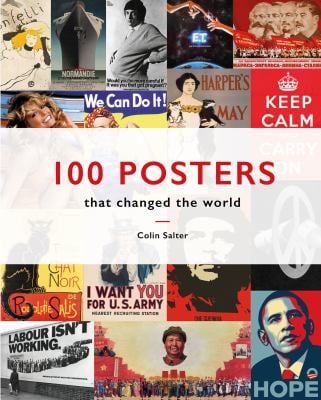
A collection of the world's most memorable, provocative, best-selling and groundbreaking posters from Johannes Gutenberg to Barack Obama. Classic posters from the last 300 years and the stories behind them. Posters have always been designed to seek an immediate response. From the time when paper was first affordable, the poster has been used to provoke a direct reaction, whether a public appeal, a legal threat, a call to arms, or the offer of entertainment. Newspapers might have the advantage of ubiquity in spreading the word, but a poster could be tightly targeted by its location. Organized chronologically, 100 Posters That Changed the World charts the history of poster design from their earliest forms as a means of information communication to the more subtle visual communication of the 21st century. As printing became cheaper, posters were used for more than just promoting the capture of local villains or announcing government decrees. Advertisements took over, citing up-and-coming events, auctions, public meetings, political rallies, sports games, lectures and theatrical performances. The technological leaps from engraving to aquatints to lithography, chromolithography and the offset press, all had their impact on what could be advertised by poster, and the art form took off spectacularly in the late 19th century with the influence of Lautrec and the Paris nightclubs. From then on, the poster became a sophisticated means of visual communication. In the West it was used to sell products - in the East it was used to sell regimes and control behaviour. Along with historic moments in poster evolution, 100 Posters That Changed the World charts the most impactful designs of the last 300 years - images that communicate a message whether commercial or political, images that sell a film, a musical, a cause or used for decoration, inspiration, motivation and affirmation. The affirmation for teenagers in the 1970s that Farah Fawcett was looking at you.
Categories
All Available Copies Find out more about shipping times from these sellers.
| Condition | Price | |||
|---|---|---|---|---|
|
eBook Obtain a digital book from our friends at eBooks.com.
|
{{ebooksDotComPrice}} {{ebooksDotComCurrency}} | eBooks.com | Digital edition from eBooks.com | |
|
Audio Book Obtain a digital book from our friends at AudiobooksNow.com.
|
{{audioBooksNowPrice}} {{audioBooksNowCurrency}} | AudiobooksNow.com | Digital edition from AudiobooksNow.com |
Professional Reviews
| Find at your local library from our friends at WorldCat | Find Libraries |
Overview
A collection of the world's most memorable, provocative, best-selling and groundbreaking posters from Johannes Gutenberg to Barack Obama. Classic posters from the last 300 years and the stories behind them. Posters have always been designed to seek a ...
Read full overview
Overview
A collection of the world's most memorable, provocative, best-selling and groundbreaking posters from Johannes Gutenberg to Barack Obama. Classic posters from the last 300 years and the stories behind them. Posters have always been designed to seek an immediate response. From the time when paper was first affordable, the poster has been used to provoke a direct reaction, whether a public appeal, a legal threat, a call to arms, or the offer of entertainment. Newspapers might have the advantage of ubiquity in spreading the word, but a poster could be tightly targeted by its location. Organized chronologically, 100 Posters That Changed the World charts the history of poster design from their earliest forms as a means of information communication to the more subtle visual communication of the 21st century. As printing became cheaper, posters were used for more than just promoting the capture of local villains or announcing government decrees. Advertisements took over, citing up-and-coming events, auctions, public meetings, political rallies, sports games, lectures and theatrical performances. The technological leaps from engraving to aquatints to lithography, chromolithography and the offset press, all had their impact on what could be advertised by poster, and the art form took off spectacularly in the late 19th century with the influence of Lautrec and the Paris nightclubs. From then on, the poster became a sophisticated means of visual communication. In the West it was used to sell products - in the East it was used to sell regimes and control behaviour. Along with historic moments in poster evolution, 100 Posters That Changed the World charts the most impactful designs of the last 300 years - images that communicate a message whether commercial or political, images that sell a film, a musical, a cause or used for decoration, inspiration, motivation and affirmation. The affirmation for teenagers in the 1970s that Farah Fawcett was looking at you.
Product Details
Professional Reviews
All Available Copies
| Condition | Source | Price | |
|---|---|---|---|
|
eBook Obtain a digital book from our friends at eBooks.com.
|
Digital edition from eBooks.com | {{ebooksDotComPrice}} {{ebooksDotComCurrency}} | eBooks.com |
|
Audio Book Obtain a digital book from our friends at AudiobooksNow.com.
|
|
{{audioBooksNowPrice}} {{audioBooksNowCurrency}} | Audiobook |
Limited Preview for '100 Posters that Changed the World' provided by Archive.org
*This is a limited preview of the contents of this book and does not directly represent the item available for sale.*
A preview for '100 Posters that Changed the World' is unavailable.
You are now leaving the Better World Books website to complete your transaction. Your eBook download will be facilitated by our friends at eBooks.com. Thank you for your support and for shopping with Better World Books!
You are now leaving the Better World Books website to complete your transaction. Your audio book download will be facilitated by our friends at AudiobooksNow.com. Thank you for your support and for shopping with Better World Books!
You are now leaving the Better World Books website. Thank you for your support and for shopping with Better World Books!