
- Track every order
- Save books to your wishlist
- Earn rewards on every order
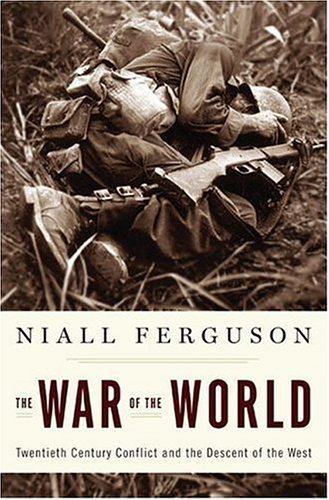
The War of the World : Twentieth-Century Conflict and the Descent of the West
3.2 (8)
Hardcover
- Other Available Editions
The War of the World : Twentieth-Century Conflict and the Descent of the West
3.2 (8)
Hardcover
- Other Available Editions
- All Available Copies
- Overview
- About the Author
- Awards
- Professional Reviews
- Reader Reviews
- Table Of Contents
- Borrow
Overview
Niall Fergusson's most important book to date-a revolutionary reinterpretation of the modern era that resolves its central paradox: why unprecedented progress coincided with unprecedented violence and why the seeming triumph of the West bore the seeds of its undoing. From the conflicts that presaged the First World War to the aftershocks of the cold war, the twentieth century was by far the bloodiest in all of human history. How can we explain the astonishing scale and intensity of its violence when, thanks to the advances of science and economics, most people were better off than ever before-eating better, growing taller, and living longer? Wherever one looked, the world in 1900 offered the happy prospect of ever-greater interconnection. Why, then, did global progress descend into internecine war and genocide? Drawing on a pioneering combination of history, economics, and evolutionary theory, Niall Ferguson-one of Timemagazine's
"100 Most Influential People"-masterfully examines what he calls the age of hatred and sets out to explain what went wrong with modernity. On a quest that takes him from the Siberian steppe to the plains of Poland, from the streets of Sarajevo to the beaches of Okinawa, Ferguson reveals an age turned upside down by economic volatility, multicultural communities torn apart by the irregularities of boom and bust, an era poisoned by the idea of irreconcilable racial differences, and a struggle between decaying old empires and predatory new states. Who won the war of the world? We tend to assume it was the West. Some even talk of the American century. But for Ferguson, the biggest upshot of twentieth-century upheaval was the decline of Western dominance over Asia. A work of revelatory interpretive power, The War of the Worldis Niall Ferguson's masterwork.
Niall Ferguson
Niall Ferguson was born April 18, 1964, in Glasgow. He is a Scottish historian. He specializes in financial and economic history as well as the history of empire. He is the Laurence A. Tisch Professor of History at Harvard University and the William Ziegler Professor of Business Administration at Harvard Business School. His books include Paper and Iron: Hamburg Business and German Politics in the Era of Inflation 1897-1927 (1993), Virtual History: Alternatives and Counterfactuals (1997), The Pity of War: Explaining World War One (1998), The World's Banker: The History of the House of Rothschild (1998), The Cash Nexus: Money and Power in the Modern World, 1700-2000 (2001), Empire: The Rise and Demise of the British World Order and the Lessons for Global Power (2003), Colossus: The Rise and Fall of the American Empire (2004), The War of the World: Twentieth-Century Conflict and the Descent of the West (2006) and The Ascent of Money: A Financial History of the World (2008), Civilization: The West and the Rest (2011) , The Great Degeneration: How Institutions Decay and Economies Die, and The Square and the Tower: Networks and Power, from the Freemasons to Facebook.
Categories
All Available Copies Find out more about shipping times from these sellers.
| Condition | Price | |||
|---|---|---|---|---|
|
Used Very Good (7 available)
Former Library Book 
|
$6.36 USD | Add To Cart |
Ships directly from Better World Books
|
|
|
Used Good (9 available)
|
$6.36 USD | Add To Cart |
Ships directly from Better World Books
|
|
|
Used Good (5 available)
Former Library Book
|
$6.36 USD | Add To Cart |
Ships directly from Better World Books
|
|
|
eBook Obtain a digital book from our friends at eBooks.com.
|
{{ebooksDotComPrice}} {{ebooksDotComCurrency}} | eBooks.com | Digital edition from eBooks.com | |
|
Audio Book Obtain a digital book from our friends at AudiobooksNow.com.
|
{{audioBooksNowPrice}} {{audioBooksNowCurrency}} | AudiobooksNow.com | Digital edition from AudiobooksNow.com |
Reader Reviews for The War of the World : Twentieth-Century Conflict and the Descent of the West
| Find at your local library from our friends at WorldCat | Find Libraries |
Overview
Niall Fergusson's most important book to date-a revolutionary reinterpretation of the modern era that resolves its central paradox: why unprecedented progress coincided with unprecedented violence and why the seeming triumph of the West bore the seed ...
Read full overview
Overview
Niall Fergusson's most important book to date-a revolutionary reinterpretation of the modern era that resolves its central paradox: why unprecedented progress coincided with unprecedented violence and why the seeming triumph of the West bore the seeds of its undoing. From the conflicts that presaged the First World War to the aftershocks of the cold war, the twentieth century was by far the bloodiest in all of human history. How can we explain the astonishing scale and intensity of its violence when, thanks to the advances of science and economics, most people were better off than ever before-eating better, growing taller, and living longer? Wherever one looked, the world in 1900 offered the happy prospect of ever-greater interconnection. Why, then, did global progress descend into internecine war and genocide? Drawing on a pioneering combination of history, economics, and evolutionary theory, Niall Ferguson-one of Timemagazine's
"100 Most Influential People"-masterfully examines what he calls the age of hatred and sets out to explain what went wrong with modernity. On a quest that takes him from the Siberian steppe to the plains of Poland, from the streets of Sarajevo to the beaches of Okinawa, Ferguson reveals an age turned upside down by economic volatility, multicultural communities torn apart by the irregularities of boom and bust, an era poisoned by the idea of irreconcilable racial differences, and a struggle between decaying old empires and predatory new states. Who won the war of the world? We tend to assume it was the West. Some even talk of the American century. But for Ferguson, the biggest upshot of twentieth-century upheaval was the decline of Western dominance over Asia. A work of revelatory interpretive power, The War of the Worldis Niall Ferguson's masterwork.
Product Details
About the Author
Niall Ferguson
Niall Ferguson was born April 18, 1964, in Glasgow. He is a Scottish historian. He specializes in financial and economic history as well as the history of empire. He is the Laurence A. Tisch Professor of History at Harvard University and the William Ziegler Professor of Business Administration at Harvard Business School. His books include Paper and Iron: Hamburg Business and German Politics in the Era of Inflation 1897-1927 (1993), Virtual History: Alternatives and Counterfactuals (1997), The Pity of War: Explaining World War One (1998), The World's Banker: The History of the House of Rothschild (1998), The Cash Nexus: Money and Power in the Modern World, 1700-2000 (2001), Empire: The Rise and Demise of the British World Order and the Lessons for Global Power (2003), Colossus: The Rise and Fall of the American Empire (2004), The War of the World: Twentieth-Century Conflict and the Descent of the West (2006) and The Ascent of Money: A Financial History of the World (2008), Civilization: The West and the Rest (2011) , The Great Degeneration: How Institutions Decay and Economies Die, and The Square and the Tower: Networks and Power, from the Freemasons to Facebook.
Reviews
Borrow
All Available Copies
| Condition | Source | Price | |
|---|---|---|---|
|
Used Very Good (7 available)
Former Library Book
Former Library Book Ships from |
Ships directly from Better World Books
|
$6.36 USD | Add To Cart |
|
Used Good (9 available)
Ships from |
Ships directly from Better World Books
|
$6.36 USD | Add To Cart |
|
Used Good (5 available)
Former Library Book
Former Library Book Ships from |
Ships directly from Better World Books
|
$6.36 USD | Add To Cart |
|
eBook Obtain a digital book from our friends at eBooks.com.
|
Digital edition from eBooks.com | {{ebooksDotComPrice}} {{ebooksDotComCurrency}} | eBooks.com |
|
Audio Book Obtain a digital book from our friends at AudiobooksNow.com.
|
|
{{audioBooksNowPrice}} {{audioBooksNowCurrency}} | Audiobook |
Limited Preview for 'The War of the World : Twentieth-Century Conflict and the Descent of the West' provided by Archive.org
*This is a limited preview of the contents of this book and does not directly represent the item available for sale.*
A preview for 'The War of the World : Twentieth-Century Conflict and the Descent of the West' is unavailable.
You are now leaving the Better World Books website to complete your transaction. Your eBook download will be facilitated by our friends at eBooks.com. Thank you for your support and for shopping with Better World Books!
You are now leaving the Better World Books website to complete your transaction. Your audio book download will be facilitated by our friends at AudiobooksNow.com. Thank you for your support and for shopping with Better World Books!
You are now leaving the Better World Books website. Thank you for your support and for shopping with Better World Books!