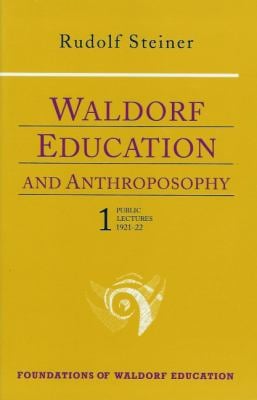
9 lectures, various cities, February 23, 1921-September 16, 1922 (CW 304) This is the first of two previously untranslated volumes of Steiner's public lectures on Waldorf education. Readers familiar with Steiner's lectures for teachers will discover here how Steiner presented his ideas to the general public with surprising directness. Teaching, Steiner says, should be artistic, creative, and improvisational, not dogmatic. Yet he is clear that the great battle concerns the spiritual nature of the child. Other themes include understanding the role of health and illness in education, as well as repeated expositions of the three major phases in child development: imitation, authority, and freedom. There are also two lectures Steiner gave in England on Shakespeare and new ideals in education. Topics include: Spiritual Science and the Great Questions of our Present Civilization Education and Practical Life from the Perspective of Spiritual Science Knowledge of Health and Illness in Education The Fundamentals of Waldorf Education Educational Methods Based on Anthroposophy Education and Drama Shakespeare and the New Ideals German source: Erziehungs- und Unterrichtsmethoden auf Anthroposophischer Grundlage (GA 304).
Austrian-born Rudolf Steiner was a noted Goethe (see Vol. 2) scholar and private student of the occult who became involved with Theosophy in Germany in 1902, when he met Annie Besant (1847--1933), a devoted follower of Madame Helena P. Blavatsky (1831--1891). In 1912 he broke with the Theosophists because of what he regarded as their oriental bias and established a system of his own, which he called Anthroposophy (anthro meaning "man"; sophia sophia meaning "wisdom"), a "spiritual science" he hoped would restore humanism to a materialistic world. In 1923 he set up headquarters for the Society of Anthroposophy in New York City. Steiner believed that human beings had evolved to the point where material existence had obscured spiritual capacities and that Christ had come to reverse that trend and to inaugurate an age of spiritual reintegration. He advocated that education, art, agriculture, and science be based on spiritual principles and infused with the psychic powers he believed were latent in everyone. The world center of the Anhthroposophical Society today is in Dornach, Switzerland, in a building designed by Steiner. The nonproselytizing society is noted for its schools.
| Condition | Price | |||
|---|---|---|---|---|
|
eBook Obtain a digital book from our friends at eBooks.com.
|
{{ebooksDotComPrice}} {{ebooksDotComCurrency}} | eBooks.com | Digital edition from eBooks.com | |
|
Audio Book Obtain a digital book from our friends at AudiobooksNow.com.
|
{{audioBooksNowPrice}} {{audioBooksNowCurrency}} | AudiobooksNow.com | Digital edition from AudiobooksNow.com |
| Find at your local library from our friends at WorldCat | Find Libraries |
9 lectures, various cities, February 23, 1921-September 16, 1922 (CW 304) This is the first of two previously untranslated volumes of Steiner's public lectures on Waldorf education. Readers familiar with Steiner's lectures for teachers will discover ...
Read full overview
9 lectures, various cities, February 23, 1921-September 16, 1922 (CW 304) This is the first of two previously untranslated volumes of Steiner's public lectures on Waldorf education. Readers familiar with Steiner's lectures for teachers will discover here how Steiner presented his ideas to the general public with surprising directness. Teaching, Steiner says, should be artistic, creative, and improvisational, not dogmatic. Yet he is clear that the great battle concerns the spiritual nature of the child. Other themes include understanding the role of health and illness in education, as well as repeated expositions of the three major phases in child development: imitation, authority, and freedom. There are also two lectures Steiner gave in England on Shakespeare and new ideals in education. Topics include: Spiritual Science and the Great Questions of our Present Civilization Education and Practical Life from the Perspective of Spiritual Science Knowledge of Health and Illness in Education The Fundamentals of Waldorf Education Educational Methods Based on Anthroposophy Education and Drama Shakespeare and the New Ideals German source: Erziehungs- und Unterrichtsmethoden auf Anthroposophischer Grundlage (GA 304).
Austrian-born Rudolf Steiner was a noted Goethe (see Vol. 2) scholar and private student of the occult who became involved with Theosophy in Germany in 1902, when he met Annie Besant (1847--1933), a devoted follower of Madame Helena P. Blavatsky (1831--1891). In 1912 he broke with the Theosophists because of what he regarded as their oriental bias and established a system of his own, which he called Anthroposophy (anthro meaning "man"; sophia sophia meaning "wisdom"), a "spiritual science" he hoped would restore humanism to a materialistic world. In 1923 he set up headquarters for the Society of Anthroposophy in New York City. Steiner believed that human beings had evolved to the point where material existence had obscured spiritual capacities and that Christ had come to reverse that trend and to inaugurate an age of spiritual reintegration. He advocated that education, art, agriculture, and science be based on spiritual principles and infused with the psychic powers he believed were latent in everyone. The world center of the Anhthroposophical Society today is in Dornach, Switzerland, in a building designed by Steiner. The nonproselytizing society is noted for its schools.
| Condition | Source | Price | |
|---|---|---|---|
|
eBook Obtain a digital book from our friends at eBooks.com.
|
Digital edition from eBooks.com | {{ebooksDotComPrice}} {{ebooksDotComCurrency}} | eBooks.com |
|
Audio Book Obtain a digital book from our friends at AudiobooksNow.com.
|
|
{{audioBooksNowPrice}} {{audioBooksNowCurrency}} | Audiobook |
*This is a limited preview of the contents of this book and does not directly represent the item available for sale.*
You are now leaving the Better World Books website to complete your transaction. Your eBook download will be facilitated by our friends at eBooks.com. Thank you for your support and for shopping with Better World Books!
You are now leaving the Better World Books website to complete your transaction. Your audio book download will be facilitated by our friends at AudiobooksNow.com. Thank you for your support and for shopping with Better World Books!
You are now leaving the Better World Books website. Thank you for your support and for shopping with Better World Books!