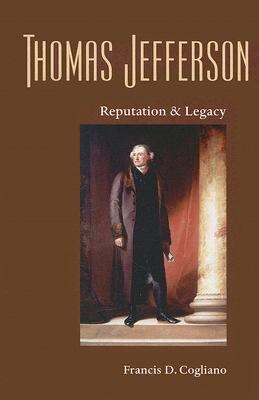
In his probing new study, Francis Cogliano focuses on Thomas Jefferson's relation to history, both as the context in which he lived, and as something he made considerable, and conscious, efforts to influence. He was acutely aware that he would be judged by posterity, and he believed that the fate of the republican experiment depended to a large extent on how it was rendered by historians.The first half of the book situates Jefferson's ideas about history within the context of eighteenth-century historical thought. It then considers the efforts Jefferson made to shape the way the history of his life and times would be written: through the careful preservation of most of his personal and public papers, and through the institutions he left behind, including his home, Monticello, and the University of Virginia. The second half of the book considers the results of Jefferson's efforts to shape historical writings about himself and his period, which have issued forth in an unbroken stream from his day to our own. Although Jefferson seemed to have achieved apotheosis in the years following World War II, his rise above controversy was short-lived. Earlier political questions were replaced by arguments over race, class, and gender, and recent scholarship has criticized Jefferson's attitudes and actions with regard to civil liberties, Native Americans, slaves, and women, not least in the context of debates surrounding his relationship with his slave, Sally Hemings. Our complex feelings about Jefferson's relation to these issues are a reflection of the man who helped engineer their place in our historical discourse.
| Condition | Price | |||
|---|---|---|---|---|
|
eBook Obtain a digital book from our friends at eBooks.com.
|
{{ebooksDotComPrice}} {{ebooksDotComCurrency}} | eBooks.com | Digital edition from eBooks.com | |
|
Audio Book Obtain a digital book from our friends at AudiobooksNow.com.
|
{{audioBooksNowPrice}} {{audioBooksNowCurrency}} | AudiobooksNow.com | Digital edition from AudiobooksNow.com |
| Acknowledgments | p. vii |
| Abbreviations | p. xi |
| Introduction: The Estimation of the World | p. 1 |
| History | p. 19 |
| The Revolution | p. 44 |
| Jefferson's Papers | p. 74 |
| Monticello | p. 106 |
| Jefferson's Epitaph | p. 137 |
| Sally Hemings | p. 170 |
| Slavery | p. 199 |
| America and the World | p. 230 |
| Conclusion: Jefferson Survives | p. 259 |
| Index | p. 269 |
| Table of Contents provided by Ingram. All Rights Reserved. |
| Find at your local library from our friends at WorldCat | Find Libraries |
In his probing new study, Francis Cogliano focuses on Thomas Jefferson's relation to history, both as the context in which he lived, and as something he made considerable, and conscious, efforts to influence. He was acutely aware that he would be jud ...
Read full overview
In his probing new study, Francis Cogliano focuses on Thomas Jefferson's relation to history, both as the context in which he lived, and as something he made considerable, and conscious, efforts to influence. He was acutely aware that he would be judged by posterity, and he believed that the fate of the republican experiment depended to a large extent on how it was rendered by historians.The first half of the book situates Jefferson's ideas about history within the context of eighteenth-century historical thought. It then considers the efforts Jefferson made to shape the way the history of his life and times would be written: through the careful preservation of most of his personal and public papers, and through the institutions he left behind, including his home, Monticello, and the University of Virginia. The second half of the book considers the results of Jefferson's efforts to shape historical writings about himself and his period, which have issued forth in an unbroken stream from his day to our own. Although Jefferson seemed to have achieved apotheosis in the years following World War II, his rise above controversy was short-lived. Earlier political questions were replaced by arguments over race, class, and gender, and recent scholarship has criticized Jefferson's attitudes and actions with regard to civil liberties, Native Americans, slaves, and women, not least in the context of debates surrounding his relationship with his slave, Sally Hemings. Our complex feelings about Jefferson's relation to these issues are a reflection of the man who helped engineer their place in our historical discourse.
| Acknowledgments | p. vii |
| Abbreviations | p. xi |
| Introduction: The Estimation of the World | p. 1 |
| History | p. 19 |
| The Revolution | p. 44 |
| Jefferson's Papers | p. 74 |
| Monticello | p. 106 |
| Jefferson's Epitaph | p. 137 |
| Sally Hemings | p. 170 |
| Slavery | p. 199 |
| America and the World | p. 230 |
| Conclusion: Jefferson Survives | p. 259 |
| Index | p. 269 |
| Table of Contents provided by Ingram. All Rights Reserved. |
| Condition | Source | Price | |
|---|---|---|---|
|
eBook Obtain a digital book from our friends at eBooks.com.
|
Digital edition from eBooks.com | {{ebooksDotComPrice}} {{ebooksDotComCurrency}} | eBooks.com |
|
Audio Book Obtain a digital book from our friends at AudiobooksNow.com.
|
|
{{audioBooksNowPrice}} {{audioBooksNowCurrency}} | Audiobook |
*This is a limited preview of the contents of this book and does not directly represent the item available for sale.*
You are now leaving the Better World Books website to complete your transaction. Your eBook download will be facilitated by our friends at eBooks.com. Thank you for your support and for shopping with Better World Books!
You are now leaving the Better World Books website to complete your transaction. Your audio book download will be facilitated by our friends at AudiobooksNow.com. Thank you for your support and for shopping with Better World Books!
You are now leaving the Better World Books website. Thank you for your support and for shopping with Better World Books!