
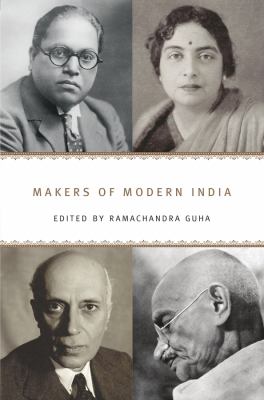
Makers of Modern India
Paperback
- Other Available Editions
- Other Available Editions
- All Available Copies
- Overview
- About the Author
- Awards
- Professional Reviews
- Reader Reviews
- Table Of Contents
- Borrow
Overview
Modern India is the world's largest democracy, a sprawling, polyglot nation containing one-sixth of all humankind. The existence of such a complex and distinctive democratic regime qualifies as one of the world's bona fide political miracles. Furthermore, India's leading political thinkers have often served as its most influential political actors--think of Gandhi, whose collected works run to more than ninety volumes, or Ambedkar, or Nehru, who recorded their most eloquent theoretical reflections at the same time as they strove to set the delicate machinery of Indian democracy on a coherent and just path. Out of the speeches and writings of these thinker-activists, Ramachandra Guha has built the first major anthology of Indian social and political thought. Makers of Modern India collects the work of nineteen of India's foremost generators of political sentiment, from those whose names command instant global recognition to pioneering subaltern and feminist thinkers whose works have until now remained obscure and inaccessible. Ranging across manifold languages and cultures, and addressing every crucial theme of modern Indian history--race, religion, language, caste, gender, colonialism, nationalism, economic development, violence, and nonviolence-- Makers of Modern India provides an invaluable roadmap to Indian political debate. An extensive introduction, biographical sketches of each figure, and guides to further reading make this work a rich resource for anyone interested in India and the ways its leading political minds have grappled with the problems that have increasingly come to define the modern world.
Categories
All Available Copies Find out more about shipping times from these sellers.
| Condition | Price | |||
|---|---|---|---|---|
New (135 available)

Ships Separately |
$31.44 USD | Add To Cart | Ships separately from Better World Books suppliers | |
|
eBook Obtain a digital book from our friends at eBooks.com.
|
{{ebooksDotComPrice}} {{ebooksDotComCurrency}} | eBooks.com | Digital edition from eBooks.com | |
|
Audio Book Obtain a digital book from our friends at AudiobooksNow.com.
|
{{audioBooksNowPrice}} {{audioBooksNowCurrency}} | AudiobooksNow.com | Digital edition from AudiobooksNow.com |
Professional Reviews
Table Of Contents
| Prologue | |
| Thinking through India | p. 1 |
| The Opening of the Indian Mind | |
| Introduction to Part One | p. 23 |
| The First Liberal: Rammohan Roy | p. 26 |
| Relations between Men and Women | p. 30 |
| The Freedom of the Press | p. 33 |
| The Need for Modern Education | p. 40 |
| Reformers and Radicals | |
| Introduction to Part Two | p. 47 |
| The Muslim Modernist: Syed Ahmad Khan | p. 53 |
| Educating the Muslims | p. 56 |
| A Modern Curriculum | p. 61 |
| The Two Eyes of India | p. 65 |
| Politics and Discord | p. 66 |
| The Agrarian Radical: Jotirao Phule | p. 71 |
| Educating the Masses | p. 74 |
| The Condition of the Peasantry | p. 80 |
| The Liberal Reformer: G. K. Gokhale | p. 92 |
| Elevating the Depressed Classes | p. 94 |
| On Hindu-Muslim Co-operation | p. 98 |
| A Call to Service | p. 103 |
| The Militant Nationalist: Bal Gangadhar Tilak | p. 107 |
| The Need for a National Hero | p. 110 |
| The Necessity for a Militant Nationalism | p. 112 |
| The Subaltern Feminist: Tarabai Shinde | p. 119 |
| A Comparison of Men and Women | p. 121 |
| Nurturing a Nation | |
| Introduction to Part Three | p. 131 |
| The Multiple Agendas of M. K. Gandhi | p. 136 |
| The Power of Non-violence | p. 139 |
| 'Non-co-operationÆ with the British Raj | p. 144 |
| The Abolition of Untouchability | p. 148 |
| Hindu-Muslim Unity and Inter-faith Dialogue | p. 157 |
| The Position of Women | p. 165 |
| The Rooted Cosmopolitan: Rabindranath Tagore | p. 170 |
| India and the West | p. 172 |
| The Excesses of Nationalism | p. 177 |
| The Problem with Non-co-operation | p. 183 |
| The Annihilator of Caste: B. R. Ambedkar | p. 187 |
| The Revolution against Caste | p. 190 |
| How to Annihilate Caste | p. 195 |
| Why the Untouchables Distrust Gandhi | p. 201 |
| The Muslim Separatist: Muhammad Ali Jinnah | p. 209 |
| The Steps towards a Muslim Nation | p. 212 |
| The Radical Reformer: E. V. Ramaswami | p. 222 |
| The Fraud of Religion | p. 224 |
| On the Rights of Widows | p. 233 |
| The Case for Contraception | p. 237 |
| The Constraints of Marriage | p. 238 |
| The Socialist Feminist: Kamaladevi Chattopadhyay | p. 241 |
| The Women's Movement in Perspective | p. 243 |
| A Socialist View of the Communal Question | p. 251 |
| The Renewed Agendas of M. K. Gandhi | p. 257 |
| Re-visiting Nationalism | p. 258 |
| Re-visiting Caste | p. 260 |
| Re-visiting Hindu-Muslim Co-operation | p. 265 |
| Village Renewal and Political Decentralisation | p. 276 |
| Debating Democracy | |
| Introduction to Part Four | p. 283 |
| The Wise Democrat: B. R. Ambedkar | p. 287 |
| The Indian Constitution Defended and Interpreted | p. 288 |
| The Multiple Agendas of Jawaharlal Nehru | p. 299 |
| The Treatment of Minorities | p. 301 |
| On Planning and Economic Policy | p. 308 |
| Asia Redux | p. 312 |
| India in the World | p. 318 |
| The Conflict with China | p. 324 |
| The Rights of Women | p. 331 |
| The Hindu Supremacist: M. S. Golwalkar | p. 338 |
| The Hindu Nation and Its Enemies | p. 341 |
| The Muslim Threat | p. 344 |
| Not Socialism but Hindurashtra | p. 346 |
| The Indigenous Socialist: Rammanohar Lohia | p. 351 |
| Caste and Class | p. 353 |
| Banish English | p. 363 |
| The Grassroots Socialist: Jayaprakash Narayan | p. 368 |
| A Plea for Political Decentralisation | p. 371 |
| The Tragedy of Tibet | p. 378 |
| A Fair Deal for Kashmir | p. 386 |
| The Question of Nagaland | p. 389 |
| The Gandhian Liberal: C. Rajagopalachari | p. 394 |
| Our Democracy | p. 397 |
| Wanted: Independent Thinking | p. 401 |
| The Case for the Swatantra Party | p. 405 |
| Reforming the System of Elections in India | p. 409 |
| Freeing the Economy | p. 413 |
| Assisting the Backward | p. 416 |
| Why We Need English | p. 418 |
| The India We Want | p. 422 |
| The Defender of the Tribals: Verrier Elwin | p. 425 |
| Freedom for the Tribals | p. 427 |
| Neither Isolation nor Assimilation | p. 434 |
| A Tradition Re-Affirmed | |
| Introduction to Part Five | p. 441 |
| The Last Modernist: Hamid Dalwai | p. 444 |
| The Burden of History | p. 446 |
| The Challenge of Secularism | p. 450 |
| For a United Front of Liberals | p. 453 |
| Epilogue: India in the World | p. 457 |
| Guide to Further Reading | p. 477 |
| Acknowledgements | p. 489 |
| Index | p. 491 |
| Table of Contents provided by Ingram. All Rights Reserved. |
| Find at your local library from our friends at WorldCat | Find Libraries |
Overview
Modern India is the world's largest democracy, a sprawling, polyglot nation containing one-sixth of all humankind. The existence of such a complex and distinctive democratic regime qualifies as one of the world's bona fide political miracles. Further ...
Read full overview
Overview
Modern India is the world's largest democracy, a sprawling, polyglot nation containing one-sixth of all humankind. The existence of such a complex and distinctive democratic regime qualifies as one of the world's bona fide political miracles. Furthermore, India's leading political thinkers have often served as its most influential political actors--think of Gandhi, whose collected works run to more than ninety volumes, or Ambedkar, or Nehru, who recorded their most eloquent theoretical reflections at the same time as they strove to set the delicate machinery of Indian democracy on a coherent and just path. Out of the speeches and writings of these thinker-activists, Ramachandra Guha has built the first major anthology of Indian social and political thought. Makers of Modern India collects the work of nineteen of India's foremost generators of political sentiment, from those whose names command instant global recognition to pioneering subaltern and feminist thinkers whose works have until now remained obscure and inaccessible. Ranging across manifold languages and cultures, and addressing every crucial theme of modern Indian history--race, religion, language, caste, gender, colonialism, nationalism, economic development, violence, and nonviolence-- Makers of Modern India provides an invaluable roadmap to Indian political debate. An extensive introduction, biographical sketches of each figure, and guides to further reading make this work a rich resource for anyone interested in India and the ways its leading political minds have grappled with the problems that have increasingly come to define the modern world.
Product Details
Professional Reviews
Table Of Contents
| Prologue | |
| Thinking through India | p. 1 |
| The Opening of the Indian Mind | |
| Introduction to Part One | p. 23 |
| The First Liberal: Rammohan Roy | p. 26 |
| Relations between Men and Women | p. 30 |
| The Freedom of the Press | p. 33 |
| The Need for Modern Education | p. 40 |
| Reformers and Radicals | |
| Introduction to Part Two | p. 47 |
| The Muslim Modernist: Syed Ahmad Khan | p. 53 |
| Educating the Muslims | p. 56 |
| A Modern Curriculum | p. 61 |
| The Two Eyes of India | p. 65 |
| Politics and Discord | p. 66 |
| The Agrarian Radical: Jotirao Phule | p. 71 |
| Educating the Masses | p. 74 |
| The Condition of the Peasantry | p. 80 |
| The Liberal Reformer: G. K. Gokhale | p. 92 |
| Elevating the Depressed Classes | p. 94 |
| On Hindu-Muslim Co-operation | p. 98 |
| A Call to Service | p. 103 |
| The Militant Nationalist: Bal Gangadhar Tilak | p. 107 |
| The Need for a National Hero | p. 110 |
| The Necessity for a Militant Nationalism | p. 112 |
| The Subaltern Feminist: Tarabai Shinde | p. 119 |
| A Comparison of Men and Women | p. 121 |
| Nurturing a Nation | |
| Introduction to Part Three | p. 131 |
| The Multiple Agendas of M. K. Gandhi | p. 136 |
| The Power of Non-violence | p. 139 |
| 'Non-co-operationÆ with the British Raj | p. 144 |
| The Abolition of Untouchability | p. 148 |
| Hindu-Muslim Unity and Inter-faith Dialogue | p. 157 |
| The Position of Women | p. 165 |
| The Rooted Cosmopolitan: Rabindranath Tagore | p. 170 |
| India and the West | p. 172 |
| The Excesses of Nationalism | p. 177 |
| The Problem with Non-co-operation | p. 183 |
| The Annihilator of Caste: B. R. Ambedkar | p. 187 |
| The Revolution against Caste | p. 190 |
| How to Annihilate Caste | p. 195 |
| Why the Untouchables Distrust Gandhi | p. 201 |
| The Muslim Separatist: Muhammad Ali Jinnah | p. 209 |
| The Steps towards a Muslim Nation | p. 212 |
| The Radical Reformer: E. V. Ramaswami | p. 222 |
| The Fraud of Religion | p. 224 |
| On the Rights of Widows | p. 233 |
| The Case for Contraception | p. 237 |
| The Constraints of Marriage | p. 238 |
| The Socialist Feminist: Kamaladevi Chattopadhyay | p. 241 |
| The Women's Movement in Perspective | p. 243 |
| A Socialist View of the Communal Question | p. 251 |
| The Renewed Agendas of M. K. Gandhi | p. 257 |
| Re-visiting Nationalism | p. 258 |
| Re-visiting Caste | p. 260 |
| Re-visiting Hindu-Muslim Co-operation | p. 265 |
| Village Renewal and Political Decentralisation | p. 276 |
| Debating Democracy | |
| Introduction to Part Four | p. 283 |
| The Wise Democrat: B. R. Ambedkar | p. 287 |
| The Indian Constitution Defended and Interpreted | p. 288 |
| The Multiple Agendas of Jawaharlal Nehru | p. 299 |
| The Treatment of Minorities | p. 301 |
| On Planning and Economic Policy | p. 308 |
| Asia Redux | p. 312 |
| India in the World | p. 318 |
| The Conflict with China | p. 324 |
| The Rights of Women | p. 331 |
| The Hindu Supremacist: M. S. Golwalkar | p. 338 |
| The Hindu Nation and Its Enemies | p. 341 |
| The Muslim Threat | p. 344 |
| Not Socialism but Hindurashtra | p. 346 |
| The Indigenous Socialist: Rammanohar Lohia | p. 351 |
| Caste and Class | p. 353 |
| Banish English | p. 363 |
| The Grassroots Socialist: Jayaprakash Narayan | p. 368 |
| A Plea for Political Decentralisation | p. 371 |
| The Tragedy of Tibet | p. 378 |
| A Fair Deal for Kashmir | p. 386 |
| The Question of Nagaland | p. 389 |
| The Gandhian Liberal: C. Rajagopalachari | p. 394 |
| Our Democracy | p. 397 |
| Wanted: Independent Thinking | p. 401 |
| The Case for the Swatantra Party | p. 405 |
| Reforming the System of Elections in India | p. 409 |
| Freeing the Economy | p. 413 |
| Assisting the Backward | p. 416 |
| Why We Need English | p. 418 |
| The India We Want | p. 422 |
| The Defender of the Tribals: Verrier Elwin | p. 425 |
| Freedom for the Tribals | p. 427 |
| Neither Isolation nor Assimilation | p. 434 |
| A Tradition Re-Affirmed | |
| Introduction to Part Five | p. 441 |
| The Last Modernist: Hamid Dalwai | p. 444 |
| The Burden of History | p. 446 |
| The Challenge of Secularism | p. 450 |
| For a United Front of Liberals | p. 453 |
| Epilogue: India in the World | p. 457 |
| Guide to Further Reading | p. 477 |
| Acknowledgements | p. 489 |
| Index | p. 491 |
| Table of Contents provided by Ingram. All Rights Reserved. |
Borrow
All Available Copies
| Condition | Source | Price | |
|---|---|---|---|
|
New (135 available)
Ships Separately |
Ships separately from Better World Books suppliers | $31.44 USD | Add To Cart |
|
eBook Obtain a digital book from our friends at eBooks.com.
|
Digital edition from eBooks.com | {{ebooksDotComPrice}} {{ebooksDotComCurrency}} | eBooks.com |
|
Audio Book Obtain a digital book from our friends at AudiobooksNow.com.
|
|
{{audioBooksNowPrice}} {{audioBooksNowCurrency}} | Audiobook |
Limited Preview for 'Makers of Modern India' provided by Archive.org
*This is a limited preview of the contents of this book and does not directly represent the item available for sale.*
A preview for 'Makers of Modern India' is unavailable.
You are now leaving the Better World Books website to complete your transaction. Your eBook download will be facilitated by our friends at eBooks.com. Thank you for your support and for shopping with Better World Books!
You are now leaving the Better World Books website to complete your transaction. Your audio book download will be facilitated by our friends at AudiobooksNow.com. Thank you for your support and for shopping with Better World Books!
You are now leaving the Better World Books website. Thank you for your support and for shopping with Better World Books!