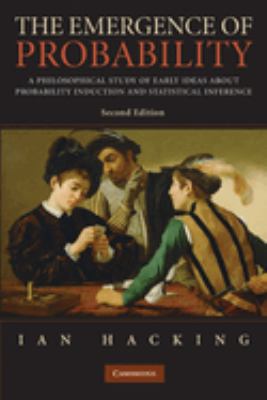
Historical records show that there was no real concept of probability in Europe before the mid-seventeenth century, although the use of dice and other randomizing objects was commonplace. Ian Hacking presents a philosophical critique of early ideas about probability, induction, and statistical inference and the growth of this new family of ideas in the fifteenth, sixteenth, and seventeenth centuries. Hacking invokes a wide intellectual framework involving the growth of science, economics, and the theology of the period. He argues that the transformations that made it possible for probability concepts to emerge have constrained all subsequent development of probability theory and determine the space within which philosophical debate on the subject is still conducted. First published in 1975, this edition includes an introduction that contextualizes his book in light of developing philosophical trends. Ian Hacking is the winner of the Holberg International Memorial Prize 2009.
| Condition | Price | |||
|---|---|---|---|---|
|
New (321 available)
Ships Separately |
$22.54 USD | Add To Cart | Ships separately from Better World Books suppliers | |
|
eBook Obtain a digital book from our friends at eBooks.com.
|
{{ebooksDotComPrice}} {{ebooksDotComCurrency}} | eBooks.com | Digital edition from eBooks.com | |
|
Audio Book Obtain a digital book from our friends at AudiobooksNow.com.
|
{{audioBooksNowPrice}} {{audioBooksNowCurrency}} | AudiobooksNow.com | Digital edition from AudiobooksNow.com |
| Find at your local library from our friends at WorldCat | Find Libraries |
Historical records show that there was no real concept of probability in Europe before the mid-seventeenth century, although the use of dice and other randomizing objects was commonplace. Ian Hacking presents a philosophical critique of early ideas a ...
Read full overview
Historical records show that there was no real concept of probability in Europe before the mid-seventeenth century, although the use of dice and other randomizing objects was commonplace. Ian Hacking presents a philosophical critique of early ideas about probability, induction, and statistical inference and the growth of this new family of ideas in the fifteenth, sixteenth, and seventeenth centuries. Hacking invokes a wide intellectual framework involving the growth of science, economics, and the theology of the period. He argues that the transformations that made it possible for probability concepts to emerge have constrained all subsequent development of probability theory and determine the space within which philosophical debate on the subject is still conducted. First published in 1975, this edition includes an introduction that contextualizes his book in light of developing philosophical trends. Ian Hacking is the winner of the Holberg International Memorial Prize 2009.
| Condition | Source | Price | |
|---|---|---|---|
|
New (321 available)
Ships Separately |
Ships separately from Better World Books suppliers | $22.54 USD | Add To Cart |
|
eBook Obtain a digital book from our friends at eBooks.com.
|
Digital edition from eBooks.com | {{ebooksDotComPrice}} {{ebooksDotComCurrency}} | eBooks.com |
|
Audio Book Obtain a digital book from our friends at AudiobooksNow.com.
|
|
{{audioBooksNowPrice}} {{audioBooksNowCurrency}} | Audiobook |
*This is a limited preview of the contents of this book and does not directly represent the item available for sale.*
You are now leaving the Better World Books website to complete your transaction. Your eBook download will be facilitated by our friends at eBooks.com. Thank you for your support and for shopping with Better World Books!
You are now leaving the Better World Books website to complete your transaction. Your audio book download will be facilitated by our friends at AudiobooksNow.com. Thank you for your support and for shopping with Better World Books!
You are now leaving the Better World Books website. Thank you for your support and for shopping with Better World Books!