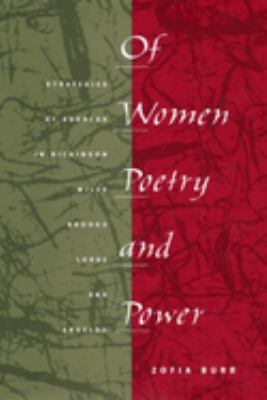
The haunting legacy of Emily Dickinson's life and work have shaped a romantic conception of poetry as private, personal, and expressive that has governed the reception of subsequent American women poets. Of Women, Poetry, and Power demonstrates how the canonization of Dickinson has consolidated limiting assumptions about women's poetry in twentieth-century America and models an alternative reading practice that allows for deeper engagement with the political work of modern poetry. Analyzing the reception of poems by Josephine Miles, Gwendolyn Brooks, Audre Lorde, and Maya Angelou, Zofia Burr shows the persistence of these critical outlooks and dispels the belief that we have long since moved beyond such limiting gendered expectations. Turning away from an obsessive concern with a poet's biography, Burr's readings of contemporary women's poetry accentuate its engagement and provocation of readers through its forms of address. Burr shows how displacing the limits of dominant reception is possible by approaching poetry as communicative utterance, not just as self-expression.
| Condition | Price | |||
|---|---|---|---|---|
|
eBook Obtain a digital book from our friends at eBooks.com.
|
{{ebooksDotComPrice}} {{ebooksDotComCurrency}} | eBooks.com | Digital edition from eBooks.com | |
|
Audio Book Obtain a digital book from our friends at AudiobooksNow.com.
|
{{audioBooksNowPrice}} {{audioBooksNowCurrency}} | AudiobooksNow.com | Digital edition from AudiobooksNow.com |
| Find at your local library from our friends at WorldCat | Find Libraries |
The haunting legacy of Emily Dickinson's life and work have shaped a romantic conception of poetry as private, personal, and expressive that has governed the reception of subsequent American women poets. Of Women, Poetry, and Power demonstrates how t ...
Read full overview
The haunting legacy of Emily Dickinson's life and work have shaped a romantic conception of poetry as private, personal, and expressive that has governed the reception of subsequent American women poets. Of Women, Poetry, and Power demonstrates how the canonization of Dickinson has consolidated limiting assumptions about women's poetry in twentieth-century America and models an alternative reading practice that allows for deeper engagement with the political work of modern poetry. Analyzing the reception of poems by Josephine Miles, Gwendolyn Brooks, Audre Lorde, and Maya Angelou, Zofia Burr shows the persistence of these critical outlooks and dispels the belief that we have long since moved beyond such limiting gendered expectations. Turning away from an obsessive concern with a poet's biography, Burr's readings of contemporary women's poetry accentuate its engagement and provocation of readers through its forms of address. Burr shows how displacing the limits of dominant reception is possible by approaching poetry as communicative utterance, not just as self-expression.
| Condition | Source | Price | |
|---|---|---|---|
|
eBook Obtain a digital book from our friends at eBooks.com.
|
Digital edition from eBooks.com | {{ebooksDotComPrice}} {{ebooksDotComCurrency}} | eBooks.com |
|
Audio Book Obtain a digital book from our friends at AudiobooksNow.com.
|
|
{{audioBooksNowPrice}} {{audioBooksNowCurrency}} | Audiobook |
*This is a limited preview of the contents of this book and does not directly represent the item available for sale.*
You are now leaving the Better World Books website to complete your transaction. Your eBook download will be facilitated by our friends at eBooks.com. Thank you for your support and for shopping with Better World Books!
You are now leaving the Better World Books website to complete your transaction. Your audio book download will be facilitated by our friends at AudiobooksNow.com. Thank you for your support and for shopping with Better World Books!
You are now leaving the Better World Books website. Thank you for your support and for shopping with Better World Books!