
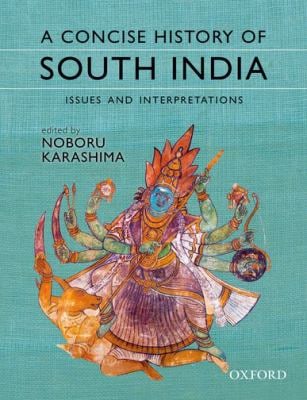
A Concise History of South India : Issues and Interpretations
Paperback
- All Available Copies
- Overview
- About the Author
- Awards
- Professional Reviews
- Reader Reviews
- Table Of Contents
- Borrow
Overview
The course of south Indian history from pre-historic times to the contemporary era is a complex narrative with many interpretations. Reflecting recent advances in the study of the region, this volume provides an assessment of the events and socio-cultural development of south India through a comprehensive analysis of its historical trajectory. Investigating the region's states and configurations, this book covers a wide range of topics that include the origins of the early inhabitants, formation of the ancient kingdoms, advancement of agriculture, new religious movements based on bhakti, and consolidation of centralized states in the medieval period. It further explores the growth of industries in relation to the development of East-West maritime trade in the Indian Ocean as well as the wave of Islamicization and the course of commercial relations with various European countries. The book then goes on to discuss the advent of early-modern state rule, impact of the raiyatwari system introduced by the British, debates about whether the region's economy developed or deteriorated during the eighteenth century, decline of matriliny in Kerala, emergence of the Dravidian Movement, and the intertwining of politics with contemporary popular culture. Well illustrated with maps and images, and incorporating new archaeological evidence and historiography, this volume presents new perspectives on a gamut of issues relating to communities, languages, and cultures of a macro-region that continues to fascinate scholars and readers alike.
Categories
All Available Copies Find out more about shipping times from these sellers.
| Condition | Price | |||
|---|---|---|---|---|
|
eBook Obtain a digital book from our friends at eBooks.com.
|
{{ebooksDotComPrice}} {{ebooksDotComCurrency}} | eBooks.com | Digital edition from eBooks.com | |
|
Audio Book Obtain a digital book from our friends at AudiobooksNow.com.
|
{{audioBooksNowPrice}} {{audioBooksNowCurrency}} | AudiobooksNow.com | Digital edition from AudiobooksNow.com |
Table Of Contents
| List of Illustrations | p. xi |
| Preface | p. xvii |
| Note on Abbreviations, Diacritical Marks, and Bibliographies | p. xxi |
| Prologue: Dravidians-Immigrant or Indigenous | p. 1 |
| Before the Common Era: Beginnings of South Indian History | p. 8 |
| Prehistoric cultures | p. 18 |
| Palaeolithic cultures | p. 18 |
| Neolithic culture | p. 12 |
| Megalithic burials and graffiti | p. 15 |
| Megalithic burials | p. 15 |
| Graffiti | p. 24 |
| Beginnings of south Indian history | p. 25 |
| The Brahmi script and south Indian languages | p. 31 |
| First Century BCE to Fifth Century CE: The Satavahanas, the Early Tamil Polities, and Their Successors | p. 40 |
| The Satavahanas in the Deccan | p. 40 |
| Sangam and post-Sangam literature | p. 43 |
| Sangam literature (c. 100 BCE to 300 CE) | p. 43 |
| Post-Sangam literature (c. 300-600 CE) | p. 46 |
| Early Tamil polity | p. 147 |
| The rulers | p. 47 |
| Political organization | p. 53 |
| Post-Satavahana and post-Sangam polities | p. 55 |
| Religion and religious monuments in early south India | p. 63 |
| Religion as known from archaeological monuments | p. 63 |
| Religion in early Tamil country as known from literature | p. 67 |
| Roman trade and contacts with Southeast Asia | p. 170 |
| Roman trade | p. 70 |
| Contact with Southeast Asia | p. 76 |
| Sixth Century to Ninth Century: The New-Type States and the Bhakti Movement | p. 84 |
| The emergence of a new type of state | p. 84 |
| Kingship and statecraft | p. 89 |
| Agrarian developments | p. 92 |
| Capitals and temples | p. 198 |
| Capitals | p. 98 |
| Temples | p. 100 |
| The bhakti movement | p. 106 |
| Synthesis of southern and northern traditions | p. 106 |
| Nayanars and alvars | p. 109 |
| The bhakti movement and the state | p. 112 |
| Women in premodern south Indian society | p. 115 |
| The Tenth to Twelfth Centuries: The Emergence of a Centralized State | p. 124 |
| The balance of two powers | p. 124 |
| The Chola stare: Centralized or segmentary? | p. 128 |
| Changes in landholding system and society | p. 135 |
| Maritime trade and merchant activities | p. 139 |
| States in the Deccan and Kerala | p. 143 |
| Religion and society | p. 147 |
| Language and literature | p. 151 |
| Development of local languages and the dawn of Kannada and Telugu literature | p. 151 |
| Development of Tamil literature and the emergence of new trends | p. 153 |
| Temples and sculpture | p. 157 |
| The Tamil region | p. 157 |
| The other regions | p. 161 |
| Thirteenth and Fourteenth Centuries: Period of Social Change and Transition | p. 172 |
| The fall of the old states | p. 172 |
| Emergence of new jatis and supra-local/community organizations | p. 175 |
| Mathas, Saivasiddhantism, and Virasaivism | p. 183 |
| Fifteenth Century to Seventeenth Century: Vijayanagar State and the Wider World | p. 188 |
| Vijayanagar and the sultanates in the Deccan | p. 188 |
| Vijayanagar state and the nayakas | p. 194 |
| The nayaka system | p. 194 |
| Early polity | p. 198 |
| Development of trade and industry | p. 203 |
| 'Hindu Sultan' and religions | p. 209 |
| 'Hindu Sultan' | p. 209 |
| Religions | p. 212 |
| Architecture and sculpture | p. 216 |
| Vijayanagar and nayaka architecture | p. 216 |
| Islamic (Bahmaui) and European architecture | p. 221 |
| The nayaka states and the emergence of new ethos | p. 224 |
| The coming of the Europeans | p. 229 |
| The advent of the Portuguese in the Indian Ocean | p. 229 |
| Trade competition between the Dutch and the English in the seventeenth century | p. 231 |
| The decline of the Dutch and the advent of the French in the eighteenth century | p. 234 |
| Eighteenth and Nineteenth Centuries: British Rule and Indian Society | p. 239 |
| Regional states | p. 239 |
| The Deccan sultanates and the hegemony of the Mughals | p. 239 |
| Successor state: Hyderabad | p. 241 |
| Successor state: Mysore | p. 244 |
| Successor state: Tanjore | p. 245 |
| Successor state: Travancore | p. 249 |
| Economy and society | p. 252 |
| The colonization of south India: The East India Companies and the wars | p. 254 |
| The fortunes of the native powers and the Carnatic Wars | p. 254 |
| The rise of the Mysore kingdom and the Mysore Wars | p. 257 |
| Incorporation into the global economy | p. 260 |
| The development of the market economy | p. 260 |
| Asian and European market relations | p. 263 |
| Political and economic subordination | p. 266 |
| Colonial formation | p. 266 |
| Mirasidars and colonial land systems | p. 266 |
| Colonial administration and education policy | p. 273 |
| Responses to colonial formation | p. 278 |
| Landholders in the nineteenth century | p. 278 |
| The south Indian cotton industry | p. 281 |
| Changes in agrarian society | p. 284 |
| Social movements: The Tamil Renaissance and new identities | p. 289 |
| The decline of the matrilineal system in modern Kerala | p. 293 |
| Twentieth Century: Independence and After | p. 302 |
| Towards Independence: Politics, society, and economy | p. 302 |
| The non-Brahmin movement | p. 302 |
| The women's movement in pre-Independence south India | p. 313 |
| The south Indian economy before Independence | p. 317 |
| The devadasi issue | p. 321 |
| New trends in music | p. 324 |
| Independence and after: Politics, society, and economy | p. 326 |
| The language issue and the reorganization of states | p. 326 |
| State politics in Tamil Nadu | p. 330 |
| State politics in Andhra Pradesh by Keiko Yamada | p. 338 |
| The women's movement in post-Independence south India | p. 341 |
| Industrial growth and agrarian change | p. 346 |
| Cinema and television | p. 354 |
| Epilogue: Southern Spice-Seasoning the National Cuisine | p. 363 |
| Chronological Tables of Dynastic Rulers | p. 369 |
| About the Editor and Contributors | p. 374 |
| Index | p. 376 |
| Table of Contents provided by Ingram. All Rights Reserved. |
| Find at your local library from our friends at WorldCat | Find Libraries |
Overview
The course of south Indian history from pre-historic times to the contemporary era is a complex narrative with many interpretations. Reflecting recent advances in the study of the region, this volume provides an assessment of the events and socio-cul ...
Read full overview
Overview
The course of south Indian history from pre-historic times to the contemporary era is a complex narrative with many interpretations. Reflecting recent advances in the study of the region, this volume provides an assessment of the events and socio-cultural development of south India through a comprehensive analysis of its historical trajectory. Investigating the region's states and configurations, this book covers a wide range of topics that include the origins of the early inhabitants, formation of the ancient kingdoms, advancement of agriculture, new religious movements based on bhakti, and consolidation of centralized states in the medieval period. It further explores the growth of industries in relation to the development of East-West maritime trade in the Indian Ocean as well as the wave of Islamicization and the course of commercial relations with various European countries. The book then goes on to discuss the advent of early-modern state rule, impact of the raiyatwari system introduced by the British, debates about whether the region's economy developed or deteriorated during the eighteenth century, decline of matriliny in Kerala, emergence of the Dravidian Movement, and the intertwining of politics with contemporary popular culture. Well illustrated with maps and images, and incorporating new archaeological evidence and historiography, this volume presents new perspectives on a gamut of issues relating to communities, languages, and cultures of a macro-region that continues to fascinate scholars and readers alike.
Product Details
Table Of Contents
| List of Illustrations | p. xi |
| Preface | p. xvii |
| Note on Abbreviations, Diacritical Marks, and Bibliographies | p. xxi |
| Prologue: Dravidians-Immigrant or Indigenous | p. 1 |
| Before the Common Era: Beginnings of South Indian History | p. 8 |
| Prehistoric cultures | p. 18 |
| Palaeolithic cultures | p. 18 |
| Neolithic culture | p. 12 |
| Megalithic burials and graffiti | p. 15 |
| Megalithic burials | p. 15 |
| Graffiti | p. 24 |
| Beginnings of south Indian history | p. 25 |
| The Brahmi script and south Indian languages | p. 31 |
| First Century BCE to Fifth Century CE: The Satavahanas, the Early Tamil Polities, and Their Successors | p. 40 |
| The Satavahanas in the Deccan | p. 40 |
| Sangam and post-Sangam literature | p. 43 |
| Sangam literature (c. 100 BCE to 300 CE) | p. 43 |
| Post-Sangam literature (c. 300-600 CE) | p. 46 |
| Early Tamil polity | p. 147 |
| The rulers | p. 47 |
| Political organization | p. 53 |
| Post-Satavahana and post-Sangam polities | p. 55 |
| Religion and religious monuments in early south India | p. 63 |
| Religion as known from archaeological monuments | p. 63 |
| Religion in early Tamil country as known from literature | p. 67 |
| Roman trade and contacts with Southeast Asia | p. 170 |
| Roman trade | p. 70 |
| Contact with Southeast Asia | p. 76 |
| Sixth Century to Ninth Century: The New-Type States and the Bhakti Movement | p. 84 |
| The emergence of a new type of state | p. 84 |
| Kingship and statecraft | p. 89 |
| Agrarian developments | p. 92 |
| Capitals and temples | p. 198 |
| Capitals | p. 98 |
| Temples | p. 100 |
| The bhakti movement | p. 106 |
| Synthesis of southern and northern traditions | p. 106 |
| Nayanars and alvars | p. 109 |
| The bhakti movement and the state | p. 112 |
| Women in premodern south Indian society | p. 115 |
| The Tenth to Twelfth Centuries: The Emergence of a Centralized State | p. 124 |
| The balance of two powers | p. 124 |
| The Chola stare: Centralized or segmentary? | p. 128 |
| Changes in landholding system and society | p. 135 |
| Maritime trade and merchant activities | p. 139 |
| States in the Deccan and Kerala | p. 143 |
| Religion and society | p. 147 |
| Language and literature | p. 151 |
| Development of local languages and the dawn of Kannada and Telugu literature | p. 151 |
| Development of Tamil literature and the emergence of new trends | p. 153 |
| Temples and sculpture | p. 157 |
| The Tamil region | p. 157 |
| The other regions | p. 161 |
| Thirteenth and Fourteenth Centuries: Period of Social Change and Transition | p. 172 |
| The fall of the old states | p. 172 |
| Emergence of new jatis and supra-local/community organizations | p. 175 |
| Mathas, Saivasiddhantism, and Virasaivism | p. 183 |
| Fifteenth Century to Seventeenth Century: Vijayanagar State and the Wider World | p. 188 |
| Vijayanagar and the sultanates in the Deccan | p. 188 |
| Vijayanagar state and the nayakas | p. 194 |
| The nayaka system | p. 194 |
| Early polity | p. 198 |
| Development of trade and industry | p. 203 |
| 'Hindu Sultan' and religions | p. 209 |
| 'Hindu Sultan' | p. 209 |
| Religions | p. 212 |
| Architecture and sculpture | p. 216 |
| Vijayanagar and nayaka architecture | p. 216 |
| Islamic (Bahmaui) and European architecture | p. 221 |
| The nayaka states and the emergence of new ethos | p. 224 |
| The coming of the Europeans | p. 229 |
| The advent of the Portuguese in the Indian Ocean | p. 229 |
| Trade competition between the Dutch and the English in the seventeenth century | p. 231 |
| The decline of the Dutch and the advent of the French in the eighteenth century | p. 234 |
| Eighteenth and Nineteenth Centuries: British Rule and Indian Society | p. 239 |
| Regional states | p. 239 |
| The Deccan sultanates and the hegemony of the Mughals | p. 239 |
| Successor state: Hyderabad | p. 241 |
| Successor state: Mysore | p. 244 |
| Successor state: Tanjore | p. 245 |
| Successor state: Travancore | p. 249 |
| Economy and society | p. 252 |
| The colonization of south India: The East India Companies and the wars | p. 254 |
| The fortunes of the native powers and the Carnatic Wars | p. 254 |
| The rise of the Mysore kingdom and the Mysore Wars | p. 257 |
| Incorporation into the global economy | p. 260 |
| The development of the market economy | p. 260 |
| Asian and European market relations | p. 263 |
| Political and economic subordination | p. 266 |
| Colonial formation | p. 266 |
| Mirasidars and colonial land systems | p. 266 |
| Colonial administration and education policy | p. 273 |
| Responses to colonial formation | p. 278 |
| Landholders in the nineteenth century | p. 278 |
| The south Indian cotton industry | p. 281 |
| Changes in agrarian society | p. 284 |
| Social movements: The Tamil Renaissance and new identities | p. 289 |
| The decline of the matrilineal system in modern Kerala | p. 293 |
| Twentieth Century: Independence and After | p. 302 |
| Towards Independence: Politics, society, and economy | p. 302 |
| The non-Brahmin movement | p. 302 |
| The women's movement in pre-Independence south India | p. 313 |
| The south Indian economy before Independence | p. 317 |
| The devadasi issue | p. 321 |
| New trends in music | p. 324 |
| Independence and after: Politics, society, and economy | p. 326 |
| The language issue and the reorganization of states | p. 326 |
| State politics in Tamil Nadu | p. 330 |
| State politics in Andhra Pradesh by Keiko Yamada | p. 338 |
| The women's movement in post-Independence south India | p. 341 |
| Industrial growth and agrarian change | p. 346 |
| Cinema and television | p. 354 |
| Epilogue: Southern Spice-Seasoning the National Cuisine | p. 363 |
| Chronological Tables of Dynastic Rulers | p. 369 |
| About the Editor and Contributors | p. 374 |
| Index | p. 376 |
| Table of Contents provided by Ingram. All Rights Reserved. |
All Available Copies
| Condition | Source | Price | |
|---|---|---|---|
|
eBook Obtain a digital book from our friends at eBooks.com.
|
Digital edition from eBooks.com | {{ebooksDotComPrice}} {{ebooksDotComCurrency}} | eBooks.com |
|
Audio Book Obtain a digital book from our friends at AudiobooksNow.com.
|
|
{{audioBooksNowPrice}} {{audioBooksNowCurrency}} | Audiobook |
Limited Preview for 'A Concise History of South India : Issues and Interpretations' provided by Archive.org
*This is a limited preview of the contents of this book and does not directly represent the item available for sale.*
A preview for 'A Concise History of South India : Issues and Interpretations' is unavailable.
You are now leaving the Better World Books website to complete your transaction. Your eBook download will be facilitated by our friends at eBooks.com. Thank you for your support and for shopping with Better World Books!
You are now leaving the Better World Books website to complete your transaction. Your audio book download will be facilitated by our friends at AudiobooksNow.com. Thank you for your support and for shopping with Better World Books!
You are now leaving the Better World Books website. Thank you for your support and for shopping with Better World Books!