
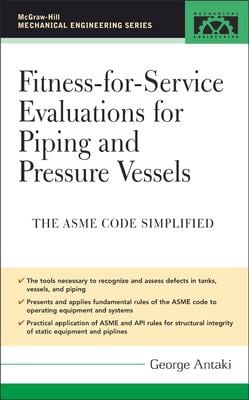
Fitness-for-Service Evaluations for Piping and Pressure Vessels : ASME Code Simplified
Hardcover
Fitness-for-Service Evaluations for Piping and Pressure Vessels : ASME Code Simplified
Hardcover
- All Available Copies
- Overview
- About the Author
- Awards
- Professional Reviews
- Reader Reviews
- Table Of Contents
- Borrow
Overview
Publisher's Note: Products purchased from Third Party sellers are not guaranteed by the publisher for quality, authenticity, or access to any online entitlements included with the product. Based on some of his students most frequently asked questions, Antaki emphasizes the practical applications of this ASME recommended practice. With this book readers will understand and apply API 579 in their daily work. The material is based on the author's course and presented in clear concise manor. The book demonstrates how the disciplines of stress analysis, materials engineering, and nondestructive inspection interact and apply to fitness-for-service assessment. These assessment methods apply to pressure vessels, piping, and tanks that are in service. This makes it the perfect companion book for Ellenberger's, Pressure Vessels: ASME Code Simplified as well as Ellenberger's Piping Systems and Pipeline: ASME B31 Code Simplified.
Categories
All Available Copies Find out more about shipping times from these sellers.
| Condition | Price | |||
|---|---|---|---|---|
Used Like New (1 available)

|
$144.60 USD | Add To Cart |
Ships directly from Better World Books
|
|
|
Used Good (1 available)
|
$144.60 USD | Add To Cart |
Ships directly from Better World Books
|
|
|
New (258 available)
Ships Separately |
$158.21 USD | Add To Cart | Ships separately from Better World Books suppliers | |
|
eBook Obtain a digital book from our friends at eBooks.com.
|
{{ebooksDotComPrice}} {{ebooksDotComCurrency}} | eBooks.com | Digital edition from eBooks.com | |
|
Audio Book Obtain a digital book from our friends at AudiobooksNow.com.
|
{{audioBooksNowPrice}} {{audioBooksNowCurrency}} | AudiobooksNow.com | Digital edition from AudiobooksNow.com |
Table Of Contents
| Preface | p. xiii |
| Principles | p. 1 |
| What Is Fitness-for-Service? | p. 1 |
| FFS and Conduct of Operations | p. 1 |
| Fitness-for-Service of Old and New Equipment | p. 6 |
| Workmanship and FFS | p. 7 |
| FFS in Construction Codes | p. 9 |
| The Fitness-for-Service Step | p. 10 |
| Three Critical Questions | p. 10 |
| Maintenance Strategy | p. 11 |
| Pressure Boundary Integrity | p. 11 |
| The Five Disciplines | p. 13 |
| Regulatory Perspective | p. 14 |
| Codes, Standards, and Guides | p. 15 |
| Cum Laude | p. 16 |
| Technical Basis | p. 18 |
| Response Time | p. 19 |
| Summary | p. 21 |
| References | p. 21 |
| Materials | p. 25 |
| Demand and Capacity | p. 25 |
| Material Groups | p. 25 |
| Ferrous Metals | p. 26 |
| Nonferrous Metals | p. 31 |
| Nonmetallic Materials | p. 33 |
| Basis for Material Selections | p. 34 |
| Mechanical Properties Overview | p. 34 |
| How to Achieve Desired Properties | p. 35 |
| Phase Diagram of Carbon Steel | p. 36 |
| Heat Treatment | p. 39 |
| Benefits of Postweld Heat Treatment | p. 40 |
| Types of Heat Treatment | p. 41 |
| Shop and Field Heat Treatment | p. 42 |
| The Larson-Miller Parameter | p. 45 |
| Heat and Lot | p. 45 |
| The Three Strength Parameters | p. 47 |
| Allowable Stress | p. 49 |
| Obtaining Strength Properties of Operating Equipment | p. 50 |
| Factors Affecting Strength Properties | p. 52 |
| Ductility | p. 52 |
| Ductile Fracture | p. 53 |
| Brittle Fracture | p. 55 |
| Toughness | p. 58 |
| Charpy Toughness | p. 59 |
| Fracture Toughness | p. 60 |
| Toughness Exemption Curve | p. 62 |
| Hardness | p. 62 |
| References | p. 64 |
| Design | p. 67 |
| Basic Design and Detailed Design | p. 67 |
| Design Codes | p. 67 |
| Design Minimum Wall t[subscript min] | p. 69 |
| Future Corrosion Allowance FCA | p. 69 |
| Loads, Stresses, and Strains | p. 71 |
| Applied Loads and Residual Stresses | p. 73 |
| General Stresses | p. 74 |
| Example: Bending Stress | p. 74 |
| Pressure Stress | p. 76 |
| Pressure Stress Example | p. 76 |
| Wall Thickness Selection | p. 77 |
| Fossil Power Plant Example | p. 78 |
| Butt-Welded Fittings | p. 79 |
| Flanges | p. 79 |
| Socket and Threaded Fittings | p. 79 |
| Specialty Fittings and Components | p. 80 |
| Vessel Example | p. 80 |
| Design Principles | p. 82 |
| Design Pressure | p. 83 |
| Vessel Cylindrical Shell | p. 84 |
| Spherical or Hemispherical Head | p. 86 |
| Elliptical Head | p. 87 |
| Torispherical Head | p. 89 |
| Flat Head | p. 89 |
| Comparison | p. 90 |
| Plant Piping-ASME B31.3 | p. 91 |
| Plant Piping Moment Stress | p. 93 |
| Applied Forces | p. 95 |
| Liquid Pipelines-ASME B31.4 | p. 96 |
| Gas Pipelines | p. 97 |
| Fatigue | p. 97 |
| The ASME Boiler and Pressure Vessel Code Fatigue Method | p. 100 |
| The Markl Fatigue Method | p. 104 |
| Example of the Markl Method in Vibration | p. 105 |
| The Fracture Mechanics Fatigue Method | p. 106 |
| The AWS-AASHTO Fatigue Method | p. 108 |
| Fatigue Testing | p. 109 |
| ASME Stress Classification along a Line | p. 110 |
| External Pressure | p. 112 |
| References | p. 114 |
| Fabrication | p. 117 |
| Fabrication and Construction Flaws | p. 117 |
| Base Metal Defects | p. 118 |
| Fabrication Flaws | p. 120 |
| Welding Techniques | p. 121 |
| Carbon Equivalent | p. 124 |
| Weld Quality | p. 125 |
| Welding in Service | p. 126 |
| Pressure or Leak Testing-How? | p. 130 |
| Pressure of Leak Testing-Why? | p. 131 |
| Pressure or Leak Testing-Cautions | p. 133 |
| Test Pressure for Tanks | p. 133 |
| Test Pressure for Pressure Vessels | p. 134 |
| Test Pressure for Power Piping | p. 135 |
| Test Pressure for Process Piping | p. 135 |
| Test Pressure for Liquid Pipelines | p. 136 |
| Test Pressure for Gas Pipelines | p. 136 |
| Mill and Handling Flaws | p. 137 |
| Field Weld Flaws | p. 137 |
| Weld Size | p. 143 |
| Residual Stress | p. 143 |
| Measuring Residual Stresses | p. 145 |
| Calculating Residual Stresses | p. 147 |
| Mechanical Joint Flaws | p. 149 |
| References | p. 149 |
| Degradation | p. 153 |
| Corrosion | p. 153 |
| The Corrosion Engineer's Perspective | p. 153 |
| The Facility Engineer's Perspective | p. 154 |
| Damage | p. 156 |
| Degradation and Fitness-for-Service | p. 156 |
| Understanding Wall Thinning Mechanisms | p. 156 |
| The Electrochemical Cell | p. 157 |
| The Single Metal Electrochemical Cell | p. 159 |
| The Galvanic Cell | p. 160 |
| Concentration Cell | p. 161 |
| Size Effect | p. 163 |
| Parameters Affecting Corrosion Rate | p. 163 |
| Predicting Corrosion Rate-Is It Linear? | p. 165 |
| Predicting Corrosion Rate-Time in Service | p. 166 |
| Deposits and Tuberculation | p. 166 |
| General Corrosion | p. 167 |
| Galvanic Corrosion | p. 169 |
| Pitting | p. 169 |
| Crevice Corrosion | p. 170 |
| Corrosion under Insulation | p. 173 |
| Liquid-Line Corrosion | p. 175 |
| Microbial-Induced Corrosion | p. 175 |
| MIC Prevention | p. 177 |
| MIC Mitigation | p. 177 |
| Carbon Dioxide Corrosion | p. 178 |
| Erosion | p. 179 |
| Cavitation | p. 179 |
| Vapor-Liquid Erosion | p. 181 |
| Erosion in Gas-Liquid Service | p. 181 |
| Liquid Pipelines | p. 182 |
| Liquid-Sand Pipelines | p. 182 |
| Erosion-Corrosion | p. 182 |
| Environmental-Assisted Cracking Mechanisms | p. 184 |
| Corrosion Fatigue | p. 186 |
| Sensitized Stainless Steel | p. 186 |
| Sour Corrosion | p. 188 |
| Blisters and Cracks | p. 190 |
| High-Temperature Corrosion | p. 192 |
| Measuring Corrosion and Corrosion Rates | p. 194 |
| Coating | p. 196 |
| Common Coatings | p. 196 |
| Selection | p. 197 |
| Surface Preparation | p. 198 |
| Wrap Tape | p. 199 |
| Epoxy | p. 200 |
| Coal Tar Enamel | p. 202 |
| Heat-Shrinkable Sleeves | p. 203 |
| Multilayer Coating | p. 203 |
| Coating Performance | p. 204 |
| Coating Quality Control | p. 205 |
| Comparison | p. 207 |
| Practical Challenges | p. 207 |
| References | p. 208 |
| Inspection | p. 213 |
| Principles of Inspection | p. 213 |
| Why? | p. 213 |
| What? | p. 214 |
| Where? | p. 214 |
| How? | p. 214 |
| When? | p. 215 |
| Risk-Based Inspection-What Is Risk? | p. 216 |
| A Number or a Matrix | p. 216 |
| The Objective of RBI | p. 218 |
| Necessary and Sufficient | p. 218 |
| Is RBI a Cost-Saving? | p. 219 |
| Qualitative or Quantitative RBI | p. 219 |
| RBI: A Seven-Step Process | p. 220 |
| Qualitative RBI | p. 222 |
| Example of Qualitative RBI-Steam Systems | p. 223 |
| Semiquantitative RBI-Likelihood | p. 226 |
| Semiquantitative RBI-Consequence | p. 227 |
| Fully Quantitative RBI-Likelihood | p. 228 |
| General Metal Loss Example | p. 229 |
| Limit State Function for a Crack | p. 230 |
| Crack Example | p. 230 |
| Likelihood Reduction Options | p. 231 |
| Correction for Reliability | p. 232 |
| Fully Quantitative Consequence | p. 233 |
| Advantages of Applying RBI | p. 237 |
| Cautions When Applying RBI | p. 237 |
| Integrity Programs for Pipelines | p. 238 |
| Overview of Inspection Techniques for Tanks, Vessels, and Pipes | p. 239 |
| Visual Examination (VT) | p. 239 |
| Magnetic Particle Testing (MT) | p. 240 |
| Liquid Penetrant Testing (PT) | p. 241 |
| Radiographic Testing (RT) | p. 242 |
| Ultrasonic Testing (UT) | p. 243 |
| Long-Range Guided Wave Ultrasonic Inspection | p. 246 |
| Eddy Current Testing | p. 246 |
| Magnetic Flux Leakage | p. 246 |
| Acoustic Emission Testing (AE) | p. 248 |
| Pig Inspections of Pipelines | p. 248 |
| Leak Detection Systems | p. 249 |
| Direct Assessment | p. 249 |
| References | p. 249 |
| Thinning | p. 253 |
| Three Categories of Wall Thinning | p. 253 |
| Leak or Break | p. 254 |
| When Is Corrosion Considered General? | p. 254 |
| Principles of Evaluation for GML | p. 257 |
| Limitations | p. 258 |
| Buckling | p. 258 |
| Ultrasonic Grid | p. 258 |
| Storage Tank Example | p. 259 |
| API 653 Tank Thickness | p. 262 |
| Tank Fitness-for-Service-Level 1 | p. 263 |
| Resolution | p. 265 |
| Tank Fitness-for-Service-Level 2 | p. 265 |
| Power Plant Pipe Rupture | p. 266 |
| Power Pipe Fitness-for-Service-Level 1 | p. 266 |
| Process Pipe Fitness-for-Service-Level 1 | p. 269 |
| Asme B31G for Pipelines: What Is It? | p. 270 |
| Basis of ASME B31G | p. 271 |
| Derating a Pipeline | p. 273 |
| B31G Example for Gas Pipeline | p. 274 |
| Modified B31G | p. 274 |
| The Rstreng Method | p. 276 |
| The Remaining Strength Factor in B31G | p. 276 |
| Steam Condensate | p. 277 |
| The Asme VIII, Div.1, App. 32 Method | p. 279 |
| The Asme XI Code Case N-480 Method | p. 281 |
| Widespread Pitting | p. 281 |
| Localized Pitting | p. 282 |
| Example Pitting in Pipeline | p. 283 |
| Simple Criterion | p. 286 |
| References | p. 287 |
| Geometric Defects | p. 289 |
| Integrity of Geometric Defects | p. 289 |
| Assessment Steps | p. 289 |
| Distorted Tank Bottom Example | p. 291 |
| Accidentally Bent Riser Example | p. 292 |
| Dents in Pipelines | p. 294 |
| Dents with Gouges | p. 296 |
| Wrinkles and Buckles | p. 298 |
| Mild Ripples | p. 300 |
| Blisters | p. 300 |
| Fitness-for-Service of Equipment with Blisters | p. 300 |
| Assessment of Weld Misalignment and Shell Distortions | p. 302 |
| Fitness-for-Service Assessment of Peaking | p. 302 |
| Deformed and Repaired Vessel Explosion | p. 305 |
| Defects Beyond Assessment | p. 307 |
| References | p. 307 |
| Cracks | p. 309 |
| Cracklike Flaws | p. 309 |
| Crack Stability | p. 310 |
| Stress Intensity | p. 311 |
| Example-Crack in Pipeline | p. 312 |
| Stress Intensity Solutions | p. 314 |
| Fracture Toughness | p. 314 |
| Weld Residual Stresses | p. 315 |
| Ligament Reference Stress | p. 315 |
| Flow Stress | p. 317 |
| Foundation of Fracture Assessment, the FAD | p. 317 |
| The 15 Steps of Crack Analysis | p. 319 |
| Vessel Example | p. 320 |
| Margin to Failure | p. 323 |
| Leak Through Cracks | p. 325 |
| Application of Fracture Mechanics to Fatigue | p. 326 |
| References | p. 327 |
| Creep Damage | p. 329 |
| What Is Creep? | p. 329 |
| High-Temperature Corrosion | p. 331 |
| The Difficulties of Creep Analysis and Predictions | p. 332 |
| Short- and Long-Term Overheating | p. 335 |
| Creep Assessment Methods | p. 336 |
| ASME III NH Method | p. 337 |
| Operating Loads | p. 337 |
| Time-Independent Material Properties | p. 338 |
| Time-Dependent Material Properties | p. 338 |
| Creep Life Analysis | p. 340 |
| Qualification | p. 342 |
| API 530 Creep Assessment | p. 343 |
| Nondestructive Assessment | p. 345 |
| High-Temperature B31.3 Pipe Application | p. 346 |
| Draft Method of API 579 Level 1 | p. 347 |
| Life Fraction Analysis | p. 347 |
| Thinned Wall Remaining Life | p. 348 |
| Metallographic Life Assessment | p. 349 |
| References | p. 350 |
| Overload | p. 351 |
| Overloads in Practice | p. 351 |
| Overpressure Allowance | p. 351 |
| Overpressure beyond Allowance | p. 352 |
| Key Considerations for Overpressure | p. 354 |
| Waterhammer Overload | p. 355 |
| Bolted Joint Failure | p. 357 |
| The Bullet Pig | p. 360 |
| Detonations and Deflagrations | p. 360 |
| Explosion Pressures | p. 361 |
| Explosion Damage | p. 363 |
| Example-Deflagration in Pipe | p. 364 |
| Material Strength at High Strain Rates | p. 364 |
| Explosive Rupture and Fragmentation | p. 365 |
| Effect of External Explosions | p. 368 |
| Natural Phenomena Hazards | p. 369 |
| Fitness-for-Service by Plastic or Collapse Analysis | p. 372 |
| Bending Failure | p. 373 |
| References | p. 374 |
| Failure Analysis | p. 377 |
| Failure Mode and Effects | p. 377 |
| Root Cause Failure Analysis | p. 378 |
| Failure Analysis Tools | p. 380 |
| Leak-before-Break (LBB) | p. 382 |
| Stored Energy Associated with Flashing Liquids | p. 384 |
| Hydrotest Failure | p. 384 |
| Gas or Liquid Contents | p. 385 |
| The Tank Top Example | p. 386 |
| Tanks with Frangible Roof Design | p. 386 |
| Stored Energy | p. 388 |
| Leak-before-Break Using the Failure Assessment Diagram | p. 389 |
| References | p. 389 |
| Repairs | p. 393 |
| Repair Work Package | p. 393 |
| Postconstruction Codes and Standards | p. 393 |
| Temporary or Permanent Repair? | p. 395 |
| Safety | p. 395 |
| Regulatory Requirements | p. 395 |
| Common Considerations for Materials | p. 396 |
| Common Considerations for Design | p. 396 |
| Common Considerations for Fabrication-Welding | p. 397 |
| Controlled Deposition Welding | p. 398 |
| Postconstruction Standards for Controlled Deposition | p. 401 |
| Common Considerations for Fabrication-Nonwelding | p. 402 |
| Common Considerations for Examination | p. 402 |
| Common Considerations for Testing | p. 403 |
| Common Considerations for Quality Control | p. 405 |
| Replacement | p. 405 |
| Flush Patch Repair | p. 406 |
| Example of Flush Patch Repair | p. 407 |
| Flaw Excavation | p. 407 |
| Example of Flaw Excavation Repair | p. 409 |
| Weld Overlay | p. 409 |
| Full Encirclement Welded Sleeve | p. 411 |
| Welded Leak Box | p. 413 |
| Fillet-Welded Patch | p. 414 |
| Mechanical Clamp | p. 417 |
| Inserted Liner | p. 418 |
| Pipe Splitting | p. 419 |
| Sacrificial Component | p. 419 |
| Nonmetallic Wrap | p. 419 |
| References | p. 422 |
| WRC Bulletins | p. 425 |
| Index | p. 451 |
| Table of Contents provided by Ingram. All Rights Reserved. |
| Find at your local library from our friends at WorldCat | Find Libraries |
Overview
Publisher's Note: Products purchased from Third Party sellers are not guaranteed by the publisher for quality, authenticity, or access to any online entitlements included with the product. Based on some of his students most frequently asked questions ...
Read full overview
Overview
Publisher's Note: Products purchased from Third Party sellers are not guaranteed by the publisher for quality, authenticity, or access to any online entitlements included with the product. Based on some of his students most frequently asked questions, Antaki emphasizes the practical applications of this ASME recommended practice. With this book readers will understand and apply API 579 in their daily work. The material is based on the author's course and presented in clear concise manor. The book demonstrates how the disciplines of stress analysis, materials engineering, and nondestructive inspection interact and apply to fitness-for-service assessment. These assessment methods apply to pressure vessels, piping, and tanks that are in service. This makes it the perfect companion book for Ellenberger's, Pressure Vessels: ASME Code Simplified as well as Ellenberger's Piping Systems and Pipeline: ASME B31 Code Simplified.
Product Details
Table Of Contents
| Preface | p. xiii |
| Principles | p. 1 |
| What Is Fitness-for-Service? | p. 1 |
| FFS and Conduct of Operations | p. 1 |
| Fitness-for-Service of Old and New Equipment | p. 6 |
| Workmanship and FFS | p. 7 |
| FFS in Construction Codes | p. 9 |
| The Fitness-for-Service Step | p. 10 |
| Three Critical Questions | p. 10 |
| Maintenance Strategy | p. 11 |
| Pressure Boundary Integrity | p. 11 |
| The Five Disciplines | p. 13 |
| Regulatory Perspective | p. 14 |
| Codes, Standards, and Guides | p. 15 |
| Cum Laude | p. 16 |
| Technical Basis | p. 18 |
| Response Time | p. 19 |
| Summary | p. 21 |
| References | p. 21 |
| Materials | p. 25 |
| Demand and Capacity | p. 25 |
| Material Groups | p. 25 |
| Ferrous Metals | p. 26 |
| Nonferrous Metals | p. 31 |
| Nonmetallic Materials | p. 33 |
| Basis for Material Selections | p. 34 |
| Mechanical Properties Overview | p. 34 |
| How to Achieve Desired Properties | p. 35 |
| Phase Diagram of Carbon Steel | p. 36 |
| Heat Treatment | p. 39 |
| Benefits of Postweld Heat Treatment | p. 40 |
| Types of Heat Treatment | p. 41 |
| Shop and Field Heat Treatment | p. 42 |
| The Larson-Miller Parameter | p. 45 |
| Heat and Lot | p. 45 |
| The Three Strength Parameters | p. 47 |
| Allowable Stress | p. 49 |
| Obtaining Strength Properties of Operating Equipment | p. 50 |
| Factors Affecting Strength Properties | p. 52 |
| Ductility | p. 52 |
| Ductile Fracture | p. 53 |
| Brittle Fracture | p. 55 |
| Toughness | p. 58 |
| Charpy Toughness | p. 59 |
| Fracture Toughness | p. 60 |
| Toughness Exemption Curve | p. 62 |
| Hardness | p. 62 |
| References | p. 64 |
| Design | p. 67 |
| Basic Design and Detailed Design | p. 67 |
| Design Codes | p. 67 |
| Design Minimum Wall t[subscript min] | p. 69 |
| Future Corrosion Allowance FCA | p. 69 |
| Loads, Stresses, and Strains | p. 71 |
| Applied Loads and Residual Stresses | p. 73 |
| General Stresses | p. 74 |
| Example: Bending Stress | p. 74 |
| Pressure Stress | p. 76 |
| Pressure Stress Example | p. 76 |
| Wall Thickness Selection | p. 77 |
| Fossil Power Plant Example | p. 78 |
| Butt-Welded Fittings | p. 79 |
| Flanges | p. 79 |
| Socket and Threaded Fittings | p. 79 |
| Specialty Fittings and Components | p. 80 |
| Vessel Example | p. 80 |
| Design Principles | p. 82 |
| Design Pressure | p. 83 |
| Vessel Cylindrical Shell | p. 84 |
| Spherical or Hemispherical Head | p. 86 |
| Elliptical Head | p. 87 |
| Torispherical Head | p. 89 |
| Flat Head | p. 89 |
| Comparison | p. 90 |
| Plant Piping-ASME B31.3 | p. 91 |
| Plant Piping Moment Stress | p. 93 |
| Applied Forces | p. 95 |
| Liquid Pipelines-ASME B31.4 | p. 96 |
| Gas Pipelines | p. 97 |
| Fatigue | p. 97 |
| The ASME Boiler and Pressure Vessel Code Fatigue Method | p. 100 |
| The Markl Fatigue Method | p. 104 |
| Example of the Markl Method in Vibration | p. 105 |
| The Fracture Mechanics Fatigue Method | p. 106 |
| The AWS-AASHTO Fatigue Method | p. 108 |
| Fatigue Testing | p. 109 |
| ASME Stress Classification along a Line | p. 110 |
| External Pressure | p. 112 |
| References | p. 114 |
| Fabrication | p. 117 |
| Fabrication and Construction Flaws | p. 117 |
| Base Metal Defects | p. 118 |
| Fabrication Flaws | p. 120 |
| Welding Techniques | p. 121 |
| Carbon Equivalent | p. 124 |
| Weld Quality | p. 125 |
| Welding in Service | p. 126 |
| Pressure or Leak Testing-How? | p. 130 |
| Pressure of Leak Testing-Why? | p. 131 |
| Pressure or Leak Testing-Cautions | p. 133 |
| Test Pressure for Tanks | p. 133 |
| Test Pressure for Pressure Vessels | p. 134 |
| Test Pressure for Power Piping | p. 135 |
| Test Pressure for Process Piping | p. 135 |
| Test Pressure for Liquid Pipelines | p. 136 |
| Test Pressure for Gas Pipelines | p. 136 |
| Mill and Handling Flaws | p. 137 |
| Field Weld Flaws | p. 137 |
| Weld Size | p. 143 |
| Residual Stress | p. 143 |
| Measuring Residual Stresses | p. 145 |
| Calculating Residual Stresses | p. 147 |
| Mechanical Joint Flaws | p. 149 |
| References | p. 149 |
| Degradation | p. 153 |
| Corrosion | p. 153 |
| The Corrosion Engineer's Perspective | p. 153 |
| The Facility Engineer's Perspective | p. 154 |
| Damage | p. 156 |
| Degradation and Fitness-for-Service | p. 156 |
| Understanding Wall Thinning Mechanisms | p. 156 |
| The Electrochemical Cell | p. 157 |
| The Single Metal Electrochemical Cell | p. 159 |
| The Galvanic Cell | p. 160 |
| Concentration Cell | p. 161 |
| Size Effect | p. 163 |
| Parameters Affecting Corrosion Rate | p. 163 |
| Predicting Corrosion Rate-Is It Linear? | p. 165 |
| Predicting Corrosion Rate-Time in Service | p. 166 |
| Deposits and Tuberculation | p. 166 |
| General Corrosion | p. 167 |
| Galvanic Corrosion | p. 169 |
| Pitting | p. 169 |
| Crevice Corrosion | p. 170 |
| Corrosion under Insulation | p. 173 |
| Liquid-Line Corrosion | p. 175 |
| Microbial-Induced Corrosion | p. 175 |
| MIC Prevention | p. 177 |
| MIC Mitigation | p. 177 |
| Carbon Dioxide Corrosion | p. 178 |
| Erosion | p. 179 |
| Cavitation | p. 179 |
| Vapor-Liquid Erosion | p. 181 |
| Erosion in Gas-Liquid Service | p. 181 |
| Liquid Pipelines | p. 182 |
| Liquid-Sand Pipelines | p. 182 |
| Erosion-Corrosion | p. 182 |
| Environmental-Assisted Cracking Mechanisms | p. 184 |
| Corrosion Fatigue | p. 186 |
| Sensitized Stainless Steel | p. 186 |
| Sour Corrosion | p. 188 |
| Blisters and Cracks | p. 190 |
| High-Temperature Corrosion | p. 192 |
| Measuring Corrosion and Corrosion Rates | p. 194 |
| Coating | p. 196 |
| Common Coatings | p. 196 |
| Selection | p. 197 |
| Surface Preparation | p. 198 |
| Wrap Tape | p. 199 |
| Epoxy | p. 200 |
| Coal Tar Enamel | p. 202 |
| Heat-Shrinkable Sleeves | p. 203 |
| Multilayer Coating | p. 203 |
| Coating Performance | p. 204 |
| Coating Quality Control | p. 205 |
| Comparison | p. 207 |
| Practical Challenges | p. 207 |
| References | p. 208 |
| Inspection | p. 213 |
| Principles of Inspection | p. 213 |
| Why? | p. 213 |
| What? | p. 214 |
| Where? | p. 214 |
| How? | p. 214 |
| When? | p. 215 |
| Risk-Based Inspection-What Is Risk? | p. 216 |
| A Number or a Matrix | p. 216 |
| The Objective of RBI | p. 218 |
| Necessary and Sufficient | p. 218 |
| Is RBI a Cost-Saving? | p. 219 |
| Qualitative or Quantitative RBI | p. 219 |
| RBI: A Seven-Step Process | p. 220 |
| Qualitative RBI | p. 222 |
| Example of Qualitative RBI-Steam Systems | p. 223 |
| Semiquantitative RBI-Likelihood | p. 226 |
| Semiquantitative RBI-Consequence | p. 227 |
| Fully Quantitative RBI-Likelihood | p. 228 |
| General Metal Loss Example | p. 229 |
| Limit State Function for a Crack | p. 230 |
| Crack Example | p. 230 |
| Likelihood Reduction Options | p. 231 |
| Correction for Reliability | p. 232 |
| Fully Quantitative Consequence | p. 233 |
| Advantages of Applying RBI | p. 237 |
| Cautions When Applying RBI | p. 237 |
| Integrity Programs for Pipelines | p. 238 |
| Overview of Inspection Techniques for Tanks, Vessels, and Pipes | p. 239 |
| Visual Examination (VT) | p. 239 |
| Magnetic Particle Testing (MT) | p. 240 |
| Liquid Penetrant Testing (PT) | p. 241 |
| Radiographic Testing (RT) | p. 242 |
| Ultrasonic Testing (UT) | p. 243 |
| Long-Range Guided Wave Ultrasonic Inspection | p. 246 |
| Eddy Current Testing | p. 246 |
| Magnetic Flux Leakage | p. 246 |
| Acoustic Emission Testing (AE) | p. 248 |
| Pig Inspections of Pipelines | p. 248 |
| Leak Detection Systems | p. 249 |
| Direct Assessment | p. 249 |
| References | p. 249 |
| Thinning | p. 253 |
| Three Categories of Wall Thinning | p. 253 |
| Leak or Break | p. 254 |
| When Is Corrosion Considered General? | p. 254 |
| Principles of Evaluation for GML | p. 257 |
| Limitations | p. 258 |
| Buckling | p. 258 |
| Ultrasonic Grid | p. 258 |
| Storage Tank Example | p. 259 |
| API 653 Tank Thickness | p. 262 |
| Tank Fitness-for-Service-Level 1 | p. 263 |
| Resolution | p. 265 |
| Tank Fitness-for-Service-Level 2 | p. 265 |
| Power Plant Pipe Rupture | p. 266 |
| Power Pipe Fitness-for-Service-Level 1 | p. 266 |
| Process Pipe Fitness-for-Service-Level 1 | p. 269 |
| Asme B31G for Pipelines: What Is It? | p. 270 |
| Basis of ASME B31G | p. 271 |
| Derating a Pipeline | p. 273 |
| B31G Example for Gas Pipeline | p. 274 |
| Modified B31G | p. 274 |
| The Rstreng Method | p. 276 |
| The Remaining Strength Factor in B31G | p. 276 |
| Steam Condensate | p. 277 |
| The Asme VIII, Div.1, App. 32 Method | p. 279 |
| The Asme XI Code Case N-480 Method | p. 281 |
| Widespread Pitting | p. 281 |
| Localized Pitting | p. 282 |
| Example Pitting in Pipeline | p. 283 |
| Simple Criterion | p. 286 |
| References | p. 287 |
| Geometric Defects | p. 289 |
| Integrity of Geometric Defects | p. 289 |
| Assessment Steps | p. 289 |
| Distorted Tank Bottom Example | p. 291 |
| Accidentally Bent Riser Example | p. 292 |
| Dents in Pipelines | p. 294 |
| Dents with Gouges | p. 296 |
| Wrinkles and Buckles | p. 298 |
| Mild Ripples | p. 300 |
| Blisters | p. 300 |
| Fitness-for-Service of Equipment with Blisters | p. 300 |
| Assessment of Weld Misalignment and Shell Distortions | p. 302 |
| Fitness-for-Service Assessment of Peaking | p. 302 |
| Deformed and Repaired Vessel Explosion | p. 305 |
| Defects Beyond Assessment | p. 307 |
| References | p. 307 |
| Cracks | p. 309 |
| Cracklike Flaws | p. 309 |
| Crack Stability | p. 310 |
| Stress Intensity | p. 311 |
| Example-Crack in Pipeline | p. 312 |
| Stress Intensity Solutions | p. 314 |
| Fracture Toughness | p. 314 |
| Weld Residual Stresses | p. 315 |
| Ligament Reference Stress | p. 315 |
| Flow Stress | p. 317 |
| Foundation of Fracture Assessment, the FAD | p. 317 |
| The 15 Steps of Crack Analysis | p. 319 |
| Vessel Example | p. 320 |
| Margin to Failure | p. 323 |
| Leak Through Cracks | p. 325 |
| Application of Fracture Mechanics to Fatigue | p. 326 |
| References | p. 327 |
| Creep Damage | p. 329 |
| What Is Creep? | p. 329 |
| High-Temperature Corrosion | p. 331 |
| The Difficulties of Creep Analysis and Predictions | p. 332 |
| Short- and Long-Term Overheating | p. 335 |
| Creep Assessment Methods | p. 336 |
| ASME III NH Method | p. 337 |
| Operating Loads | p. 337 |
| Time-Independent Material Properties | p. 338 |
| Time-Dependent Material Properties | p. 338 |
| Creep Life Analysis | p. 340 |
| Qualification | p. 342 |
| API 530 Creep Assessment | p. 343 |
| Nondestructive Assessment | p. 345 |
| High-Temperature B31.3 Pipe Application | p. 346 |
| Draft Method of API 579 Level 1 | p. 347 |
| Life Fraction Analysis | p. 347 |
| Thinned Wall Remaining Life | p. 348 |
| Metallographic Life Assessment | p. 349 |
| References | p. 350 |
| Overload | p. 351 |
| Overloads in Practice | p. 351 |
| Overpressure Allowance | p. 351 |
| Overpressure beyond Allowance | p. 352 |
| Key Considerations for Overpressure | p. 354 |
| Waterhammer Overload | p. 355 |
| Bolted Joint Failure | p. 357 |
| The Bullet Pig | p. 360 |
| Detonations and Deflagrations | p. 360 |
| Explosion Pressures | p. 361 |
| Explosion Damage | p. 363 |
| Example-Deflagration in Pipe | p. 364 |
| Material Strength at High Strain Rates | p. 364 |
| Explosive Rupture and Fragmentation | p. 365 |
| Effect of External Explosions | p. 368 |
| Natural Phenomena Hazards | p. 369 |
| Fitness-for-Service by Plastic or Collapse Analysis | p. 372 |
| Bending Failure | p. 373 |
| References | p. 374 |
| Failure Analysis | p. 377 |
| Failure Mode and Effects | p. 377 |
| Root Cause Failure Analysis | p. 378 |
| Failure Analysis Tools | p. 380 |
| Leak-before-Break (LBB) | p. 382 |
| Stored Energy Associated with Flashing Liquids | p. 384 |
| Hydrotest Failure | p. 384 |
| Gas or Liquid Contents | p. 385 |
| The Tank Top Example | p. 386 |
| Tanks with Frangible Roof Design | p. 386 |
| Stored Energy | p. 388 |
| Leak-before-Break Using the Failure Assessment Diagram | p. 389 |
| References | p. 389 |
| Repairs | p. 393 |
| Repair Work Package | p. 393 |
| Postconstruction Codes and Standards | p. 393 |
| Temporary or Permanent Repair? | p. 395 |
| Safety | p. 395 |
| Regulatory Requirements | p. 395 |
| Common Considerations for Materials | p. 396 |
| Common Considerations for Design | p. 396 |
| Common Considerations for Fabrication-Welding | p. 397 |
| Controlled Deposition Welding | p. 398 |
| Postconstruction Standards for Controlled Deposition | p. 401 |
| Common Considerations for Fabrication-Nonwelding | p. 402 |
| Common Considerations for Examination | p. 402 |
| Common Considerations for Testing | p. 403 |
| Common Considerations for Quality Control | p. 405 |
| Replacement | p. 405 |
| Flush Patch Repair | p. 406 |
| Example of Flush Patch Repair | p. 407 |
| Flaw Excavation | p. 407 |
| Example of Flaw Excavation Repair | p. 409 |
| Weld Overlay | p. 409 |
| Full Encirclement Welded Sleeve | p. 411 |
| Welded Leak Box | p. 413 |
| Fillet-Welded Patch | p. 414 |
| Mechanical Clamp | p. 417 |
| Inserted Liner | p. 418 |
| Pipe Splitting | p. 419 |
| Sacrificial Component | p. 419 |
| Nonmetallic Wrap | p. 419 |
| References | p. 422 |
| WRC Bulletins | p. 425 |
| Index | p. 451 |
| Table of Contents provided by Ingram. All Rights Reserved. |
All Available Copies
| Condition | Source | Price | |
|---|---|---|---|
|
Used Like New (1 available)
Ships from |
Ships directly from Better World Books
|
$144.60 USD | Add To Cart |
|
Used Good (1 available)
Ships from |
Ships directly from Better World Books
|
$144.60 USD | Add To Cart |
|
New (258 available)
Ships Separately |
Ships separately from Better World Books suppliers | $158.21 USD | Add To Cart |
|
eBook Obtain a digital book from our friends at eBooks.com.
|
Digital edition from eBooks.com | {{ebooksDotComPrice}} {{ebooksDotComCurrency}} | eBooks.com |
|
Audio Book Obtain a digital book from our friends at AudiobooksNow.com.
|
|
{{audioBooksNowPrice}} {{audioBooksNowCurrency}} | Audiobook |
Limited Preview for 'Fitness-for-Service Evaluations for Piping and Pressure Vessels : ASME Code Simplified' provided by Archive.org
*This is a limited preview of the contents of this book and does not directly represent the item available for sale.*
A preview for 'Fitness-for-Service Evaluations for Piping and Pressure Vessels : ASME Code Simplified' is unavailable.
You are now leaving the Better World Books website to complete your transaction. Your eBook download will be facilitated by our friends at eBooks.com. Thank you for your support and for shopping with Better World Books!
You are now leaving the Better World Books website to complete your transaction. Your audio book download will be facilitated by our friends at AudiobooksNow.com. Thank you for your support and for shopping with Better World Books!
You are now leaving the Better World Books website. Thank you for your support and for shopping with Better World Books!